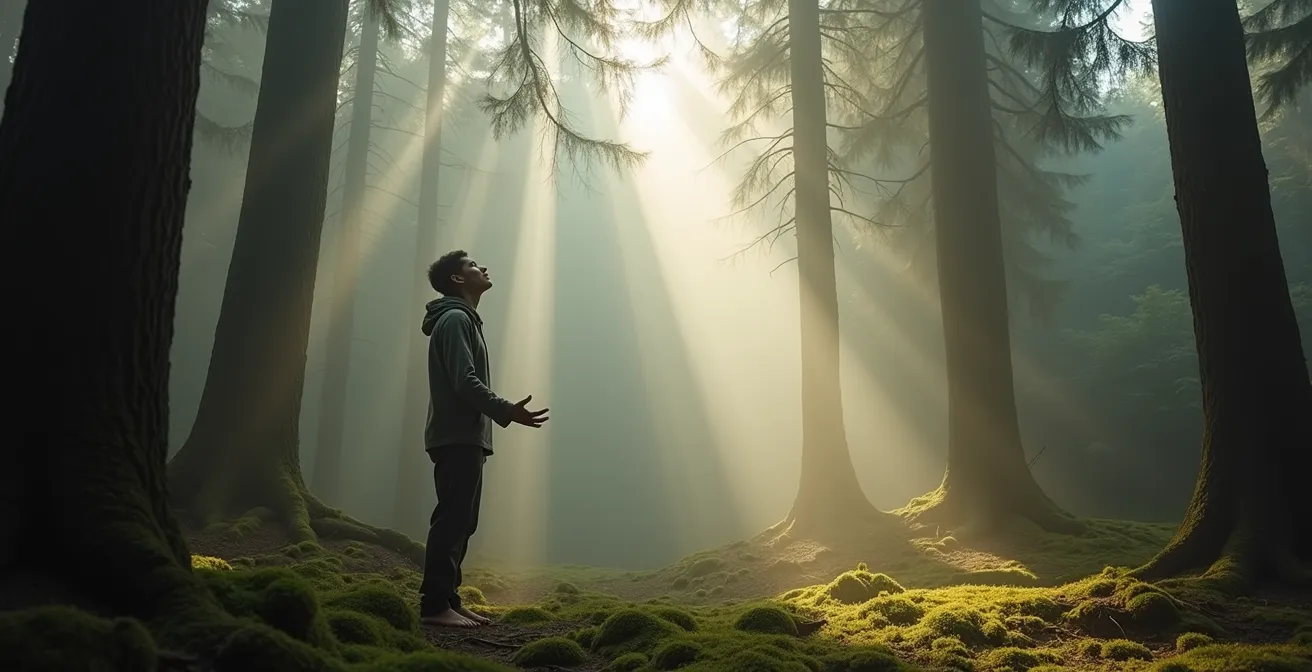
Contrary to popular belief, a deeper connection with nature isn’t achieved by trying harder to see, but by learning to quiet the mind and reawaken your body’s primal senses.
- True sensory awareness relies on understanding the hidden language of scent and the complex ecology of sound.
- Strategic stillness and un-masking your senses from artificial scents are the keys to letting the natural world reveal itself.
Recommendation: Begin by auditing your personal “scent bubble” and dedicating time to the simple, profound art of listening without an agenda.
For many travelers, a stunning landscape becomes just another photo, a fleeting moment seen through a screen. You stand at the edge of a grand canyon or within an ancient forest, yet feel a strange disconnect, a sense that you are merely a spectator rushing through. The common advice—to “pay attention” or “be mindful”—often feels hollow, another task on a mental checklist. We are told to look at the view and listen to the birds, but this conscious effort can paradoxically create more distance.
This approach overlooks a fundamental truth. The modern world has wrapped us in a bubble of artificial scents, constant noise, and a visual focus narrowed to our screens. We’ve become desensitized, our innate sensory instruments dulled. But what if the key to a profound nature experience wasn’t about adding another layer of thought, but about stripping one away? What if the real secret lies not in trying harder to perceive, but in creating the conditions for our primal perception to reawaken?
This guide offers a different path. It’s an invitation to move beyond mere observation and into a state of sensory immersion. We will explore how to reclaim your sense of smell from the chemical fog of daily life, discover the universe of information hidden in natural silence, and learn why stillness is the most powerful tool for seeing wildlife. By embracing these practices, you can transform your relationship with nature from one of passive viewing to one of deep, reciprocal connection, where the forest speaks and you, finally, understand its language.
To fully immerse yourself in this journey, this guide is structured to awaken each sense progressively. The following sections will provide practical techniques and insights to help you peel back the layers of modern distraction and engage with the natural world on a truly elemental level.
Summary: Awaken Your Senses: A Guide to a Deeper, Primal Experience of Nature
- Why Does Your Sense of Smell Sharpen After 24 Hours in the Woods?
- How to Sit Still Long Enough for Wildlife to Approach You?
- Looking or Listening: Which Sense Reveals More in a Dense Forest?
- The Scent Mistake That Hides You from Nature’s Olfactory Experience
- When to Be in the Forest to See the Light Transform the Landscape?
- Why Natural Silence Is More Than Just the Absence of Noise?
- Night Walk or Day Hike: Which Reveals More Mammals?
- How to Practice Shinrin-Yoku Without a Guide for Stress Relief?
Why Does Your Sense of Smell Sharpen After 24 Hours in the Woods?
The first sense to reawaken in nature is often the most overlooked: smell. In our daily lives, we are bombarded by a constant barrage of artificial fragrances—laundry detergents, perfumes, air fresheners—that effectively deafen our olfactory receptors. When you first step into a forest, your nose is still “shouting” with these synthetic scents, making it impossible to hear the subtle whispers of the earth. It’s only after a day or so, once these artificial layers have washed away, that your brain can recalibrate to a natural baseline.
This process is more than just a passive cleansing; it’s an active re-sensitization. Your olfactory system, freed from overstimulation, begins to detect the complex olfactory topography of the environment. You start to notice the sharp, resinous tang of pine needles underfoot, the deep, loamy smell of decomposition, the crisp scent of ozone after a rain shower, and the faint, sweet perfume of a hidden wildflower. Each of these is a data point, a clue about the health of the ecosystem, the time of day, and the presence of unseen life.
This heightened awareness is a return to a more primal state. For our ancestors, a sharp sense of smell was a critical tool for survival—for finding food, avoiding predators, and navigating the landscape. By allowing this sense to re-emerge, you are not just enjoying pleasant aromas; you are reconnecting with an ancient, instinctual part of your own consciousness and beginning to read the landscape in a language older than words.
How to Sit Still Long Enough for Wildlife to Approach You?
After smell, the next step in deepening your nature connection is mastering the art of stillness. In a world that prizes movement and productivity, the simple act of sitting still can feel profoundly counter-cultural and surprisingly difficult. Yet, it is the single most effective technique for allowing the natural world to forget you are there. Wildlife perceives movement as a primary threat signal. When you cease to move, you gradually blend back into the landscape, transitioning from an “intruder” to a part of the scenery.
The challenge is not physical, but mental. Your mind, accustomed to constant stimulation, will rebel. It will conjure lists of tasks, replay conversations, and urge you to check your phone. The key is not to fight these thoughts, but to gently redirect your focus to your immediate sensory experience. Feel the texture of the bark against your back, the coolness of the earth beneath you, the faint breeze on your skin. This practice of sensory quietude anchors you in the present moment, making prolonged stillness not a test of endurance, but a state of deep, restful observation.
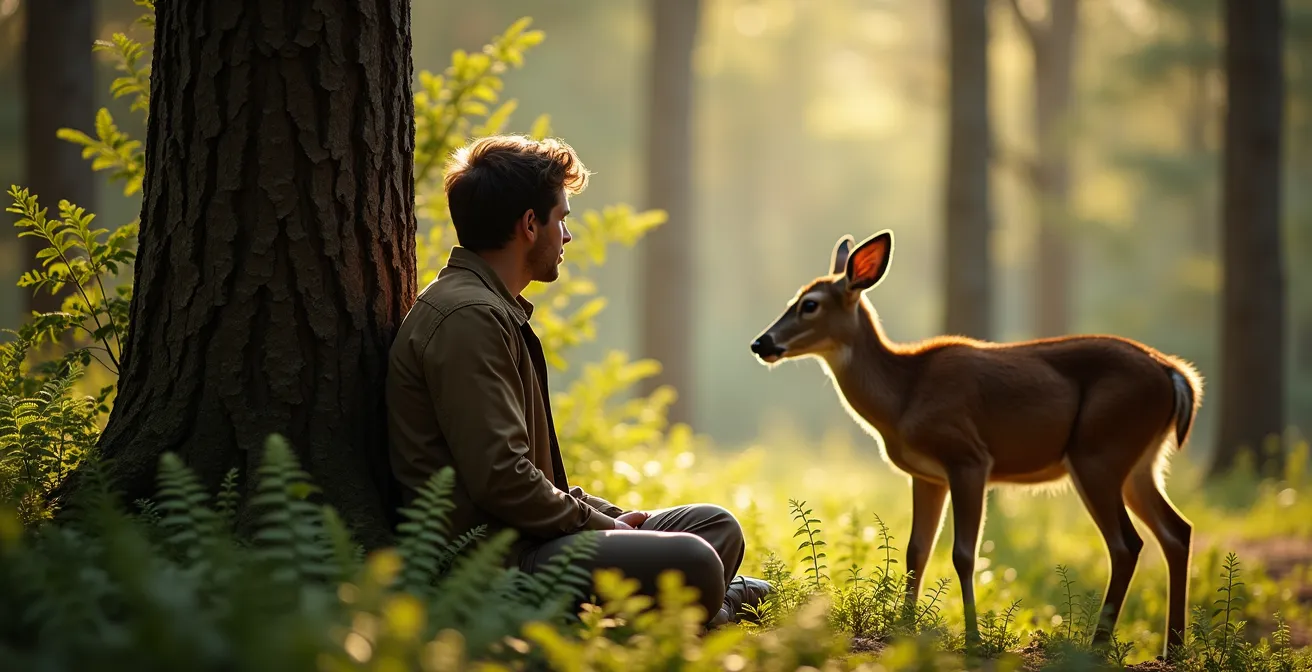
True stillness allows you to become a gravitational center for natural activity. After about 15-20 minutes, the forest’s ambient rhythm resumes. Birds that fell silent upon your arrival begin to call again. Squirrels resume their foraging. And eventually, more timid creatures like deer or foxes may emerge, their curiosity overcoming their caution as they accept you as a non-threatening part of their environment. This is when the real magic happens—when nature chooses to reveal itself to you.
Looking or Listening: Which Sense Reveals More in a Dense Forest?
Our culture is overwhelmingly visual. We “look” for things, we “watch” nature documentaries, and we value what we can see. In an open landscape, sight is indeed a powerful tool. But in the dense, layered environment of a forest, vision can be deceptive. The canopy and undergrowth create a chaotic visual field that easily hides movement and camouflages animals. Here, your ears often reveal far more than your eyes.
The forest is an intricate system of acoustic ecology. Every sound has a meaning. The sharp crack of a twig can signal a deer’s passage. A frantic chipping from a squirrel might indicate a hawk circling overhead. The pattern and frequency of bird calls can tell you about territorial disputes, mating rituals, or the approach of a predator. By closing your eyes and simply listening, you can map the unseen life around you, constructing a three-dimensional picture of the forest’s activity that is far more detailed than what your eyes alone can perceive.
This auditory awareness requires a shift from passive hearing to active listening. Instead of letting sound wash over you as background noise, you must learn to dissect it. Where is the sound coming from? Is it near or far? Is it rhythmic or erratic? Is it a sound of alarm or of calm? An illuminating study on wildlife monitoring confirms this, revealing how acoustic recorders in a dense forest captured patterns of animal activity that were completely invisible to traditional visual observation. The soundscape, it turns out, is a rich tapestry of data.
Case Study: Acoustic Monitoring Reveals Hidden Wildlife
Autonomous recording units placed in the Nouragues forest captured soundscapes every 15 minutes. This acoustic monitoring revealed that wildlife activity patterns were far more accurately detected through sound than by sight, with recorders positioned at both understory (1.5m) and canopy (40m) heights capturing distinct biophonic layers invisible to a human observer.
The Scent Mistake That Hides You from Nature’s Olfactory Experience
Even if you leave your perfume and cologne at home, you are likely still walking through the wilderness inside an invisible bubble of artificial scent. The most common and potent mistake is wearing clothes washed in standard, fragranced laundry detergent. These chemical scents cling to fabric and are designed to be powerful and long-lasting—precisely the opposite of what you want in nature. To an animal with a sensitive nose, you smell like a walking chemical factory, an alarm bell that announces your presence long before you are seen or heard.
Breaking free from this “scent bubble” is a critical step toward true immersion. This involves a conscious protocol of scent-stripping. Switching to unscented soaps, shampoos, and deodorants a week before your trip is a good start. The most crucial step, however, is washing all your outdoor clothing in an unscented, “free and clear” detergent and, if possible, air-drying it outside. This allows the clothes to shed their chemical signature and begin to take on the neutral scent of the environment.
Once you are scent-neutral, you not only become less alarming to wildlife, but you also open yourself up to the health benefits of the forest’s own chemical communication. Trees release airborne compounds called phytoncides to protect themselves from pests and disease. When we inhale these compounds, our bodies respond by increasing the number and activity of our natural killer cells, a vital part of our immune system. In fact, research shows the immune-boosting effects of phytoncides from a single forest walk can last up to 30 days. By masking yourself in artificial fragrance, you are not just hiding from nature; you are blocking one of its most profound gifts.
Action Plan: Auditing Your Personal Scent Profile
- Points of Contact: Identify all sources of artificial scent you carry daily, from deodorant and shampoo to laundry detergent and fabric softener.
- Collection: Inventory your daily routine and make a specific list of when and where you apply or are exposed to these artificial scents.
- Coherence: Confront this list with your goal of deep nature connection. Honestly assess whether each product is masking the environment or allowing you to engage with it.
- Emotional Contrast: Intentionally contrast the memory of an artificial scent (e.g., “fresh linen”) with a true natural one (e.g., damp earth after rain). Note which one fosters a sense of place and connection.
- Integration Plan: Before your next nature trip, systematically replace key scented products with unscented alternatives, starting with your laundry detergent and soap.
When to Be in the Forest to See the Light Transform the Landscape?
Sight may not be the most reliable sense for detecting wildlife in a dense forest, but it is unparalleled for experiencing its soul. The character of a forest is not static; it is a living stage that is constantly transformed by its most dynamic actor: light. To truly know a place, you must witness it through the changing moods of the sun. The same grove of trees can feel alien and mysterious during the pre-dawn “blue hour,” jubilant and alive during the “golden hour,” or serene and cathedral-like under midday dappled light.
Timing your presence in the forest to coincide with these transitional light periods is key. The blue hour, the 30-minute window before sunrise, bathes the world in a cool, diffuse, and shadowless light. This is a time of quiet magic, when mist hangs low and the world feels ancient. It’s the prime time for observing crepuscular (twilight-active) species like deer and owls. As the sun crests the horizon, the golden hour begins, casting long shadows and painting the landscape in warm, dramatic tones. This is when diurnal life awakens, and the forest fills with the activity of songbirds and insects.
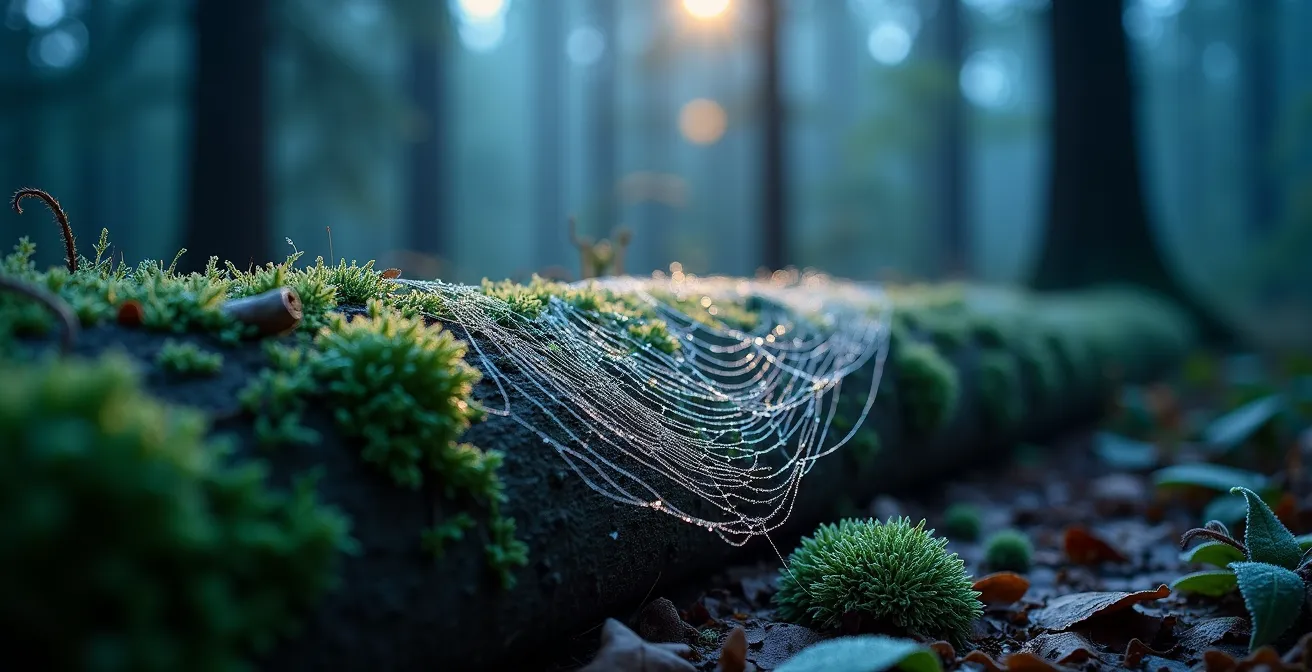
Even conditions that might seem “bad” for photography, like an overcast or foggy day, offer unique visual opportunities. The flat, shadowless light saturates colors, making the green of mosses and the red of fungi incredibly vibrant. It’s a time for appreciating micro-landscapes and intricate details. Understanding how light interacts with the environment allows you to see the forest not as a single entity, but as an ever-changing masterpiece.
A comparative analysis from wildlife acoustics experts reveals a clear correlation between light quality and animal behavior, providing a practical guide for any aspiring observer. This data shows how treating light as a character is essential for planning your time in nature.
| Time Period | Light Quality | Wildlife Activity | Best For Observing |
|---|---|---|---|
| Blue Hour (30min before sunrise) | Cool, diffused, low contrast | Crepuscular species most active | Deer, rabbits, owl transitions |
| Golden Hour (1hr after sunrise) | Warm, directional, high contrast | Diurnal species beginning activity | Songbirds, squirrels, insects |
| Midday Dappled Light | High contrast patches, cathedral effect | Reduced mammal activity | Canopy birds, light patterns, butterflies |
| Overcast/Foggy | Flat, color-saturated, shadowless | Extended morning activity | Detail observation, mushrooms, moss |
Why Natural Silence Is More Than Just the Absence of Noise?
In our urbanized world, we have come to define silence as the absence of man-made noise—the cessation of traffic, sirens, and chatter. But in a natural setting, true silence is something entirely different. It is not an absence, but a presence. It is the rich, complex, and layered soundscape of a living ecosystem, what is often called biophony. This natural “silence” is composed of the rustle of leaves, the buzz of insects, the distant call of a bird, and the gentle creak of tree branches swaying in the wind.
Our brains are hardwired to find this kind of complex, natural soundscape deeply calming. Unlike the jarring, unpredictable noises of the city, the sounds of nature often follow fractal patterns—repeating, self-similar structures found in things like branching trees, coastlines, and snowflakes. As one expert on forest therapy notes, this quality is profoundly restorative. Leigha Horton, in an interview with Minnesota Public Radio, explains:
The human brain responds beautifully to fractal patterns in nature – like a tree that branches, and branches again. These repeating patterns that we passively take in calm the brain.
– Leigha Horton, Minnesota Public Radio interview on forest bathing benefits
This calming effect has measurable physiological benefits. Immersion in natural soundscapes lowers blood pressure, reduces the stress hormone cortisol, and improves focus. In fact, a University of Wisconsin-La Crosse study demonstrated that forest therapy decreased ADHD symptoms and improved sleep quality in children with mental health challenges. By learning to tune into this natural silence, you are not just finding peace and quiet; you are tapping into a powerful therapeutic tool that is built into the very fabric of the natural world.
Night Walk or Day Hike: Which Reveals More Mammals?
A daytime hike offers sweeping views and the cheerful soundtrack of songbirds, but for those seeking to encounter mammals, the forest truly comes alive after the sun goes down. The vast majority of mammal species, from tiny shrews to larger predators like foxes and owls, are either nocturnal (active at night) or crepuscular (active at dawn and dusk). Venturing into the woods at night is like pulling back a curtain to reveal a second, hidden world of activity.
Night walking requires a complete re-calibration of your senses. Your vision, severely limited, takes a backseat. Instead, you must rely on your hearing and your sense of proprioception—the body’s ability to feel its position in space. You learn to “see” the trail through the soles of your feet, feeling for the subtle changes in texture between solid ground, loose leaves, and gnarled roots. Your ears become your primary tool for detection, deciphering the difference between the rustle of a mouse in the leaf litter and the heavier tread of a raccoon.
To do this effectively, one must adopt specific techniques. Using a flashlight with a red filter is crucial, as red light is less disruptive to the night vision of both humans and animals. The most effective strategy is to walk slowly for a minute, then stand perfectly still for three to five minutes, listening intently. This allows the nocturnal soundscape to re-emerge around you. Case studies utilizing passive acoustic monitoring have consistently shown that nocturnal predator activity is overwhelmingly detected through sound, revealing a landscape of interaction completely missed by daytime observers.
Acoustic Monitoring Reveals Nocturnal Dominance
A comprehensive study using passive acoustic recordings across 276 sites in Oregon forests revealed that nocturnal predator activity patterns, particularly those of owls, were primarily detected through sound rather than visual observation. This acoustic data showed a hidden landscape of use that declines significantly in areas with even low levels of noise pollution, confirming that the night forest is best understood through listening.
Key Takeaways
- The greatest barrier to sensory awareness is the “scent bubble” created by fragranced products like laundry detergent.
- In a dense forest, your ears reveal more about wildlife activity than your eyes; learning to listen is a primary skill.
- Prolonged, mindful stillness is the most effective way to shift from being an intruder to being an accepted part of the landscape.
How to Practice Shinrin-Yoku Without a Guide for Stress Relief?
All the sensory techniques we’ve explored—olfactory awareness, stillness, deep listening, and light observation—culminate in the Japanese practice of Shinrin-yoku, or “forest bathing.” While guided sessions can be wonderful, the essence of this practice is deeply personal and can be easily adopted on your own. It is not about hiking or exercise; it is the simple, slow, and meditative act of being with nature and allowing your senses to lead the way. It is the art of doing nothing.
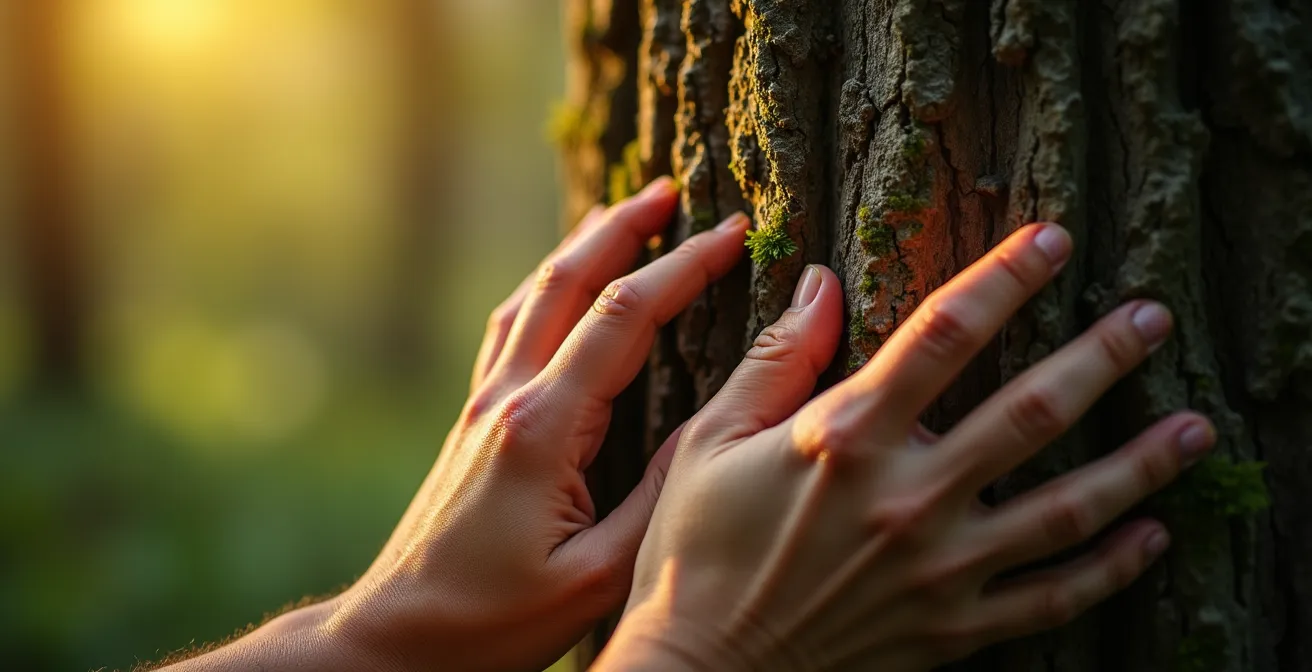
A self-guided practice can be structured around a series of “invitations.” These are not strict rules, but gentle suggestions to help you transition from your goal-oriented mind to a state of sensory presence. Begin with an “Invitation of Arrival”: find a spot and consciously leave your worries behind. Then, move to an “Invitation of a Sense,” where you dedicate 15 minutes to fully exploring just one sense. Finally, an “Invitation of Stillness” might involve sitting with a tree, feeling its bark, and simply being present with it. The goal is to be slow, aimless, and open.
The benefits of this practice are not merely poetic; they are scientifically validated. Consistent time in nature has a profound impact on well-being. A comprehensive UK study of 20,000 participants found that spending at least 120 minutes per week in nature led to significantly better self-reported health and well-being. Shinrin-yoku provides the framework to make that time as rich and restorative as possible.
- Invitation of Arrival (10 min): Find a threshold spot. Set an intention to leave your worries behind for this time and take ten deep, cleansing breaths.
- Invitation of a Sense (15 min): Choose one sense to focus on completely. You might close your eyes and count every distinct sound, or map all the different smells in the air.
- Invitation of Stillness (10 min): Find a tree that draws you in. Sit with it, place a hand on its bark, and try to synchronize your breathing with the movement of the wind in its leaves.
- Invitation of Sharing (5 min): Before you leave, find a way to offer gratitude. This can be a silent “thank you,” or a small, impermanent offering like a few interestingly arranged stones.
To begin your own journey of sensory reawakening, the most meaningful next step is to consciously schedule and undertake your first self-guided forest bath. Use these invitations as a gentle map, but allow your intuition and senses to be your ultimate guide.