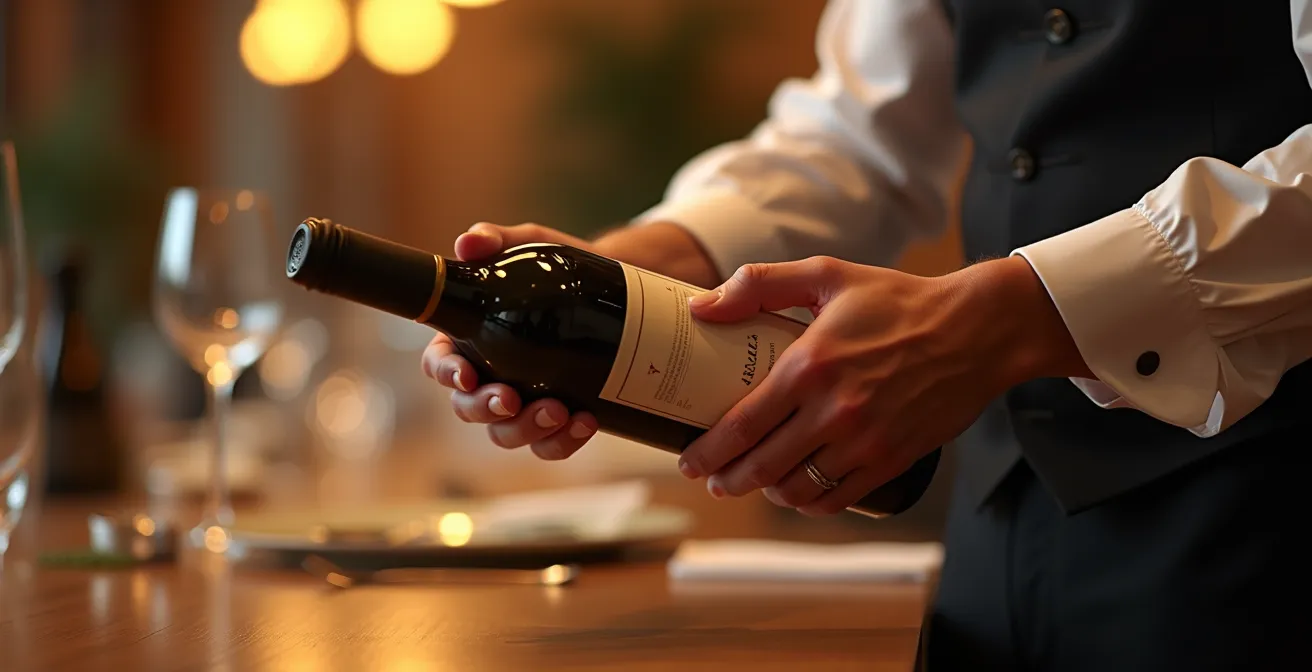
Spotting a sustainable wine isn’t about finding a logo; it’s about recognizing the tangible results of holistic farming in your glass.
- Biodynamics creates measurably healthier soil and more resilient vines, moving beyond simply prohibiting chemicals.
- Low-intervention “flaws” like cloudiness or slight fizz are often intentional signatures of authentic, living winemaking.
- Grape choices like Gamay over Pinot Noir are becoming crucial for adapting to climate change and ensuring the future of wine.
Recommendation: Learn to taste for texture, acidity, and evolution—not just familiar flavors—to unlock the rich world of sustainable wine.
Navigating a wine list can feel like deciphering a code, especially when terms like “organic” and “biodynamic” enter the conversation. For the wine lover eager to drink more sustainably, the default advice is often to “look for the certification label.” While not incorrect, this approach barely scratches the surface. It turns a fascinating agricultural story into a simple checkbox exercise and misses the entire point: the profound impact these practices have on the wine’s character, its ability to age, and even its viability in a changing climate.
The common perception frames organic as “no pesticides” and biodynamic as “organic with a bit of moon-cycle magic.” This oversimplification leads to missed opportunities. We might dismiss a cloudy wine as flawed or overlook a lesser-known grape variety that is, in fact, a hero of climate adaptation. The conversation often stagnates around what is *prohibited* rather than celebrating what is *created*: a more vibrant, expressive, and resilient vineyard ecosystem.
But what if the true key to identifying these wines wasn’t in memorizing logos, but in understanding the philosophy behind them? What if you could learn to recognize the sensory signatures of sustainable viticulture directly in your glass? This guide moves beyond the label to explore the tangible consequences of holistic farming. We will delve into how these choices shape a wine’s unique profile, why certain grapes are better adapted for our future, and how to build a cellar of sustainable wines that will evolve beautifully for years to come.
This article provides a complete framework for appreciating and identifying sustainable wines. From understanding the core differences in farming to mastering the art of tasting and cellaring, you’ll gain the confidence to make informed choices that align with your palate and your values.
Summary: Beyond the Label: How to Truly Identify Organic and Biodynamic Wines on Any Menu
- Why Is Biodynamic Wine Different from Standard Organic Wine?
- How to Taste Natural Wine to Appreciate Its Unique Profile?
- Pinot Noir or Gamay: Which Grape Is Adapting Better to Climate Change?
- The Temperature Mistake That Kills the Flavor of Local Red Wines
- How to Curate a Cellar of Age-Worthy Sustainable Wines?
- When to Arrive at Wineries to Ensure a Personal Tasting Session?
- Why Does the AOP Label Guarantee the True Taste of Roquefort?
- How to Distinguish Authentic Regional Dishes from Tourist Traps?
Why Is Biodynamic Wine Different from Standard Organic Wine?
The most common misconception is that biodynamics is simply “organic plus.” While it begins with all the principles of organic farming—chiefly, the prohibition of synthetic chemicals—it takes a radical leap forward. Organic viticulture is primarily defined by what it *avoids* (pesticides, herbicides). Biodynamics, in contrast, is defined by what it *actively creates*: a holistic, self-sustaining farm ecosystem. It views the vineyard not as a factory for grapes but as a living organism, where soil, plants, animals, and even cosmic rhythms are interconnected.
The practical applications of this philosophy, like the famous cow-horn preparations, are not arbitrary rituals. They are tools designed to enhance the life and fertility of the soil. For example, Preparation 500 (horn manure) is used to stimulate microbial life and root growth, building a vibrant soil microbiome. The tangible result of this approach is a dramatic improvement in vineyard health. In fact, comparative soil studies show that biodynamic soils exhibit 67% greater disease suppression and a 40% increase in organic material compared to conventionally farmed soils. Healthier soil leads to healthier vines, which require fewer interventions and produce grapes that more purely express their terroir.
This table highlights the key practical distinctions between the two most recognized certification standards.
| Aspect | Organic Certification (USDA/EU) | Biodynamic Certification (Demeter) |
|---|---|---|
| Synthetic Chemicals | Prohibited | Prohibited |
| Sulfites Allowed | US: 10ppm naturally occurring only EU: 100-150ppm |
100ppm maximum |
| Farming Calendar | Not required | Lunar/astronomical calendar mandatory |
| Biodiversity Requirements | Basic crop rotation | 10% land reserved for biodiversity |
| Compost Preparations | Standard organic compost | Nine specific preparations required |
| Certification Philosophy | Input prohibition focus | Holistic farm organism approach |
| Soil Health Testing | Chemical analysis | Biological activity + crystallization tests |
Ultimately, the goal of biodynamics is to create a vineyard so healthy and balanced that it can defend itself, resulting in wines that offer a more transparent and vibrant expression of their origin.
How to Taste Natural Wine to Appreciate Its Unique Profile?
Natural wines, often produced with organic or biodynamic grapes and minimal intervention in the cellar, are frequently described with one word: “funky.” This label can be intimidating, suggesting unpredictable or flawed flavors. However, a more productive approach is to understand these unique characteristics as sensory signatures of a specific winemaking intent. A slight cloudiness, a hint of fizz (pétillance), or a savory, earthy note are not accidents; they are the direct results of choices like forgoing filtration, bottling with residual CO2 for preservation, or fermenting with native yeasts.
Appreciating these wines requires a slight shift in your tasting method. Instead of immediately judging against a conventional benchmark, give the wine time to reveal itself. Many natural wines need 10-15 minutes in the glass to open up and shed initial reductive aromas. Pay close attention to texture—the “grip” from unfiltered particles or the “electric” vivacity on the palate. These are signs of a living wine.
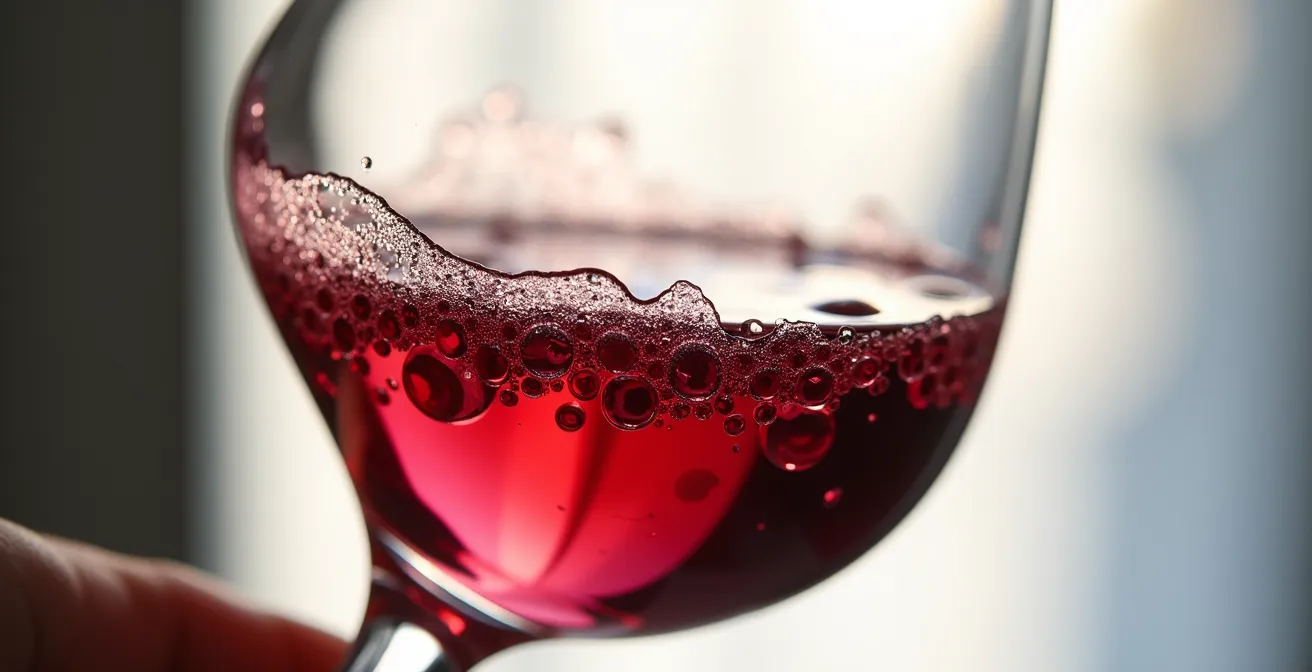
The image above perfectly illustrates the unfiltered nature of many of these wines, where texture and visual character are part of the experience. One of the most debated sensory signatures is volatile acidity (VA). Below a certain threshold, it can be a feature, not a flaw.
Case Study: Volatile Acidity as a Feature
Natural winemakers often embrace minimal-intervention techniques, resulting in what some call “funky” profiles. In practice, volatile acidity (VA) below 0.7 g/L can add lifted aromatics and complexity, creating what enthusiasts call ‘energy.’ This is especially evident in some Italian natural wines, where a touch of VA enhances notes of cherry and balsamic. However, when VA exceeds 1.2 g/L, it can create an unpleasant nail polish remover aroma. The key is integration: if the acidity lifts the fruit and adds vibrancy, it’s a feature of the winemaker’s intent; if it dominates and masks the terroir, it’s a flaw.
Instead of asking “Is this good?”, a better question is “What was the winemaker’s intention here?” This reframing transforms tasting from a verdict into a dialogue, allowing you to appreciate the wine on its own terms.
Pinot Noir or Gamay: Which Grape Is Adapting Better to Climate Change?
The conversation around sustainable wine must include climate resilience. As global temperatures rise, some of the world’s most beloved grape varieties are struggling. Pinot Noir, the celebrated grape of Burgundy, is notoriously sensitive. It is a classic “canary in the coal mine” for viticulture, demanding a very narrow climate window to thrive. As heat spikes and droughts become more common, producing elegant, balanced Pinot Noir is becoming increasingly challenging.
This is where lesser-known but more resilient varieties like Gamay come into focus. Traditionally associated with Beaujolais, Gamay is proving to be a workhorse in a warming world. It tolerates heat better, retains its natural acidity for freshness, and is more resistant to disease. According to research on viticultural climate impacts, Pinot Noir requires an average temperature range of just 3.6°F for optimal growing, while more resilient varieties can tolerate much wider fluctuations. This makes grapes like Gamay a smarter bet for the future.
| Characteristic | Pinot Noir | Gamay |
|---|---|---|
| Optimal Temperature Range | 57-61°F (13.8-16.1°C) | 59-66°F (15-18.8°C) |
| Heat Tolerance | Low – thin skins prone to sunburn | High – maintains freshness in heat |
| Ripening Period | Early – vulnerable to heat spikes | Mid-season – avoids extreme heat |
| Disease Resistance | Low – tight clusters trap moisture | High – loose clusters, thicker skins |
| Drought Adaptation | Poor – requires consistent moisture | Good – deeper root systems |
| Acid Retention at High Temps | Poor – loses acidity rapidly | Excellent – maintains freshness |
| 2°C Warming Impact | Net losses in most regions | Net gains in suitability |
Case Study: Oregon’s Forward-Thinking Shift
In Oregon, a region famous for Pinot Noir, forward-thinking viticulturists are already diversifying. Bryan Berenguer of Human Cellars, for example, planted his vineyard with warmer-climate varieties like Gamay, Chenin Blanc, and Lagrein, completely forgoing Pinot Noir. This strategy is proving successful, demonstrating that heat-tolerant grapes can maintain exceptional quality while adapting to new climate realities. It also revitalizes a region that has been heavily reliant on a single grape, offering consumers new and exciting profiles to explore.
As a conscious consumer, exploring these climate-adaptable varieties is one of the most impactful ways to support a truly sustainable future for wine.
The Temperature Mistake That Kills the Flavor of Local Red Wines
One of the most common and destructive mistakes made when serving red wine, especially lighter-bodied, low-intervention styles, is serving it at “room temperature.” This vague concept is often a relic of drafty old European homes and is far too warm for modern, centrally heated environments. When a delicate red wine is served too warm (above 65°F / 18°C), its nuanced flavors are obliterated. The alcohol becomes more volatile, masking delicate fruit and floral notes and making the wine taste flat, soupy, and unbalanced.
As the renowned natural wine expert Isabelle Legeron MW explains, temperature is not a minor detail. In her book “Natural Wine: An Introduction to Organic and Biodynamic Wines,” she highlights its scientific importance:
The science behind temperature’s effect on natural wine is crucial – excessive warmth makes alcohol more volatile, completely masking delicate fruit and floral notes that low-intervention winemaking aims to preserve.
– Isabelle Legeron MW, Natural Wine: An Introduction to Organic and Biodynamic Wines
The solution is simple: chill your reds slightly. This is especially critical for organic and biodynamic wines that rely on their freshness and vibrancy. In a restaurant, don’t hesitate to ask for an ice bucket for 5-10 minutes if your red arrives warm. This simple act can rescue a wine and unlock its true potential.
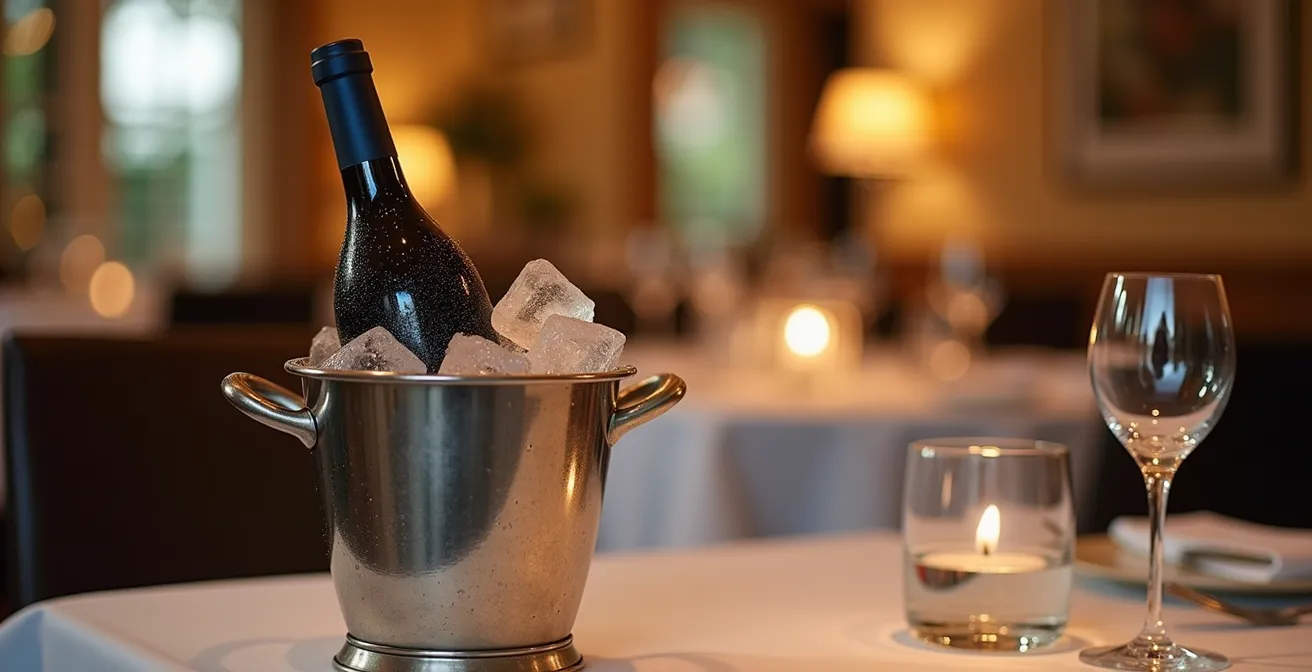
To get the best from your sustainable wines, follow this simple temperature guide:
- Light-bodied natural reds (Gamay, Trousseau): Serve at 54-57°F (12-14°C). A slight chill emphasizes freshness and bright fruit.
- Medium-bodied organic reds (Sangiovese, Grenache): Serve at 57-61°F (14-16°C). This is cool enough to preserve fruit but warm enough for complexity to emerge.
- Full-bodied biodynamic reds (Bordeaux blends, Barolo): Serve at 61-64°F (16-18°C). This allows tannins to soften while maintaining structure.
- Restaurant Fix: If a bottle feels warm, request an ice bucket. Remove it once the bottle feels cool to the touch—usually 5-10 minutes is enough.
Treating temperature with the same respect as glassware or food pairings is the mark of a truly knowledgeable wine lover. It’s the final, crucial step in honoring the farmer’s and winemaker’s hard work.
How to Curate a Cellar of Age-Worthy Sustainable Wines?
A persistent myth surrounding natural and biodynamic wines is that they lack aging potential due to lower or non-existent levels of added sulfites (SO2). While it’s true that sulfites are a powerful preservative, they are not the only factor in a wine’s longevity. Many of the world’s most sought-after and age-worthy wines are made with minimal intervention, proving that vineyard health and winemaking precision are the true keys to a long life in the cellar.
Well-made sustainable wines possess their own powerful set of natural preservatives. High natural acidity (a low pH), phenolic structure from tannins (often from skin or stem inclusion), and the antioxidant compounds imparted during extended aging on the lees (the dead yeast cells) all contribute to a wine’s ability to evolve and improve over years, even decades.
Case Study: The Ageless Wines of Jean-François Ganevat
Producer Jean-François Ganevat from the Jura region of France has become a benchmark for aging zero-sulfite wines. His Chardonnays, made with no added SO2, have demonstrated a remarkable 20+ year aging potential. This is achieved through a combination of high natural acidity (pH around 3.2), extended aging on the lees which provides natural antioxidants, and precise, oxidative-handled winemaking. As confirmed by tastings of his library wines, bottles from the 1990s show stunning complexity with notes of honey, nuts, and preserved citrus, all while maintaining incredible freshness. This proves that when vineyard health and winemaking precision align, sulfites are not a prerequisite for longevity.
So, how can you identify these age-worthy gems for your own cellar? It’s about looking for the markers of quality and structure, not just a certification logo. Use this checklist to guide your selections.
Action Plan: Identifying Age-Worthy Natural Wines
- Check pH Levels: Wines with a pH below 3.5 have significant natural preservation from their acidity. Don’t be afraid to ask for a producer’s technical sheet.
- Assess Tannin Structure: Look for wines with firm but ripe tannins, often from skin or whole-bunch inclusion. These provide the structural backbone for aging.
- Look for Old Vine Indicators: The term “Vieilles Vignes” (French for old vines) on a label often signals fruit with greater concentration and complexity, ideal for cellaring.
- Evaluate Producer Track Record: Research producers known for their library releases. If a winery holds back vintages to prove their aging capability, it’s a strong sign of quality.
- Buy Two Bottles: This is the ultimate strategy. Purchase one bottle to drink now to understand its youthful character, and cellar the second for 5-10 years to witness its evolution.
Building a cellar of sustainable wines is an investment in the future, both for your own palate and for the health of the planet’s vineyards.
When to Arrive at Wineries to Ensure a Personal Tasting Session?
Visiting a winery that practices organic or biodynamic farming is a fundamentally different experience than visiting a large, conventional producer. You are not visiting a tourist attraction with a gift shop; you are visiting a working farm. The winemaker might be out pruning vines, driving a tractor, or cleaning tanks. Their time is their most precious resource. Therefore, strategic timing is crucial to ensure you get a personal, insightful tasting session rather than a rushed pour from a busy intern.
The golden rule is to book an appointment well in advance and to be mindful of the agricultural calendar. Never attempt to visit during the busiest periods like harvest (typically September-October in the Northern Hemisphere) or bottling season (often in the spring). Instead, target the “shoulder seasons” like late May or early November, when winemakers are more relaxed and have more time to talk.
As winemaker Mick Unti, who has farmed organically from the start, puts it, this isn’t a marketing gimmick; it’s simply the proper way to make wine. He doesn’t identify as a “natural” winemaker because, for him, this low-intervention approach is the only authentic way. This philosophy underscores the importance of visiting with respect for their process. When you book, signaling your serious interest by mentioning a specific wine or farming practice you’d like to discuss can transform your visit from a simple tasting into a memorable conversation.
For the best possible experience, follow these timing guidelines:
- Book a weekday appointment between 10-11 AM. This is often the sweet spot after morning vineyard work is done but before lunch fatigue sets in.
- Request the first appointment of the day. This guarantees you a fresh palate (for both you and the host) and their undivided attention.
- Consider the last appointment gamble. A 3-4 PM slot can sometimes extend into a more casual, extended conversation if there are no other appointments following yours.
- Follow the biodynamic calendar. For a truly unique experience, try booking your visit on a “Fruit” or “Flower” day, which are considered optimal for tasting according to biodynamic principles.
A well-timed visit shows respect for the craft and opens the door to a deeper understanding of the wines you love.
Key Takeaways
- Biodynamics is a holistic system focused on creating a self-sustaining vineyard, resulting in healthier soil and more expressive wines.
- Learn to appreciate the “sensory signatures” of natural wine—like texture and vibrant acidity—as signs of intentional, low-intervention winemaking.
- Prioritize climate-resilient grapes like Gamay and seek out reds served at the correct, slightly chilled temperature (54-64°F / 12-18°C) to experience their full flavor.
Why Does the AOP Label Guarantee the True Taste of Roquefort?
At first glance, a question about Roquefort cheese might seem out of place in a discussion about wine. However, it provides the perfect analogy for understanding one of the most critical concepts in the world of wine: terroir and authenticity. The French “Appellation d’Origine Protégée” (AOP) system, which protects products like Roquefort, is the blueprint for the wine world’s AOC, DOC, and AVA systems.
The AOP for Roquefort guarantees much more than just a place of origin. It dictates that the cheese must be made from the milk of a specific breed of sheep (Lacaune), raised in a specific geographical area, and aged in the natural caves of Roquefort-sur-Soulzon. This strict set of rules ensures that every wheel of authentic Roquefort delivers a consistent and unique taste profile—that signature salty, tangy, and spicy character that cannot be replicated elsewhere. The AOP guarantees the “true taste” by protecting the entire ecosystem and process that creates it.
This is precisely the goal of a wine appellation. An AOP/AOC label on a bottle of wine is supposed to guarantee that the wine is a genuine expression of its specific place. It governs which grapes can be grown, the maximum yields, and sometimes even the viticultural and winemaking methods. Just as the Roquefort AOP protects against industrial imitations, a wine appellation aims to protect the authentic taste of a region from generic, mass-produced products that have no sense of place.
When you choose a wine from a specific, high-quality appellation, you are choosing a product that is deeply connected to its land, its history, and its culture—much like a true wedge of Roquefort.
How to Distinguish Authentic Regional Dishes from Tourist Traps?
The final step in your journey as an informed wine consumer is to apply the same logic you would use when seeking out authentic food while traveling. Imagine you are in Rome. You can either go to the restaurant by the Colosseum with a glossy menu in six languages serving a generic “Pasta Carbonara,” or you can walk a few blocks into a neighborhood and find the small trattoria where locals are eating a Carbonara made with real guanciale and pecorino. The first is a tourist trap; the second is an authentic experience.
This same distinction exists in the world of wine. “Tourist trap” wines are the mass-produced, international-style bottles that taste the same whether they come from California, Chile, or Australia. They are often made from overripe fruit, manipulated with additives, and aged in new oak to create a loud, generic, and predictable flavor profile. They have no connection to a specific place; their terroir is the factory.
An authentic, terroir-driven wine is the equivalent of that local trattoria. It speaks of its origin. It might be quieter, more nuanced, and perhaps even a little “imperfect” by industrial standards. Its flavors are a direct reflection of the soil it grew in, the climate of that specific vintage, and the hands-off philosophy of the farmer. These are the wines made with the sustainable, biodynamic, and organic principles we’ve discussed. They prioritize authenticity over predictability.
To truly elevate your wine experience, seek out the producers who are farming with respect and making wine with intent. Choose the trattoria over the tourist trap, and you will be rewarded with an authentic taste of place every time.