Spotting staged authenticity isn’t about finding a ‘pure’ culture frozen in time; it’s about learning to read the subtle signals of context, connection, and commodification.
- Genuine cultural practices have deep context and community meaning, whereas staged shows are simplified for entertainment.
- The economic model reveals a lot: community cooperatives foster dignity, while direct tipping can encourage dependency and exaggeration.
- Authentic crafts show signs of human touch and use, unlike mass-produced souvenirs that are perfectly uniform and too cheap.
Recommendation: Shift from being a passive consumer of a spectacle to a respectful observer of a living practice by asking better questions and analyzing the ‘why’ behind what you see.
For any traveler seeking a genuine connection, the question is a familiar whisper in the back of the mind: “Is this real?” You’re watching a vibrant dance, listening to ancient songs, or admiring a local craft, yet a flicker of doubt remains. This experience, meticulously packaged for tourists, can feel less like a cultural immersion and more like a transaction. The common advice—to “go off the beaten path” or “talk to locals”—is well-intentioned but often insufficient. It doesn’t equip you with the critical tools to distinguish a living tradition from a well-rehearsed performance.
The truth is, the line between authentic and staged is rarely a clear one. Culture is not a static museum piece; it is alive, and it evolves. The pressure of a global tourism market, however, often accelerates a process known as cultural commodification, where sacred rituals, intricate crafts, and community stories are simplified, shortened, and stripped of their context to become easily consumable products. But what if the key wasn’t to futilely search for an untouched, “pure” past? What if, instead, the real skill was in learning to read the signs? This guide is not about judging cultures but about sharpening your own perception. It’s about developing a form of “forensic observation” to understand the dynamics at play.
This article will provide you with a framework to analyze the context of a performance, the economic structure that supports it, and the subtle details of objects and interactions. By learning to ask better questions—of your guide, of the performers, and of yourself—you can move beyond the surface-level spectacle. You will learn how to identify the difference between a tradition that has adapted to survive and one that has been hollowed out for show, enabling a more respectful and meaningful travel experience.
Summary: How to Spot “Staged Authenticity” in Cultural Performances?
- Why Does Turning Culture into a Show Destroy Its Meaning?
- Tipping or Ticket: How to Pay Performers Without Creating Dependency?
- Which Question Shifts a Conversation from Small Talk to Real Connection?
- Dancing or Watching: When Is It Appropriate to Join In?
- How to Tell if a Mask Was Used in Ritual or Made for Export?
- The Photography Habit That Violates Privacy Laws in Many Countries
- How to Distinguish Real Local Crafts from Imported Souvenirs?
- Why Some Traditions Must Change to Survive in the Modern World?
Why Does Turning Culture into a Show Destroy Its Meaning?
The transformation of culture into a performance for tourists is driven by powerful economic forces. As the desire for unique experiences grows, so does the market to supply them. In fact, recent market analysis reveals that the global cultural tourism market is expected to grow from $7.25 billion to $16.95 billion by 2032. This intense demand creates what is known as “cultural commodification,” where traditions are packaged and sold like any other product. The result is often a form of cultural shrinkflation: the experience looks the same on the surface but has been fundamentally hollowed out.
A sacred ceremony that traditionally lasts for hours might be condensed into a 15-minute highlight reel. The intricate narrative behind a dance, full of symbolism and history, is often removed because it’s deemed too complex for a transient audience. Performers, under pressure to entertain, may start to focus on the most visually spectacular elements, repeating them over and over. Their engagement shifts from an internal, spiritual focus to an external one, seeking applause rather than connection. This process severs the link between the practice and its original purpose, turning a meaningful act of community expression into a superficial spectacle.
To the untrained eye, the show can still be beautiful, but its soul is missing. The danger is twofold: visitors leave with a distorted and shallow understanding of the culture, and younger generations within the community may learn this simplified “tourist version” instead of the original, leading to the gradual erosion of their own heritage. Recognizing these signs is the first step toward seeking more meaningful interactions.
Tipping or Ticket: How to Pay Performers Without Creating Dependency?
The question of how to financially support cultural performers is fraught with ethical complexities. While the instinct to tip an individual for a moving performance seems natural, it can inadvertently create a cycle of dependency and distort the very art form you wish to support. Direct tipping often pressures performers to exaggerate or pander, prioritizing spectacle over authenticity to earn more. It can also create internal community conflicts. A more sustainable approach focuses on the economic dignity of the performers and the preservation of their culture, which requires looking at the payment structure itself.
A far better model ensures that revenue benefits the entire community and supports the cultural ecosystem. This removes the pressure on individuals and reinforces the collective nature of the tradition. This is not just a theoretical ideal; successful examples exist around the world.
Case Study: Community Cooperative Model in Papua New Guinea’s Mask Festival
Papua New Guinea’s National Mask Festival demonstrates a successful economic model where performance revenues flow into community cooperatives rather than individual performers. This system maintains cultural integrity by ensuring economic benefits are distributed equitably among artisans who create the masks, the performers, and the cultural knowledge holders who teach the traditions. This structure prevents the dependency that direct, individual tipping can create and empowers the community to manage its own cultural heritage.
Understanding the different models is key for a traveler who wants to make a positive impact. Each system has a different effect on the autonomy of the performers and the long-term health of their traditions. A fixed ticket price that goes to a community fund is almost always a more ethical choice than making it rain small bills after a dance.
This comparative table, based on an analysis of various cultural tourism economic models, breaks down the impact of different payment systems.
| Payment Model | Performer Autonomy | Cultural Preservation | Economic Sustainability |
|---|---|---|---|
| Direct Tips | Low – creates performance pressure | Poor – encourages exaggeration | Unstable – seasonal fluctuations |
| Fixed Salary | Medium – regular income | Medium – less pressure to modify | Stable but may lack incentive |
| Community Cooperative | High – collective decision-making | Strong – community oversight | Most sustainable – shared benefits |
| Platform-based (Airbnb) | Variable – depends on terms | Risk of standardization | Can provide wider reach |
Which Question Shifts a Conversation from Small Talk to Real Connection?
Many travelers, wanting to show respect, fall back on simple, factual questions: “How old is this tradition?” or “What does this mask mean?” While well-intentioned, these questions often solicit rehearsed, surface-level answers. They position the performer as a living exhibit rather than a skilled artist with personal experience. The key to unlocking a genuine connection lies not in finding a single “magic question,” but in shifting the focus from historical facts to personal perspective and lived experience.
As anthropologist Dr. Frank Manning noted in the Cultural Survival Quarterly, genuine connection comes from demonstrating authentic interest in the individual. This is the difference between an interview and a conversation.
The key to connection is not a magic question, but practicing active listening and asking follow-up questions based on the performer’s own words, showing genuine interest.
– Dr. Frank Manning, Cultural Survival Quarterly on Staged Authenticity
Instead of asking a question that can be answered with a date or a single word, try asking open-ended questions that honor the performer’s expertise and personal journey. This reframes the interaction, inviting them to share a piece of their world rather than just a piece of information. This simple shift can transform a sterile Q&A session into a memorable human exchange.
Here are some examples of questions that reframe the dynamic to foster a more meaningful dialogue:
- Instead of “What does this mean?”, ask: “What feeling do you hope the audience takes away from this performance?”
- Replace “Is this authentic?” with: “How has this performance evolved in your lifetime?”
- Rather than “How old is this tradition?”, try: “Who taught you, and what was the most important lesson they emphasized?”
- Avoid “Do you do this in your ‘real life’?” Instead, ask: “How does performing for visitors differ from when you perform for your own community?”
- Skip “Can you teach me the move?” and try: “What part of this art form takes the longest to master?”
Dancing or Watching: When Is It Appropriate to Join In?
The invitation comes, often with a broad smile and a beckoning gesture: “Come, dance with us!” For a traveler, this moment is a crossroads between enthusiastic participation and respectful observation. Jumping in can feel like the ultimate form of engagement, but it can also be a profound cultural misstep. The appropriateness of participation is not universal; it is entirely dependent on the context of the event. Understanding your place can be visualized as concentric circles of participation: a core of performers, a ring of community members, and an outer circle of observers.
This wide shot of a cultural festival clearly illustrates the different layers of involvement. The performers are at the heart of the action, community members participate actively around them, and visitors observe from a respectful distance, fully engaged but understanding their role as guests.
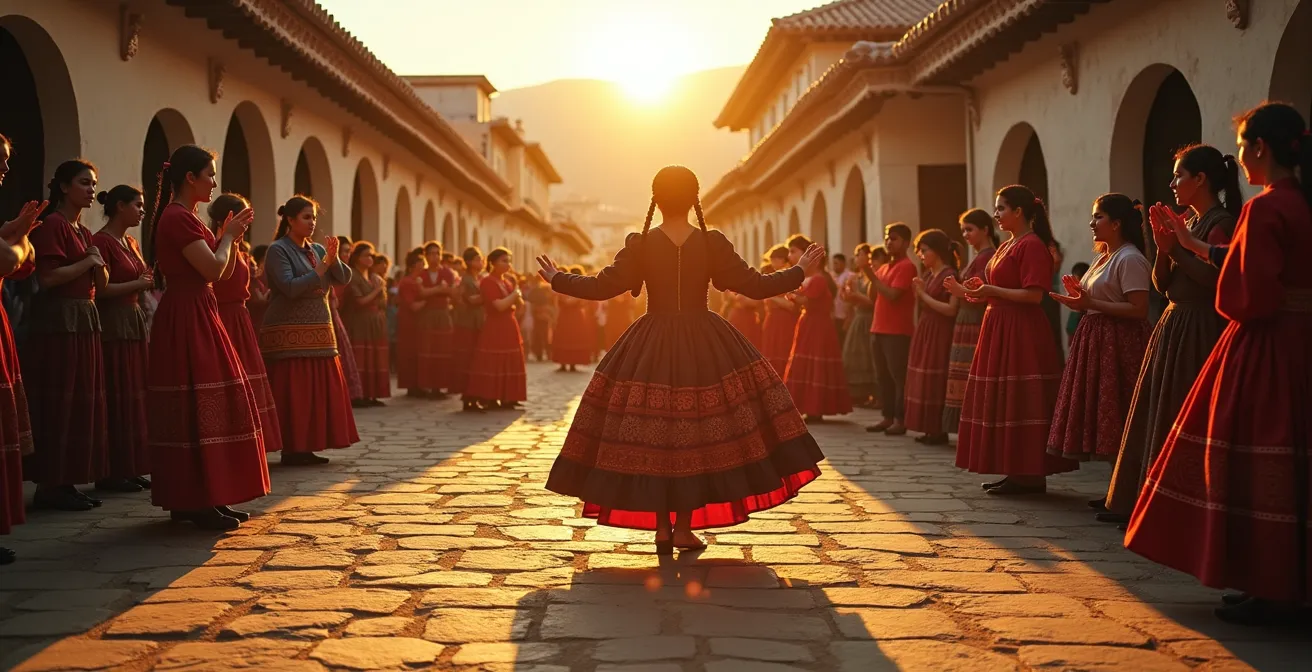
As the image shows, observing is not a passive act. It is a form of respect. Your primary role as a visitor is to be a witness, not the center of attention. In a sacred ritual, for example, participation by an outsider is almost never appropriate. Your presence alone is a privilege. In a community celebration, you might be genuinely invited to join, but the key is to do so with humility—mirroring simple steps rather than attempting to take the spotlight. In a performance explicitly designed for tourists, participation is often expected and part of the show.
The crucial skill is to read the situation. Is the invitation a blanket gesture to all tourists, or a specific, personal one? Is the event a solemn ceremony or a joyous party? When in doubt, the most respectful default position is to watch, listen, and appreciate from the sidelines.
This decision matrix can help you navigate the complex social cues of cultural events.
| Event Context | Explicit Verbal Invite | Implicit Non-verbal Cue | Commercial Blanket Invite |
|---|---|---|---|
| Sacred Ritual | Observe quietly | Do not participate | N/A – not commercialized |
| Community Celebration | Join with respect | Mirror small gestures first | Participate mindfully |
| Tourist Performance | Full participation OK | Follow lead of others | Designed for participation |
How to Tell if a Mask Was Used in Ritual or Made for Export?
In a bustling market filled with vibrant handicrafts, it’s easy to be captivated by a beautifully carved mask. But is it a genuine cultural object with a history, or a decorative piece made specifically for the tourist trade? The proliferation of mass-produced souvenirs is a significant issue; in fact, recent heritage tourism market data shows that up to 57% of the cultural heritage market involves commodified artifacts. Distinguishing between the two requires a shift in mindset—from that of a shopper to that of a forensic observer.
A mask created for ritual use is a tool, not a decoration. It is designed to be worn, often for long periods, and its form follows its function. An export mask, by contrast, is designed to be hung on a wall. Its primary function is aesthetic appeal. The clues to an object’s history are written on its surface, in its weight, and even in its imperfections. You just need to know how to read them. Signs of wear, the materials used for repairs, and the overall balance of the piece are all tell-tale indicators of its past life.
This approach transforms souvenir shopping from a simple transaction into a fascinating investigation, connecting you more deeply with the object and the culture that produced it. It’s about appreciating the story embedded in the material itself.
Your Action Plan: Forensic Analysis for Cultural Objects
- Check the Interior: Look for a dark patina from sweat and oils at the forehead, cheeks, and chin. Ritual masks that have been worn will show these signs of human contact.
- Examine Wear Patterns: Identify areas that are worn smooth from being repeatedly held during ceremonies. Look at the edges and any grip points.
- Inspect for Repairs: Authentic, field-used objects are often repaired with traditional materials like plant fibers, resin, or local adhesives. Modern glue or screws are a red flag.
- Test Weight and Balance: A mask made for dancing is balanced to be worn comfortably. A mask made for a wall is often heavier or awkwardly weighted for display.
- Look for Display Hardware: A pre-drilled hole or a wire loop on the back is a clear sign it was made as a decorative item for export, not for use in a ceremony.
The Photography Habit That Violates Privacy Laws in Many Countries
In the age of social media, the impulse to capture and share every moment of our travels is powerful. For many, a photo is proof of an experience. However, this habit of constant documentation can cross a line from appreciation to exploitation, transforming people into “content” and violating their right to privacy. What seems like a harmless snapshot can be a profound intrusion, and increasingly, it is also illegal.
Many countries and communities are pushing back against the relentless tourist gaze. The issue is not photography itself, but the lack of consent and respect. Photographing someone, especially a close-up, without their explicit permission is disrespectful. Publishing that photo online, potentially with a geotag, can have serious legal ramifications under privacy laws like the GDPR in Europe and similar regulations elsewhere. Travelers are often unaware that they are not just being rude, but are breaking the law.
Case Study: Kyoto’s Gion District Photography Restrictions
In 2024, after years of tourists harassing Geishas and their apprentices (maiko), the Gion district in Kyoto implemented strict photography bans on private roads. This came after countless incidents of visitors treating these working professionals like public property, blocking their path and taking photos without consent. The city now imposes fines of up to 10,000 yen for unauthorized photography that disrupts the women’s work. This case is a stark example of how the relentless pursuit of the “perfect shot” can harm a community and lead to legal restrictions.
The fundamental principle is simple: ask for permission first. A nod and a smile go a long way. If they say no, respect their decision without question. Remember that you are a guest in their home and workplace. The best memories are often the ones you don’t capture with a lens, but with your full, respectful attention.
How to Distinguish Real Local Crafts from Imported Souvenirs?
The souvenir market is a minefield. That “traditional” textile or “handmade” pottery you’re admiring might have been mass-produced in a factory thousands of miles away and imported for the tourist trade. Buying a genuine, locally-made craft supports an artisan and their family directly, preserving a skill and a tradition. Buying an import, on the other hand, supports a supply chain that often undermines those same local artisans. Telling the difference requires engaging more than just your eyes; it demands a full sensory investigation.
Mass production prioritizes uniformity and speed. Every item is identical, flawless, and often made from synthetic materials that are cheap and easy to work with. True handcraft, by contrast, is defined by its perfect imperfections. It carries the marks of the maker’s tools and hands. You’ll find slight variations in size, color, and pattern. The materials will often have a distinct smell—of wood, leather, or natural dyes—that is absent in factory-made goods. These are not flaws; they are the signature of authenticity.
Beyond the object itself, the context of the sale is a powerful clue. A genuine artisan or a knowledgeable shopkeeper will be able to tell you the story behind the object: the meaning of the symbols, the source of the materials, the time it took to create. Someone selling an imported good will likely have no such details. Here are key tests you can perform:
- The Touch Test: Feel the weight and texture. Handmade items often have slight irregularities and a weight that reflects natural materials (e.g., solid wood vs. particleboard).
- The Smell Test: Natural materials like wool, leather, and plant-based dyes have distinct, earthy scents. A chemical or plastic smell is a major red flag.
- The Stack Test: Look at a pile of similar items. If they are all perfectly identical, they are machine-made. Handmade items will always show subtle variations.
- The Vendor Knowledge Test: Ask the seller about the technique or the artist. A passionate and genuine seller will be happy to share details. A blank stare is a bad sign.
- The Price Reality Check: If the price seems too good to be true for an item that would have taken hours or days of skilled labor, it probably is.
Key Takeaways
- Look for context, not purity: A living tradition evolves. The key is whether its core meaning and community connection remain intact.
- Follow the money: The economic model is a powerful indicator of authenticity. Support systems that empower the community, not just individuals.
- Your role is observer first: Respectful observation is a powerful form of participation. Join in only when the context is clearly appropriate.
Why Some Traditions Must Change to Survive in the Modern World?
The romantic ideal of a “pure,” unchanging tradition is often a fantasy projected by outsiders. In reality, cultures have always adapted to survive. The idea that a practice must remain frozen in time to be authentic is not only unrealistic but can be a death sentence for the tradition itself. In a world of globalization and digital media, standing still often means being forgotten. The most resilient traditions are not those that resist all change, but those that adapt strategically, retaining their core meaning while finding new ways to express it.
This managed evolution can be a powerful tool for cultural revitalization. When a younger generation sees their heritage being celebrated on a global stage or providing a sustainable livelihood, they are far more likely to invest their time and energy in learning it. The key is that the community itself must be in control of these changes, deciding what can be adapted for an outside audience and what must be preserved for the community alone. According to heritage tourism analysis, the $604.38 billion heritage tourism market has created significant incentives for just this kind of preservation and adaptation.
Case Study: The Tujia Bai Shou Dance and Digital Revival
The Tujia Bai Shou Dance is a powerful example of successful cultural adaptation. Originally a remote village ritual, it was facing decline as younger generations moved away. However, through strategic commodification and modern media, it found new life. A study published in 2024 notes how by 2022, videos of the dance had reached 5 million views on platforms like TikTok. This viral success attracted a new generation of Tujia youth to relearn their heritage. The dance retained its core movements and spiritual significance while its presentation was adapted for a digital audience, proving that controlled change can revitalize a tradition.
As a traveler, letting go of the expectation of a perfectly preserved past allows you to appreciate the dynamic, living nature of culture. You can celebrate the resilience of a community that has found a way to carry its stories forward into the modern world. Authenticity, in this light, is not about historical purity, but about a tradition’s unbroken, living connection to its people, however it chooses to express itself today.
The next time you travel, use these principles not as a rigid checklist, but as a lens to see the world more clearly. Observe with curiosity, listen with empathy, and engage with respect. This is how you move beyond being a mere tourist and become a true, conscious traveler.
Frequently Asked Questions about Staged Authenticity
Can I legally photograph performers during cultural shows?
Public performances generally allow photography, but many countries require consent before you can publish images online, especially those with clearly identifiable faces. Always ask first if you intend to share.
What are the penalties for drone photography at heritage sites?
Penalties for unauthorized drone use can be severe, ranging from confiscation of the drone to fines that can reach up to $5,000. Many UNESCO World Heritage sites have banned drones entirely to protect both privacy and the integrity of the site.
Does geotagging photos violate privacy laws?
Yes, it can. Publishing a geotagged photo of a person without their consent can be a violation of privacy laws, particularly in the European Union under GDPR, but also under similar regulations in other regions. It can reveal sensitive information about a person’s location and habits.