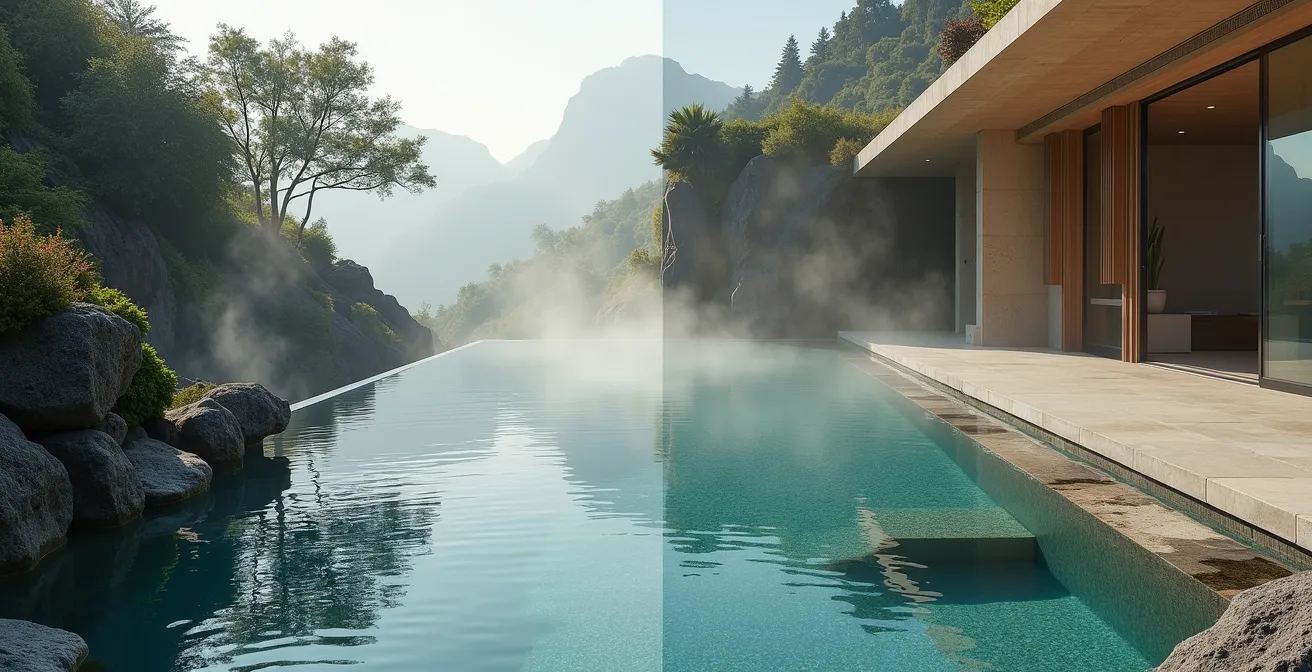
The real therapeutic power of hot springs comes from their raw, wild mineral composition, not the luxury that surrounds them.
- Natural springs offer unique, bioavailable minerals like sulfur, which modern spas often cannot replicate, providing tangible benefits for skin and inflammation.
- Historical use reveals bathing was a health ritual, a purpose-driven act that enhances benefits beyond the simple relaxation offered by many commercial spas.
Recommendation: For maximum mineral benefits, prioritize authentic geothermal sources and embrace their natural characteristics, even if it means sacrificing some comfort.
The sensation of sinking into geothermally heated water is a primal comfort, a release that feels both indulgent and deeply healing. For wellness seekers, the choice often boils down to two distinct paths: the untamed, mineral-rich pools of a natural hot spring or the curated, predictable comfort of a luxury spa. The common discourse pits authenticity against amenity, wildness against wellness packages. Spas offer pristine environments, controlled temperatures, and a host of services, promising a seamless relaxation experience. Wild springs offer a direct connection to nature, an unpredictable adventure, and a water chemistry dictated by the earth itself.
But what if the core of the debate is not about comfort versus adventure? What if the key to unlocking the profound health benefits of these waters lies in understanding their scientific composition and historical purpose? This exploration moves beyond the surface-level comparison. We will delve into why the so-called « imperfections » of natural springs—a distinct sulfurous smell, variable temperatures, or the effort required to reach them—are often the very source of their superior therapeutic efficacy. The carefully controlled environment of a spa, while comfortable, can dilute the potent, raw power that ancient cultures revered and that modern science is beginning to validate.
This guide unpacks the science behind mineral absorption, the critical safety protocols for any hot water immersion, and the historical context that separates a simple dip from a true balneotherapy ritual. By understanding these elements, you can make an informed choice that aligns with your ultimate wellness goals.
Summary: Geothermal Healing vs. Spa Luxury
- Why Is Showering Before Entering a Hot Spring Non-Negotiable?
- How Long Can You Stay in 40°C Water Before Fainting?
- Why Does Rotten Egg Smell Mean Better Skin Healing?
- How Did the Romans Use Baths for Political Networking?
- How to Find Wild Hot Springs That Require a Hike?
- The Steam Vent Mistake That Burns Tourists Every Year
- How to Plan Rest Days to Maximize Performance on Active Trips?
- Why Planning Only One Activity Per Day Increases Satisfaction?
Why Is Showering Before Entering a Hot Spring Non-Negotiable?
The ritual of showering before entering a pool is often seen as a simple matter of hygiene, a courtesy to fellow bathers. However, in the context of therapeutic hot springs, it is a crucial step for maximizing personal health benefits. The primary goal of soaking in mineral water is to facilitate the absorption of elements like silica, sulfur, and magnesium through the skin. Your skin, however, is naturally coated in oils, and may also have remnants of lotions, sunscreens, or deodorants. These substances create a barrier that significantly impedes your body’s ability to absorb the dissolved minerals from the water.
A pre-soak shower with soap and water cleanses the epidermis, removing this obstructive layer. With clean, open pores, your skin becomes far more receptive to the geothermal water’s mineral content. In essence, you are preparing the canvas for the therapeutic treatment. This simple act transforms a passive soak into an active process of mineral uptake. Failing to shower is not just unhygienic; it’s a wasted therapeutic opportunity, akin to applying a nourishing face mask over a layer of makeup. You are in the water, but its most potent benefits are not getting into you.
Therefore, whether at a luxury spa or a wild spring, this non-negotiable step ensures you receive the maximum value from the unique chemistry of the water.
How Long Can You Stay in 40°C Water Before Fainting?
The allure of a steaming hot spring can be deceptive. While heat is a primary component of the therapeutic experience, it also poses the most immediate risk. The question of duration is not about endurance but about safety. For adults, the absolute upper limit for temperature is widely recognized. According to safety guidelines, 104°F (40°C) is the maximum safe temperature, and soaks should be limited to about 20 minutes at a time to prevent hyperthermia, a dangerous overheating of the body that can lead to dizziness, nausea, and fainting.
However, an effective balneotherapy practice isn’t about pushing limits; it’s about using temperature variation to stimulate the body. Instead of a single, long soak, a more beneficial approach involves interval soaking, which alternates between hot and cold temperatures. This contrast hydrotherapy is a powerful circulatory stimulant. The heat causes vasodilation (widening of blood vessels), and the cold causes vasoconstriction (narrowing), creating a « pump » effect that boosts circulation, reduces inflammation, and enhances detoxification.
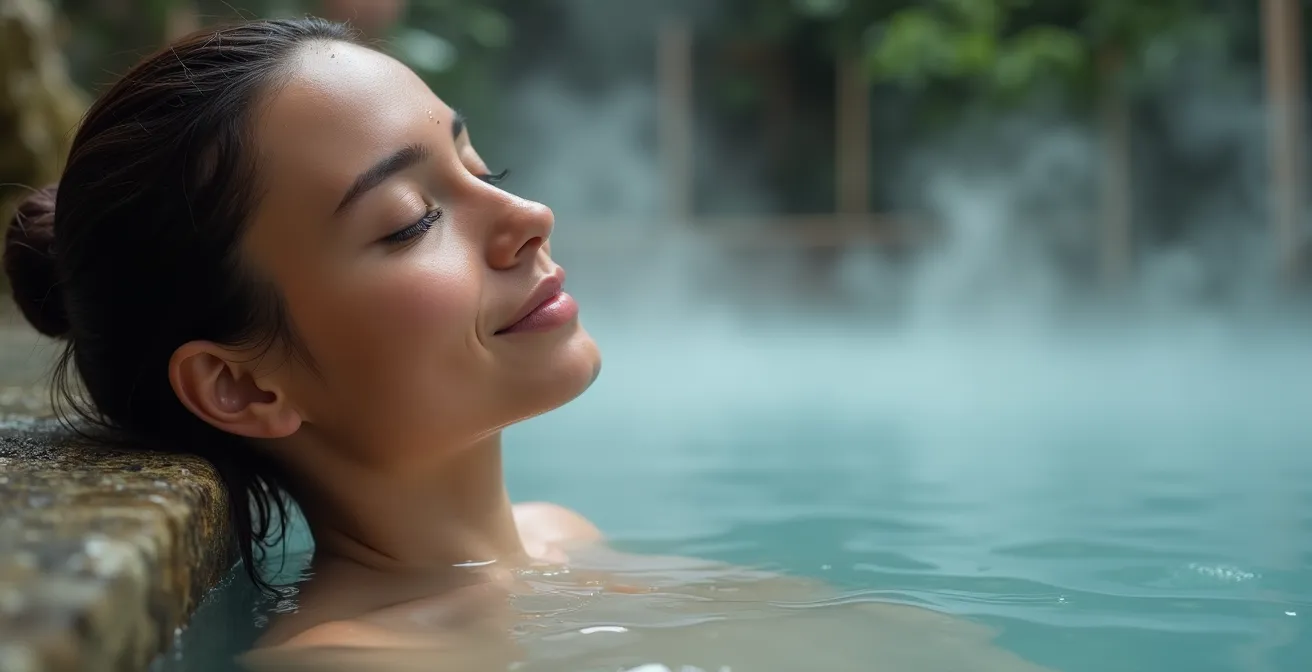
As seen in the practice of alternating between pools, this method allows for a more extended and dynamic therapeutic session without the risks of prolonged heat exposure. A typical protocol might involve:
- Start in a warm (96°F/35°C) pool for 10-15 minutes to acclimate and relax.
- Take a brief, invigorating plunge in a cold pool (around 58°F/14°C) to stimulate circulation.
- Move to the hottest pool (up to 106°F/41°C, but with extreme caution) for a maximum of 10 minutes.
- Follow with another cold plunge to flush the system.
- Finish in a neutral or warm pool (around 86°F/30°C) to allow the body to recover and stabilize.
This structured approach not only prevents the dangers of overheating but also multiplies the physiological benefits of your soak far beyond what a single-temperature immersion can offer.
Why Does Rotten Egg Smell Mean Better Skin Healing?
For the uninitiated, arriving at a natural hot spring and being greeted by the distinct smell of rotten eggs can be off-putting. This odor is the signature of hydrogen sulfide gas, produced when sulfur, a naturally occurring mineral in geothermal waters, is released. While a modern luxury spa would go to great lengths to filter out such a « flaw, » in the world of balneotherapy, this smell is the sign of a potent, high-quality therapeutic water. It is, quite literally, the smell of healing, particularly for the skin.
Sulfur is a cornerstone of traditional dermatology for a reason. As noted by experts in the field, its medicinal properties are highly effective for chronic skin conditions. In a statement on their research, the Saratoga Hot Springs Resort highlights this connection, explaining that, « Sulphur contained in the water can also hold medicinal properties that may relieve conditions such as eczema and psoriasis. » The sulfur works by softening and gently exfoliating the skin, reducing inflammation, and exhibiting antimicrobial properties.
Furthermore, research into bathing in waters with hydrogen sulfide suggests it can reduce inflammation from various sources, while other mineral combinations like salt-bromide-iodine can have a mild anti-inflammatory effect on the airways when inhaled with the steam. The key takeaway is that the raw, unfiltered nature of these springs is precisely what makes them effective. A spa might offer a more pleasant sensory experience, but by eliminating the sulfur, it may also be eliminating one of the water’s most powerful healing agents. Embracing the smell is embracing the authentic potency of the earth’s pharmacy.
This trade-off—a slightly unpleasant odor for significant therapeutic gain—lies at the heart of the difference between seeking manufactured comfort and seeking genuine geothermal healing.
How Did the Romans Use Baths for Political Networking?
The modern distinction between a personal health retreat and a social wellness center has ancient roots. While early cultures revered the restorative qualities of hot springs for aches and pains, it was the Romans who perfected the concept of the bathhouse, or *thermae*, as a multi-faceted public institution. Roman baths were not merely places to get clean; they were sprawling complexes that served as the epicenter of urban social life. They included libraries, gymnasiums (*palaestrae*), art galleries, and food vendors. Within these steamy halls, business deals were struck, political alliances were forged, and philosophical debates raged.
Bathing was a communal, hours-long affair that transcended social strata. It was one of the few places where a senator and a commoner might interact. This environment, stripped of the usual trappings of status, became a unique forum for networking and influence. This historical context provides a clear lens through which to view the modern spa experience. The luxury spa, with its group classes, juice bars, and lounges, is the direct descendant of the Roman social *thermae*. Its purpose is as much about social wellness and connection as it is about individual treatment.
This comparison highlights a fundamental difference in purpose between a natural spring and a luxury spa, which directly impacts the user’s experience and benefits.
| Aspect | Natural Hot Springs | Luxury Spas |
|---|---|---|
| Mineral Source | Naturally occurring from geothermal activity | Added minerals or salt systems |
| Mineral Concentration | Variable, often higher | Controlled and standardized |
| Social Purpose | Personal retreat and healing | Social wellness and networking |
| Temperature Control | Natural variation | Precisely regulated |
As a comparative analysis of these environments shows, the controlled, standardized nature of a spa is designed for a consistent social experience, whereas a wild hot spring offers a variable, personal, and introspective encounter with nature.
Choosing between them is not just about choosing between nature and luxury, but about deciding whether your goal is solitary healing or communal well-being.
How to Find Wild Hot Springs That Require a Hike?
The journey to a wild hot spring is often as much a part of the experience as the soak itself. Many of the most pristine and potent geothermal pools are not accessible by car but require a hike, sometimes a challenging one. This « barrier to entry » should not be seen as an inconvenience but as the first step of the therapeutic process. The physical exertion of a hike serves several important functions that enhance the benefits of the subsequent soak. Firstly, it prepares the body. The increased heart rate and body temperature from walking effectively « warm up » the system, making the transition into hot water less of a shock.
Secondly, hiking boosts circulation, a process that the hot water will then amplify. This pre-soak exercise opens up blood vessels and gets the blood flowing, which can improve the distribution of absorbed minerals throughout the body. The heat from the soak then further opens skin pores, creating a highly receptive state for mineral absorption. Finally, the hike provides a mental transition. It separates you from the noise and stress of daily life, allowing your mind to quiet down as you move through a natural landscape. By the time you reach the spring, you are already in a more relaxed and mindful state, ready to fully embrace the healing experience.
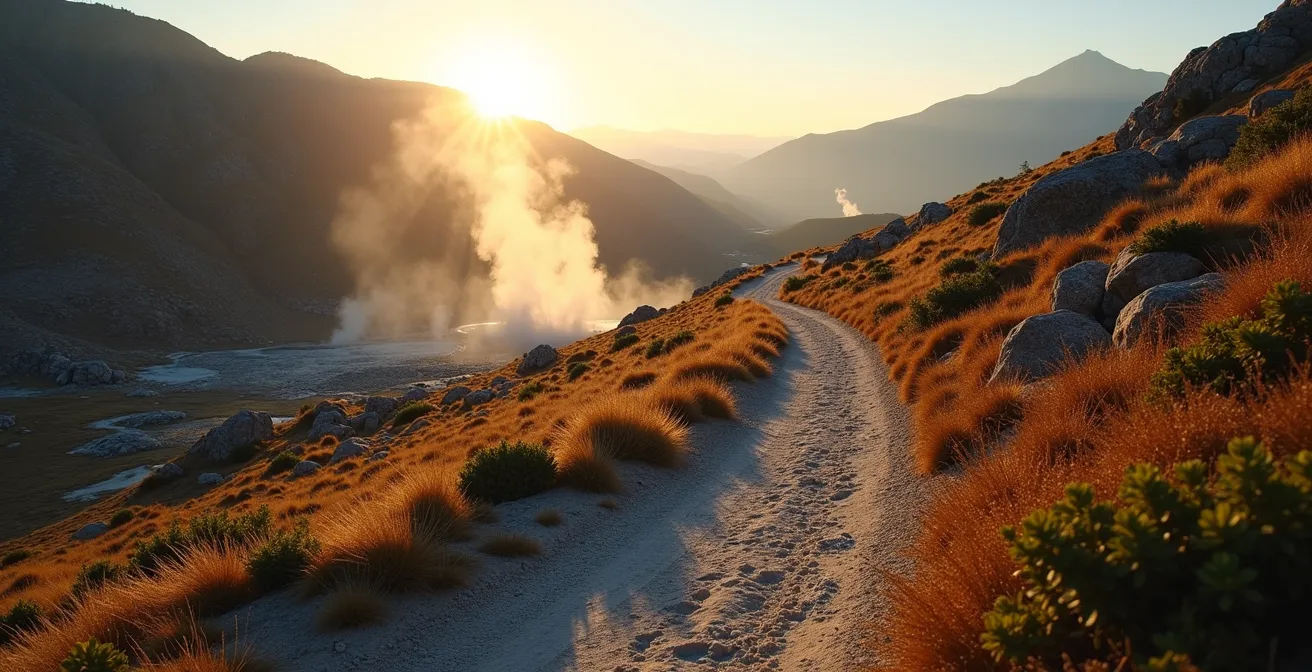
Finding these springs involves research through dedicated guidebooks, online communities, and topographical maps. It requires preparation, including carrying adequate water, navigation tools, and respecting Leave No Trace principles. The effort is rewarded not just with a solitary soak but with an integrated, holistic wellness experience where the journey and destination are one.
This approach stands in stark contrast to the instant gratification of a spa, reinforcing the idea that profound benefits sometimes require intentional effort.
The Steam Vent Mistake That Burns Tourists Every Year
The raw power that makes natural hot springs so therapeutic is also what makes them potentially dangerous. Unlike a controlled spa environment, a wild geothermal area is an active, unpredictable landscape. One of the most overlooked and serious dangers is geothermal steam. While a steamy cavern might seem like a perfect natural sauna, the temperatures can be extreme and lethal. Steam from the source spring can be trapped in underground pockets or vent through fissures in the ground at temperatures well above boiling.
The vibrant colors seen around many hot springs are evidence of this heat, as they are formed by colonies of microorganisms called thermophiles. Crucially, research on geothermal environments shows that these thermophiles survive temperatures above 212°F (100°C), a clear indicator that the water and steam at the immediate source are far too hot for human contact. Tourists unfamiliar with these environments make the mistake of approaching unstable ground near a steam vent or entering a « wild sauna » without verifying its temperature, resulting in severe burns every year. The ground itself can be a thin, fragile crust over boiling mud.
This raw power, however, has been respected and utilized for centuries. As noted by researchers at Visit Glenwood Springs, « Steam from the source spring gets trapped in the underground caverns, creating a natural steam room… The Ute Native Americans were known to use the caves for ritual cleansing and ceremonies. » This historical use underscores a vital principle: these powerful natural features are not to be trifled with but are to be approached with knowledge and profound respect. The Utes understood the system, knew where it was safe, and used it for its potent detoxifying effects. The modern visitor must adopt the same level of caution.
Unlike a spa where safety is engineered, in nature, safety is a function of your awareness and respect for the environment’s untamed power.
How to Plan Rest Days to Maximize Performance on Active Trips?
For those on active or adventurous trips—be it multi-day treks, cycling tours, or climbing excursions—a rest day is not about doing nothing. It’s about active recovery. A strategically planned visit to a hot spring can be one of the most effective recovery tools available, turning a day off into a performance-enhancing session. The benefits go far beyond simple relaxation. The combination of heat, hydrostatic pressure, and mineral content works on multiple levels to repair a tired body.
The heat and the water’s pressure work together to reduce muscle soreness and joint stiffness. But the real magic lies in the mineral absorption. Many geothermal springs are rich in magnesium, a crucial mineral for muscle function that is often depleted during strenuous exercise. As noted in research on mineral benefits, soaking in these springs is an excellent recovery method after a long hike or bike ride precisely because the skin absorbs magnesium, which helps to speed up muscle recovery and reduce cramping. This transdermal absorption can be more effective than oral supplements for some individuals.
By planning a mid-trip rest day around a hot spring soak, you are not being lazy; you are actively investing in your body’s ability to perform better in the days that follow. It helps to reduce the cumulative stress on the body and can even mitigate the risk of injury. Instead of seeing it as a separate, indulgent activity, an active traveler should view a hot spring soak as an integral part of their performance and recovery toolkit.
This re-framing of a « rest day » elevates the hot spring from a simple pleasure to a vital component of a high-performance travel itinerary.
Key Takeaways
- True mineral benefits come from raw geothermal water; its imperfections, like a sulfur smell, are often signs of potency that filtered spas remove.
- Safety is paramount in any hot water. Always respect temperature limits (max 40°C/104°F for 20 mins) and be aware of environmental dangers like unstable ground and steam vents in wild settings.
- Frame your soak as a holistic ritual, not just an activity. Planning a single, focused day around it enhances satisfaction and multiplies the therapeutic outcomes.
Why Planning Only One Activity Per Day Increases Satisfaction?
In our hyper-productive culture, travel itineraries often become a checklist of sights to see and activities to complete. This « more is more » approach can lead to exhaustion and a superficial experience. When it comes to wellness travel, particularly involving hot springs, the opposite strategy yields far greater satisfaction and deeper benefits: dedicating an entire day to a single, holistic activity. A study conducted by RMIT University found that after a bathing visit, 82% of respondents reported better sleep, a powerful indicator of deep relaxation that is difficult to achieve when rushing from one thing to the next.
Committing a full day to a « soaking ritual » allows the body and mind to fully surrender to the therapeutic process. It’s not just about the time spent in the water, but the entire arc of the day—the gentle journey there, the periods of rest between soaks, proper hydration, and a nourishing meal afterward. This unhurried approach allows the physiological effects of the soak—such as a lowered stress response and the detoxification process—to unfold completely. Rushing off to another activity immediately after a soak can jolt the nervous system and curtail these benefits.
Adopting this « one-activity » mindset transforms the experience from a simple dip into a profound restorative ritual. It honors the body’s need for time to process the intense inputs of heat and mineral absorption, leading to a more lasting sense of well-being and a significant increase in overall trip satisfaction.
Your Action Plan: The Holistic Soaking Day Protocol
- Morning: Begin the day by hydrating thoroughly with water, well before you depart for the springs.
- Midday: Engage in a gentle hike or walk to the springs, allowing your body to warm up and your mind to settle.
- Afternoon: Start with an initial soak session of no more than 15-20 minutes to acclimate your body.
- Break: Exit the water for at least a 10-minute cooling period. Use this time to rest and drink more water.
- Late Afternoon: If your body feels good, you can enter for a second, shorter 15-minute soak, followed by another rest period.
Now that you understand the science and history behind geothermal healing, the next step is to choose your experience with intention. Evaluate whether your goal is social relaxation or deep therapeutic benefit, and plan your next wellness journey accordingly.
Frequently Asked Questions About Natural Hot Springs or Luxury Spas: Which Offers Better Mineral Benefits?
What temperature should I check for before entering?
Always test the water temperature first—anything above 104°F (40°C) can be dangerous. Use a thermometer if possible, as geothermal pools can have hot spots. Start by dipping a hand or foot before committing to entering.
How do I check for harmful organisms?
Avoid soaking in springs with stagnant, murky, or foul-smelling water, as this can indicate bacterial growth. Check local health department advisories for any warnings about microorganisms like Naegleria fowleri, especially in warm freshwater locations during hot weather.
What ground conditions should I watch for?
The ground around hot springs can be extremely deceptive and dangerous. Look for areas with a thin, fragile crust over boiling mud or water. Always stick to established trails and solid ground. Test the stability of any surface before putting your full weight on it.