Contrary to popular belief, applying “slow travel” to a short vacation isn’t about doing less; it’s about a deliberate strategy to engineer deeper satisfaction and actually return rested.
- The key is replacing a packed itinerary with a single “Anchor Experience” each day, creating space for spontaneous discovery without the anxiety of an empty schedule.
- True disconnection is achieved not just by putting a phone away, but by replacing it with an “analog toolkit” (maps, notebooks) that heightens sensory engagement.
Recommendation: Start by choosing just one non-negotiable activity for each day of your next short trip and intentionally leave the hours around it unplanned.
For many overworked professionals, the promise of a five-day vacation quickly sours into a frantic race against the clock. We trade office deadlines for sightseeing checklists, convinced that squeezing in every possible museum, restaurant, and landmark is the only way to “make the most” of our precious time off. The result is a familiar paradox: we return home more exhausted than when we left, needing a vacation from our vacation. The common advice to simply “slow down” or “be spontaneous” often feels impractical, even stressful, when time is the one resource we cannot afford to waste.
The usual solutions revolve around better planning apps or more efficient packing lists. But what if the problem isn’t the efficiency of our schedule, but the very philosophy behind it? What if the key to a truly restorative short break lies not in seeing more, but in experiencing more deeply? This is the core promise of slow travel. It’s not about being lazy or missing out; it’s a strategic shift from a quantitative to a qualitative approach to travel. It’s about consciously designing a trip that prioritizes mental reset and genuine connection over a blur of photo opportunities.
This guide offers a practical framework to apply these principles, even within the tight constraints of a five-day escape. We will explore how to build a satisfying itinerary around a single daily activity, the tools to achieve a true digital detox without panic, and the science behind why a train journey can be more restorative than a quick drive. By focusing on the quality of our attention, we can transform a short trip from a source of stress into a powerful tool for burnout recovery.
To guide you through this transformative approach, this article is structured to provide actionable strategies for every aspect of your short trip. Discover how to reclaim your time, your senses, and your peace of mind.
Summary: A Practical Guide to Slowing Down a Short Trip
- Why Planning Only One Activity Per Day Increases Satisfaction?
- How to Lock Your Phone Away for 24 Hours Without Panic?
- Train Window or Car Windshield: Which View Encourages Daydreaming?
- The Restaurant Mistake That Rushes Your Digestion and Experience
- How to Start a Travel Journal That You Will Actually Write In?
- Why Does Your Brain Need 72 Hours in Nature to Fully Reset?
- Night Train or TGV: Which Is the Best Option for Long-Distance Comfort?
- How to Practice Shinrin-Yoku Without a Guide for Stress Relief?
Why Planning Only One Activity Per Day Increases Satisfaction?
The greatest enemy of a restful vacation is “decision fatigue.” The constant mental calculus of what to do next, where to eat, and how to get there depletes our cognitive resources, leaving us feeling drained and irritable. A packed itinerary, meant to maximize a trip, often ends up minimizing our enjoyment. The counter-intuitive solution is to structure your day around a single, meaningful “Anchor Experience.” This isn’t about limiting yourself; it’s about liberating your mind. By committing to just one highlight—be it a cooking class, a long museum visit, or a specific hike—you give your day a purpose without overloading it.
This approach directly aligns with a fundamental shift in traveler values, where over 72% of travelers prioritize experiences over costs or convenience. The anchor experience becomes the centerpiece of the day, an event to anticipate and savor fully. The unscheduled hours surrounding it are not empty; they are “Spontaneity Pockets.” This is where the magic happens. You might discover a hidden bookshop on the way to your museum, or decide to linger in a park after your tour. Because the day’s main goal is already secured, these spontaneous moments feel like bonuses, not distractions from a rigid schedule.
This method transforms your mindset from one of scarcity (“I have to see everything”) to one of abundance (“I get to deeply enjoy this one thing, and see what else the day brings”). It replaces the pressure of a checklist with the pleasure of discovery, ensuring that the quality of your experience—and your overall satisfaction—soars.
Your Action Plan: Designing an Anchor Experience Day
- Choose one ‘anchor experience’ as your daily main activity (e.g., museum visit, cooking class, guided tour).
- Block out a generous 3-4 hour window for this anchor, including travel time, to avoid any sense of rushing.
- Leave the morning and evening completely unscheduled, creating ‘Spontaneity Pockets’ for unplanned discoveries.
- Intentionally build in 30-minute ‘pause points’ between any transition to simply sit, observe, and breathe.
- Create a flexible ‘maybe list’ of smaller interests instead of a rigid ‘must-do list’ for low-pressure additions if time and energy permit.
How to Lock Your Phone Away for 24 Hours Without Panic?
The idea of a “digital detox” on vacation often sounds more stressful than relaxing. We rely on our phones for navigation, translation, and connection. However, this constant digital tether is precisely what prevents our brains from fully disengaging and immersing in a new environment. The key isn’t to just “put the phone away” and hope for the best, but to proactively replace its functions with an intentional, tangible “analog toolkit.” This act of preparation turns a potential source of anxiety into an empowering part of the travel experience itself.

Your toolkit should be simple and personal. Include a beautifully crafted paper map of the area, a small notebook and pen for jotting down observations or directions, and perhaps a disposable or film camera to encourage mindful photography. As this toolkit demonstrates, these are not just nostalgic objects; they are tools of engagement. A paper map forces you to understand the geography of a place, a notebook encourages you to see details worth writing down, and a camera with limited shots makes you consider each frame carefully.
Case Study: The Analog Toolkit in Action
Travel writer Gi Shieh successfully implemented 24-hour phone-free periods during her travels by creating such an ‘analog toolkit.’ During a trip to the Netherlands, this approach allowed her to connect more deeply with the local culture. Without the distraction of scrolling, she became more observant and noticed subtle customs, like the traditional 10 a.m. coffee break. This simple observation led to conversations and a more memorable experience she would have otherwise missed while looking at a screen. Her success shows that a digital detox isn’t about deprivation, but about enrichment.
Train Window or Car Windshield: Which View Encourages Daydreaming?
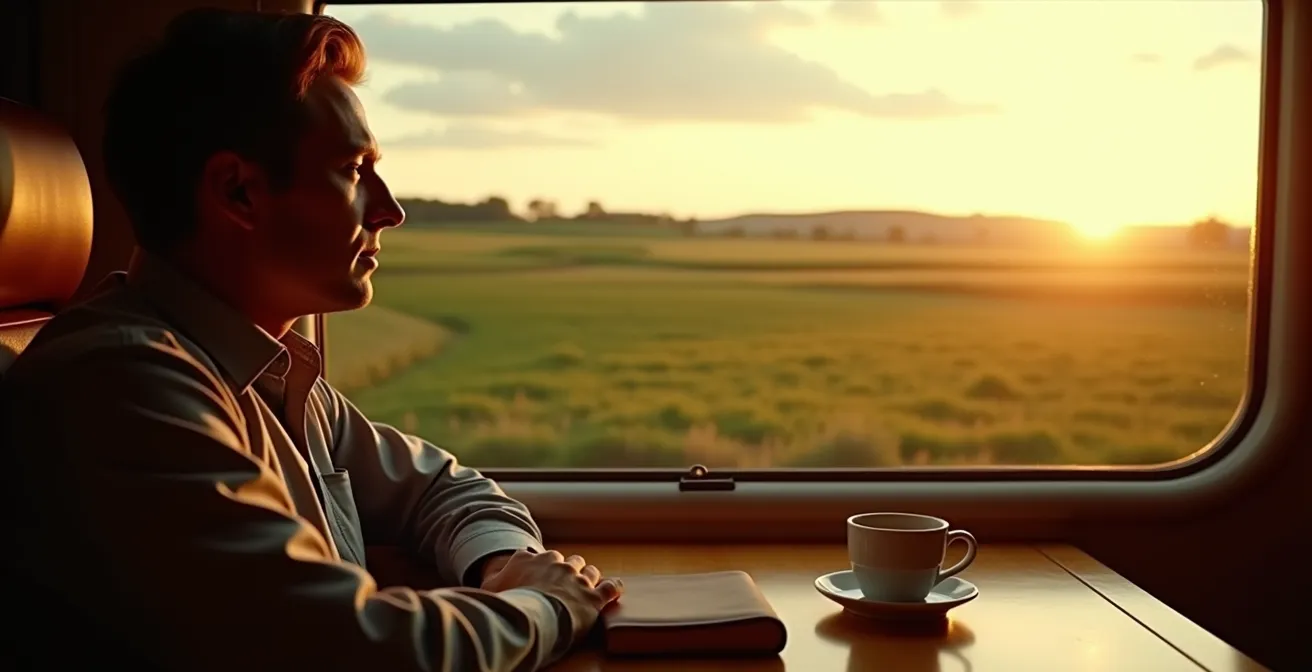
The way we travel between destinations is as much a part of the vacation as the destinations themselves. For the overworked professional, a car often feels like the default choice—it’s private, direct, and seems efficient. However, the mental state required for driving is one of constant vigilance, active decision-making, and threat scanning. Your prefrontal cortex is on high alert, which is the exact opposite of a restful state. The train, by contrast, invites a state of passive observation that neuroscientists call “soft fascination.” Watching a landscape flow by without the need to navigate or react allows the brain’s Default Mode Network (DMN) to activate. This is the network responsible for daydreaming, reflection, and creative thought—the very essence of a mental reset.
This fundamental difference in cognitive load is the core reason why train travel is superior for slow travel and mental restoration. A comparative analysis of travel modes highlights these distinct psychological impacts.
| Aspect | Train Travel | Car Travel (as Driver) |
|---|---|---|
| Mental State | Passive observation, ‘soft fascination’ | Active vigilance, threat scanning |
| Brain Activity | Default Mode Network activated (daydreaming) | Prefrontal cortex engaged (decision-making) |
| Sensory Experience | Rhythmic motion, steady sounds | Variable speed, traffic noise |
| Visual Focus | Flowing landscape, no navigation needed | Road focus, constant navigation |
| Restoration Potential | High – promotes reflection and mental rest | Low – maintains stress and alertness |
Choosing the train is not just a logistical decision; it’s a therapeutic one. The rhythmic motion, the steady sounds, and the uninterrupted visual flow create a liminal space where your mind is finally free to wander. It’s a forced pause, a period of structured idleness that is incredibly difficult to achieve in our daily lives. For a short vacation, leveraging travel time as restoration time is a powerful strategy to deepen your sense of rest.
The Restaurant Mistake That Rushes Your Digestion and Experience
One of the most common ways we rush our vacations is at the dinner table. Hungry and tired after a day of exploring, the default behavior is to order everything at once: drinks, appetizers, and mains. This seemingly efficient move instantly puts a ticking clock on the entire experience. The kitchen starts firing all orders, the courses arrive in rapid succession, and before you know it, you’re full, rushed, and being handed the bill. This common mistake turns what should be a relaxing, multi-sensory experience into a mere refueling stop, causing both digestive stress and a missed opportunity for connection.
The slow travel alternative is the “piecemeal ordering strategy.” It’s a simple but profound shift in behavior that puts you back in control of the meal’s tempo. By ordering in stages, you intentionally build pauses into the dining experience. You give yourself time to soak in the atmosphere, to truly taste your drink, to savor the appetizer without the main course looming. This deliberate pacing not only aids digestion but also transforms the meal from a transaction into an event. It creates space for conversation, observation, and genuine enjoyment of the food and company.
To master this, follow a simple, mindful sequence:
- Arrive a few minutes early and simply observe the restaurant’s atmosphere before even thinking about the menu.
- Order only your drinks first. Wait at least 10 minutes after they arrive before asking for the food menu.
- Select and order only your appetizer. Enjoy it completely before you even consider your main course.
- When each dish arrives, practice the “30-second arrival ritual”: take a moment to look at the presentation and inhale the aromas before your first bite.
- Only request the dessert menu after your main course plates have been cleared and you’ve had a moment to rest. A truly mindful meal should last a minimum of 90 minutes.
How to Start a Travel Journal That You Will Actually Write In?
The romantic idea of keeping a detailed travel journal often crashes against the reality of a busy trip. The pressure to write long, eloquent entries every night can feel like another chore, leading to an empty notebook and a sense of failure. For a short, restorative trip, the goal of journaling isn’t to create a perfect chronicle, but to deepen your sensory awareness and create memory anchors. The secret to consistent journaling is to make it a micro-habit: small, effortless, and rewarding.

Instead of aiming for a diary, aim for a “Sensory Log.” The most effective method is the five-minute journal, ideally practiced over a morning coffee or an evening tea. As this peaceful ritual suggests, the focus shifts away from recounting events and towards capturing fleeting sensory details. This small commitment is easy to maintain and has a profound impact on how you experience your day. It trains your brain to pay closer attention to the world around you, noticing the unique sound of a local bird, the specific aroma of a spice market, or the texture of a cobblestone street.
Case Study: The Five-Minute Sensory Log
Travel blogger Esther Susag transformed her journaling practice by limiting entries to just five minutes each morning. Instead of lengthy prose, she focused on creating a ‘Sensory Log,’ recording one new sound, one new smell, and one new taste she experienced each day. During a trip to Santorini, she implemented this micro-habit and successfully maintained her journal for over 33 consecutive days. This practice allowed her to capture subtle, evocative details like ‘sky-gazing through branches,’ details that a rushed, traditional approach to tourism would have completely missed. These sensory notes became more powerful memory triggers than any list of sites visited.
Why Does Your Brain Need 72 Hours in Nature to Fully Reset?
The feeling of renewal after spending time in nature is not just a placebo effect; it’s a documented neurological process known as cognitive restoration. Our brains, particularly when overworked, suffer from “directed attention fatigue.” The constant focus required by screens, schedules, and city life is draining. Natural environments, with their high “fractal density”—the complex, repeating patterns found in things like trees, coastlines, and clouds—engage our attention effortlessly. This state allows the brain’s stress response systems to downregulate and its restorative networks to take over. But how much time is truly needed for a reset, especially on a short trip?
While some research points to a 72-hour period for a full mental reset, this can seem daunting on a 5-day vacation. However, the benefits are not all-or-nothing. In fact, for a shorter trip, the most effective strategy is “front-loading” your nature exposure. According to attention restoration theory research, just 48 hours in nature can provide up to 80% of the maximum cognitive benefits for a 5-day trip. Spending the first two days of your vacation in a nature-rich setting—like a coastal town or a cabin near a forest—maximizes your mental recovery, allowing you to enjoy the rest of your trip with a clearer, more rested mind.
You can even measure this reset for yourself. A simple method is to rate your mental clarity and stress level on a scale of 1 to 10 upon arrival, and then again at the 24 and 48-hour marks. Most people report a significant positive shift between the 24 and 48-hour measurements, confirming that the restorative process is well underway. This demonstrates that even a short, concentrated dose of nature can have a profound impact on the quality of your vacation and overall well-being.
Night Train or TGV: Which Is the Best Option for Long-Distance Comfort?
The night train is a chapter in itself—a key part of the travel narrative, filled with potential for reflection and unique encounters.
– European slow travel community, The Way of Slow Travel principles guide
When covering long distances on a short trip, the immediate impulse is to choose the fastest option, like a high-speed train (TGV). The logic seems sound: less time traveling means more time at the destination. However, this calculation often overlooks the “true time cost” and the type of comfort each option provides. Slow travel philosophy invites us to reconsider this equation. The TGV offers ‘Efficiency Comfort’—it’s fast, predictable, and gets you there alert. But the journey itself is often a non-event, a blur of motion that requires you to then check into a hotel and settle in.
The night train, on the other hand, provides ‘Transitional Comfort.’ It brilliantly combines transport with accommodation, transforming travel time into a unique part of the experience. You fall asleep in one city and wake up refreshed in the center of another. This approach not only saves the cost of a hotel night but also eliminates the dead time of station transfers and hotel check-ins. It reclaims at least half a day of your precious vacation time that would otherwise be spent on logistics.
The choice between these two modes of transport is a choice between two different travel philosophies, as the following comparison illustrates.
| Factor | Night Train | TGV (High-Speed Rail) | Best For |
|---|---|---|---|
| Journey Time | 8-12 hours | 2-4 hours | TGV for efficiency |
| True Time Cost | Combines transport + accommodation | Add hotel check-in, station transfers | Night train often wins |
| Comfort Type | ‘Transitional Comfort’ – liminal space for reflection | ‘Efficiency Comfort’ – quick and predictable | Depends on travel philosophy |
| Arrival Experience | Wake up refreshed in city center | Arrive alert but need accommodation | Night train for slow travel |
| Cost Calculation | Transport + saved hotel night | Transport + full hotel cost | Night train often cheaper overall |
Key Takeaways
- True rest on a short trip comes from depth, not breadth. Prioritize one ‘Anchor Experience’ per day to eliminate decision fatigue.
- Fight digital distraction by creating a physical ‘analog toolkit’ (paper map, notebook) to replace your phone’s functions and heighten your senses.
- Choose transportation for its restorative potential; a train journey allows your mind to wander and reset, while driving keeps it on high alert.
How to Practice Shinrin-Yoku Without a Guide for Stress Relief?
Shinrin-Yoku, or “forest bathing,” is a cornerstone of restorative travel. It’s the practice of immersing yourself in nature with all your senses to reduce stress and improve well-being. While it sounds idyllic, you don’t need a vast forest or a certified guide to reap its benefits. This powerful practice can be adapted to any green space, even a single tree in a city park, making it a perfect tool for a short vacation. The goal is not to hike or exercise, but to simply connect with the natural world through a series of mindful, sensory explorations.
Testimonial: Finding Stillness in a Bustling City
An urban professional shared their experience: “After experiencing severe travel burnout from packed itineraries, I discovered Shinrin-Yoku could be practiced anywhere. During a 5-day Paris trip, I spent just 20 minutes each morning in Luxembourg Gardens focusing on one tree. This simple practice transformed my entire vacation – I felt more restored than after previous two-week trips hitting every tourist site.”
This testimony highlights the accessibility and power of a self-guided practice. It’s about shifting your focus from doing to being. By dedicating a small amount of time to this intentional observation, you create a profound sense of calm that can anchor your entire day. It’s a direct antidote to the rushed, goal-oriented mindset that many professionals carry into their time off. A simple, self-guided routine is all you need to begin.
Your Checklist: Self-Guided Forest Bathing Practice
- Find your ‘Sit Spot’: a single, comfortable location where you can sit and quietly observe for 15-20 minutes.
- Practice ‘Sense-by-Sense’ exploration: close your eyes and focus only on sounds for 5 minutes, then open them and focus only on sight, then on the sensation of touch (the breeze, the ground).
- Try ‘Urban Shinrin-Yoku’ with a single park tree: spend time observing its micro-ecosystem, from the bark texture to the insects that live on it.
- Use the ‘Sky-gazing’ technique: lie down or sit back and watch the sky and clouds through the tree branches for 10 minutes.
- End with a moment of gratitude: before leaving, take a moment to silently thank the space for providing a moment of peace.
By integrating these principles—from single-tasking your days to mindfully bathing your senses in nature—you can fundamentally change the outcome of a short vacation. The goal is no longer to return with a camera full of pictures, but with a mind that is genuinely rested and a spirit that is truly restored. Start by applying just one of these strategies to your next trip to experience the profound difference for yourself.