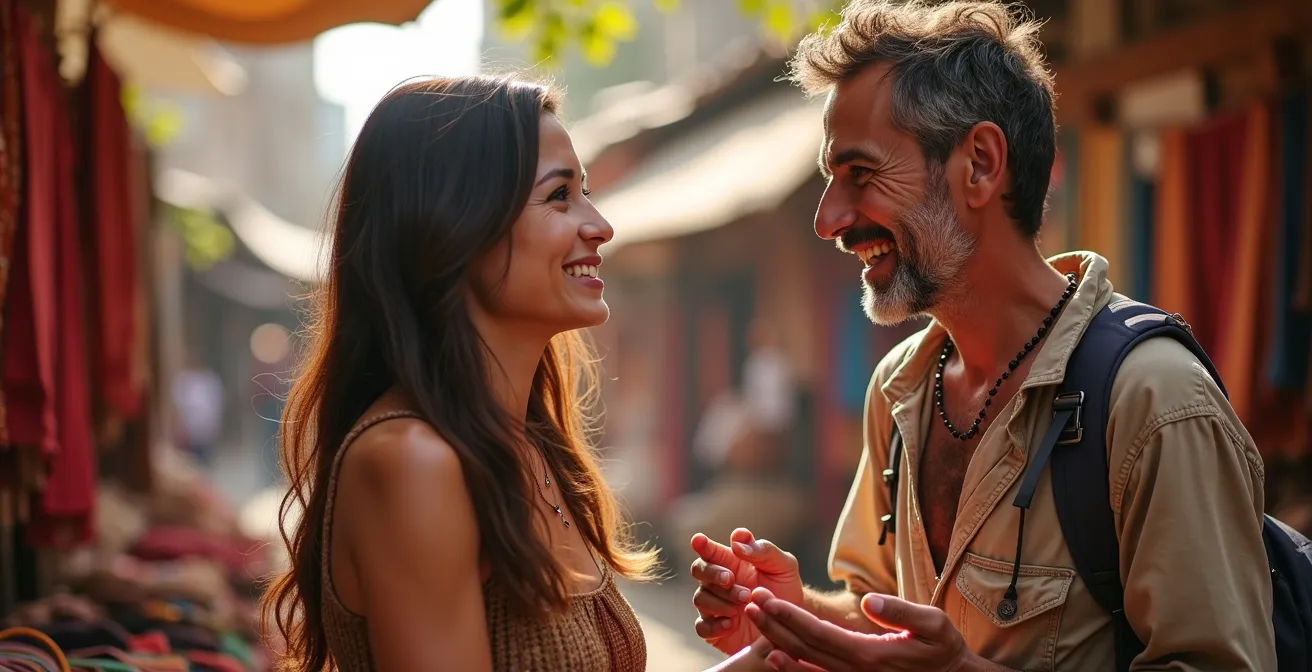
True negotiation isn’t about lowering the price; it’s about raising the value of your interaction for the entire community.
- Spending directly with a local artisan has a powerful multiplier effect, benefiting multiple families, not just one person.
- Small gestures of respect—like dressing modestly for sacred sites or learning a few key phrases—unlock more authentic and meaningful experiences than any discount could.
Recommendation: Shift your travel goal from “getting a deal” to creating a fair, memorable, and mutually beneficial value exchange.
The scene is familiar to any traveler: a vibrant market stall, overflowing with handcrafted goods, and the friendly face of the artisan who made them. You’ve found the perfect souvenir, but then comes the moment of hesitation. How much should you pay? Is it okay to negotiate? The common advice to “start at 50% and meet in the middle” often feels transactional and crude, turning a potentially beautiful human connection into a contest of wills. This approach reduces a complex cultural practice to a simple formula, ignoring the dignity of the artisan and the real-world impact of your purchase.
This feeling of unease stems from a fundamental misunderstanding. We’ve been taught to focus on the price tag, but the real currency in these interactions is respect. The most skilled travelers know that ethical travel isn’t just about what you buy, but how you behave in every moment. Your impact, or community footprint, is defined by a whole ecosystem of choices, from your accommodation to your photography habits.
But what if the key to respectful negotiation wasn’t about the bargaining itself, but about everything you do *before* you even ask for the price? This guide proposes a new perspective: true value exchange begins with demonstrating respect for the person, their culture, and their environment. By practicing economic empathy and cultural awareness, you not only ensure a fair transaction but also open the door to far richer, more authentic travel experiences.
This article will explore how your actions—from picking up litter to learning a simple greeting—build a foundation of trust that transforms you from a mere tourist into a welcomed guest. We will delve into the powerful economic impact of your spending choices and uncover the unwritten rules of respect that govern everything from sacred sites to personal photography, ultimately showing you how to ensure your vacation budget becomes a genuine force for good.
Summary: A Guide to Respectful Interaction and Fair Negotiation
- Why Picking Up Other People’s Trash Changes Your Travel Experience?
- How to Dress for Sacred Sites to Show Genuine Respect?
- Homestays or Chain Hotels: Which Truly Benefits the Local Community?
- The Photography Habit That Violates Privacy Laws in Many Countries
- Which 5 Phrases in the Local Language Open Doors to Authentic Interactions?
- Why Does spending 100€ at a Local Artisan Worth 300€ for the Community?
- Why Must You Ask the Elder Before Entering Sacred Land?
- How to Ensure Your Vacation Budget Directly Benefits Local Villages?
Why Picking Up Other People’s Trash Changes Your Travel Experience?
Respectful interaction begins long before you open your wallet. It starts with demonstrating that you value the space you are visiting as much as its residents do. One of the most powerful and unexpected ways to do this is through a simple act of service: picking up litter. This practice of participatory preservation sends a clear, non-verbal message that you are not just a passive consumer of scenery but an active participant in the well-being of the community. When locals see a visitor caring for their environment, it breaks down the “us vs. them” barrier that can so often define tourist-local dynamics.
This simple act can fundamentally alter how you are perceived. Instead of being seen as just another person who comes to take photos and leave, you are seen as a guest who contributes. This builds a foundation of goodwill that money cannot buy. The “Broken Windows Effect” suggests that visible signs of care and order create an environment where positive behavior is encouraged. In a travel context, when merchants and residents perceive care and respect from visitors, they often respond with warmer welcomes, more authentic interactions, and a greater willingness to engage genuinely.
Starting is easy. Carry a small, reusable bag and pick up a few pieces of trash during your walks near popular sites or along a beach. This isn’t about a grand, performative cleanup; it’s about a consistent, quiet gesture of respect. You’ll not only leave a place better than you found it but also find that doors open to conversations and experiences that are typically reserved for trusted friends, not anonymous tourists. Your community footprint becomes one of positive contribution, not just consumption.
How to Dress for Sacred Sites to Show Genuine Respect?
Your choice of clothing is a powerful form of non-verbal communication, and nowhere is this more critical than when visiting sacred sites. Dressing appropriately is not merely about following rules; it’s a profound act of respect for the beliefs and practices of the local community. It signals that you see the site not as a tourist attraction, but as a living place of worship and contemplation. The goal is to blend in, to become an unobtrusive presence rather than a distraction. As Dr. Sarah Chen notes in the Journal of Religious Tourism Studies, “The goal isn’t just modesty but to avoid distracting others from prayer or contemplation – your clothing becomes an act of service to the worshippers around you.”
This principle of cultural consent means understanding and adopting local norms of modesty. Generally, this involves covering shoulders, knees, and cleavage. For men, this may also mean removing hats. For women entering mosques, covering their hair is a key sign of respect. It’s wise to carry a lightweight scarf or sarong in your daypack; it’s a versatile tool for covering up when needed. Beyond coverage, color and fabric can also carry significance. While not always strict, opting for subdued, natural tones helps maintain a contemplative atmosphere.
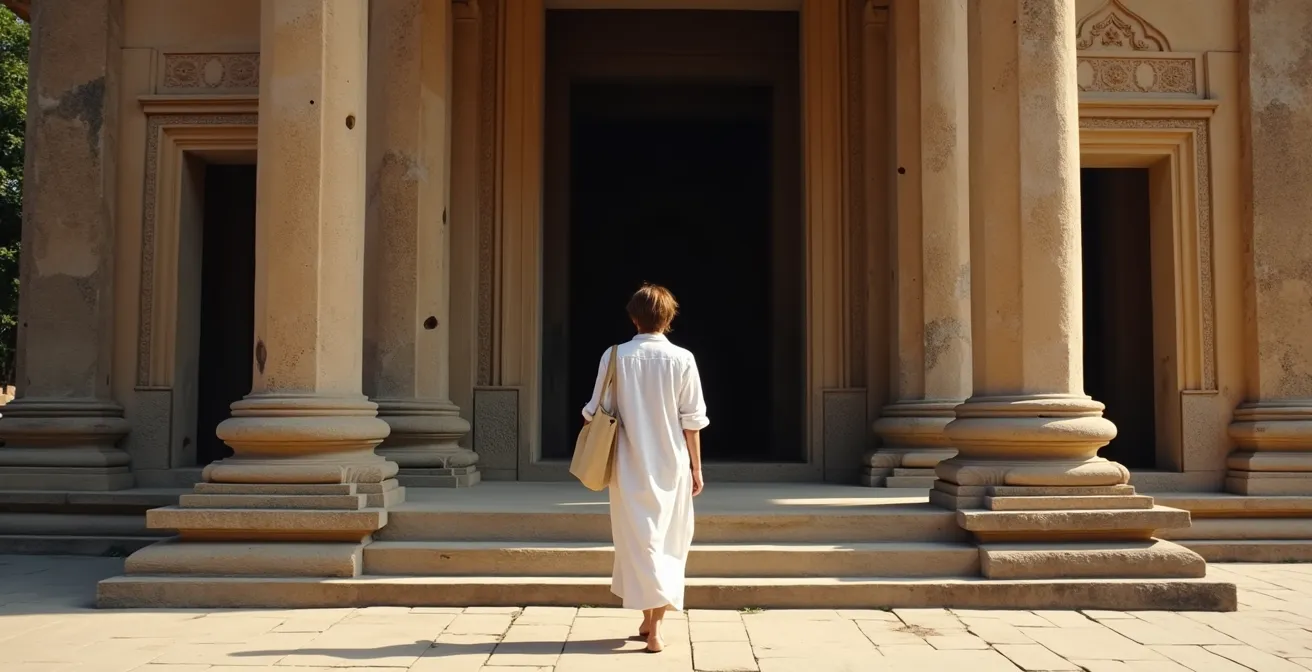
As the image above illustrates, appropriate attire is about humility and mindfulness. By dressing thoughtfully, you honor the sanctity of the space and the devotion of its people. This simple gesture of economic empathy—investing a small effort to understand and conform—pays huge dividends in the form of warmer welcomes and a deeper, more meaningful connection to the places you visit.
The table below offers a general guide, but always research the specific requirements for the temple, mosque, or church you plan to visit, as customs can vary significantly even within the same region.
| Religion/Site Type | Color Significance | Fabric Recommendations | Key Restrictions |
|---|---|---|---|
| Buddhist Temples | White for mourning, avoid bright red | Natural cotton, linen | No leather, cover shoulders/knees |
| Islamic Mosques | Green honored, modest tones | Loose, non-transparent fabrics | Women cover hair, all cover limbs |
| Hindu Temples | Saffron/orange sacred, black avoided | Cotton, silk preferred | Remove shoes, modest coverage |
| Christian Churches | No strict rules, subdued preferred | Any modest fabric | Shoulders covered, hats removed (men) |
Homestays or Chain Hotels: Which Truly Benefits the Local Community?
One of the most significant decisions you make as a traveler is where you sleep. This choice has a profound and direct impact on the local economy. While a global hotel chain might offer familiar comforts, a staggering portion of the money you spend “leaks” out of the community, flowing back to foreign headquarters and international supply chains. In contrast, choosing locally-owned accommodation, such as a guesthouse or a homestay, ensures your money stays where it’s spent, creating a powerful ripple effect.
This is known as the tourism multiplier effect. It’s a core concept in economic empathy, where every dollar spent locally circulates through the community, supporting a web of interconnected businesses. A homestay owner buys produce from the local farmer, who then pays the local schoolteacher, who in turn buys crafts from a local artisan. According to World Bank analysis, every tourist dollar spent locally can generate up to two and a half times its original value for the community. When you stay in a chain hotel that imports its food and is owned by a foreign corporation, this entire virtuous cycle is broken.
Choosing a homestay is about more than just economics; it’s a vote for cultural preservation. It provides a family with a dignified livelihood that is directly tied to sharing their culture, rather than forcing them to seek work in industries that may erode it. This choice transforms your stay from a simple transaction into a genuine value exchange. You receive an unparalleled authentic experience and a deep connection to the place, while the family receives the direct financial benefit of your presence, empowering them to thrive and preserve their way of life.
The Photography Habit That Violates Privacy Laws in Many Countries
In the age of Instagram, it’s tempting to view the world through a lens, capturing “authentic” moments to share. However, a common travel photography habit—taking photos of people without their explicit permission—is not just ethically questionable, it’s illegal in many parts of the world. Treating people as part of the scenery, like an interesting backdrop or “local color,” objectifies them and strips them of their dignity and right to privacy. This is a critical failure of cultural consent.
In many European countries like France and Germany, the “droit à l’image” or “right to one’s own image” is strictly enforced. This means you can be legally challenged for publishing a photograph of an identifiable person without their consent, even if they were in a public space. Beyond the law, the ethical implications are universal. Photographing an elderly vendor or a playing child without engaging with them first reduces a human being to an aesthetic object. It’s a form of taking, not sharing.
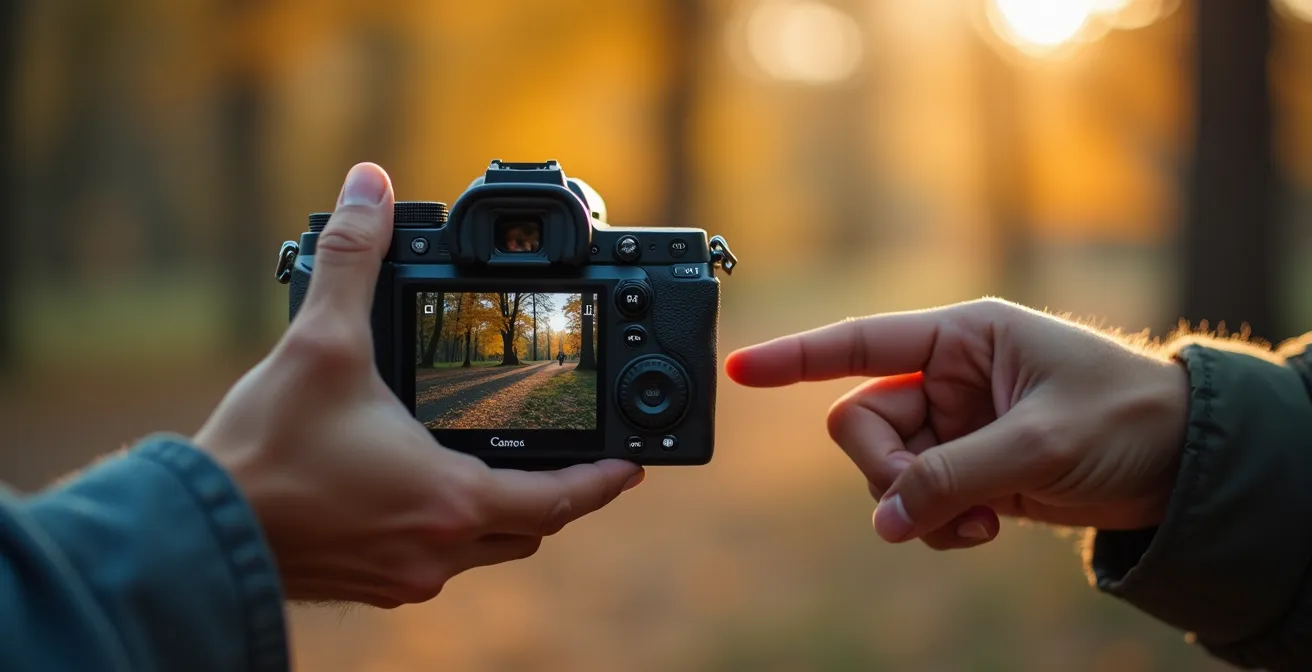
A more respectful approach is to prioritize connection over content. Engage in a genuine conversation first. Buy a small item, ask a question, or simply share a smile. If a photo feels appropriate after a connection has been made, ask for permission. A simple gesture towards your camera and a questioning look is often a universal language. Better yet, as shown in the image, show them the photo on your camera screen afterward. This simple act transforms the interaction from a theft into a shared, collaborative moment. The goal is to create a memory with a person, where the photograph is a souvenir of that connection, not the primary objective.
Which 5 Phrases in the Local Language Open Doors to Authentic Interactions?
Learning a few words in the local language is standard travel advice, but its impact is often underestimated. The most effective phrases go far beyond “hello” and “thank you.” They are tools of economic empathy that show vulnerability, express genuine appreciation, and demonstrate a curiosity that transcends a simple transaction. Making even a feeble attempt to speak the local language signals that you see the person in front of you as a cultural peer, not just a vendor. This effort, however clumsy, is a powerful bridge-builder.
Research and traveler experience show that locals are far more inclined to be warm, patient, and even offer a better price to someone who makes an effort. It’s not about fluency; it’s about the gesture. The most powerful phrases are those that build a human connection. Instead of just asking “How much?”, you can open a conversation that builds a relationship first. The right phrase can turn a transactional moment into a memorable value exchange of stories and smiles.
Consider the psychological impact of different types of phrases. Moving beyond basic greetings to express admiration for craftsmanship or curiosity about cultural meaning shows you value the person and their heritage, not just their products. This shift in focus is the key to unlocking truly authentic interactions.
This table illustrates the power of connection-building phrases:
| Phrase Category | Example (English Translation) | Psychological Impact | Typical Response |
|---|---|---|---|
| Deep Appreciation | ‘You made this? It’s beautiful!’ | Validates skill and effort | Stories about craft, family tradition |
| Self-Deprecating Vulnerability | ‘My pronunciation is terrible, sorry!’ | Disarms tension, invites teaching | Laughter, corrections, patience |
| Cultural Curiosity | ‘What does this pattern mean?’ | Shows respect for meaning beyond aesthetics | Cultural stories, deeper connection |
| Personal Connection | ‘My grandmother made similar things’ | Creates universal human bond | Sharing of family stories, warmth |
| Future Commitment | ‘I will tell others about your work’ | Shows long-term respect | Trust, better prices, contact exchange |
Why Does spending 100€ at a Local Artisan Worth 300€ for the Community?
When you buy a souvenir from a mass-produced gift shop, most of your money vanishes from the local economy. It pays for international shipping, foreign manufacturing, and corporate overhead. However, when you spend that same 100€ directly with a local artisan, you trigger a powerful economic chain reaction known as the tourism multiplier effect. This isn’t just a feel-good concept; it’s a measurable economic phenomenon that is the cornerstone of sustainable travel.
Your 100€ doesn’t stop with the artisan. She might use it to buy leather from the local tanner, who in turn buys lunch from a neighborhood café, whose owner then pays school fees for his children. According to economic multiplier research, each tourist dollar can circulate 2.5 to 3 times within a community before it “leaks” out. That means your 100€ purchase can generate up to 300€ in real economic value for the village. This is economic empathy in action: understanding that your spending is not a single transaction but an investment in an entire ecosystem.
This effect is especially powerful in fair trade artisan cooperatives. As studies in communities from Mexico to Colombia show, these organizations don’t just provide individual income; they foster collective growth. Profits are often reinvested into community-wide projects like childcare, skills training, or education initiatives. By paying a fair price, you are directly funding the preservation of time-honored cultural techniques, allowing artisans to pass their skills down to the next generation instead of abandoning their craft for low-wage factory work. Your purchase becomes a vote for cultural continuity and community resilience.
Why Must You Ask the Elder Before Entering Sacred Land?
For many travelers, an unmarked trail or a stunning natural landscape appears to be an open invitation. However, in countless indigenous cultures around the world, land is not a commodity to be owned or a park to be explored at will. It is a living, sentient entity, stewarded by the community for generations. The ultimate act of cultural consent is recognizing that your right to access this land is not a given; it is a privilege that must be requested.
The community Elder is often the gatekeeper of this stewardship. Approaching an Elder to ask for permission is not a mere formality. As indigenous rights expert Dr. Maria Gonzalez explains, “Asking isn’t about getting a yes/no, but about acknowledging their authority and the land’s sentient nature.” It is a profound gesture of respect that honors an entirely different worldview, one where humanity is not separate from nature but is an integrated part of it. This act communicates that you are not there to conquer or consume, but to learn and listen.
The protocol for such a request requires humility and preparation. It involves researching the specific customs of the nation whose land you wish to visit, identifying the recognized cultural liaison, and often bringing a small, respectful offering. Your intention should be stated clearly and humbly. It is crucial to accept any answer with grace. A “no” is a complete and valid response that requires no further justification. It is a sovereign decision to protect a sacred space from outside influence. By honoring this process, you participate in a deep value exchange, trading your entitlement for a lesson in humility and a deeper understanding of the culture.
Key Takeaways
- True respect is a 360-degree practice, demonstrated through your actions, attire, and spending long before any negotiation begins.
- Your money has a multiplier effect. Spending directly with locally-owned businesses can triple its value for the community.
- Prioritize connection over content. Authentic interactions, built on genuine curiosity and respect for privacy, are more valuable than any photo.
How to Ensure Your Vacation Budget Directly Benefits Local Villages?
You’ve chosen a homestay, dressed respectfully, and learned a few key phrases. Now, how do you apply this mindset of economic empathy to your entire vacation budget? The key is to consciously shorten the supply chain, ensuring your money flows as directly as possible to the people who create the value. This means actively seeking out and prioritizing family-run restaurants, independent tour guides, and artisans who sell their own work.
Research on tourism’s economic impact shows that when hotels and tour operators deliberately source from local farms and artisans, they can strengthen the entire community’s economic linkages by 40-60%. As a traveler, you can be the catalyst for this by asking questions. Ask your hotel where they source their food. Ask a shopkeeper if she made the items herself. These questions signal a demand for local, authentic goods and services, encouraging businesses to invest in their own communities rather than relying on imported products.
One practical method is the “Rule of Three Touches,” a mindset for minimizing the number of intermediaries between the producer and you. For a meal, this means seeking out restaurants that buy directly from farmers. For a souvenir, it means buying directly from the artisan’s workshop rather than a third-party reseller. Using cash can also be a strategic choice, as electronic payments often involve transaction fees that divert a percentage of the money to external processors, while cash stays 100% local. By making these conscious choices, you transform your budget from a simple expense sheet into a powerful tool for sustainable development and cultural preservation.
Your 5-Step Audit to Maximize Local Impact
- Points of contact: List all your daily spending channels: accommodation, food (restaurants, markets), souvenirs, tours, and local transport.
- Collecte: For a typical day, inventory exactly who received your money. Was it a global hotel chain, a local family-run guesthouse, a foreign-owned tour company, or an independent guide?
- Cohérence: Compare your spending inventory against your stated goal of supporting locals. Does your pattern of convenience-driven choices align with your values of creating a positive community footprint?
- Mémorabilité/émotion: Review the transactions. Which were most memorable? The rushed coffee from a global chain, or the tea shared with a shopkeeper while discussing her craft? Identify the link between direct spending and emotional reward.
- Plan d’intégration: Choose one spending category (e.g., your daily lunch or souvenirs) and commit to shifting 100% of that spending toward direct, locally-owned businesses for the remainder of your trip.
Ultimately, becoming a respectful traveler is a shift in mindset—from being a consumer of experiences to a participant in a living culture. By applying these principles, you ensure that your journey is not only memorable for you, but also genuinely beneficial for the communities that so graciously host you. The next step is to put this knowledge into practice on your very next trip.
Frequently Asked Questions About Respectful Travel
What is ‘droit à l’image’ and where does it apply?
The ‘right to one’s own image’ is a strict privacy law in France, Germany, Spain, and many other EU countries. It means you cannot photograph identifiable individuals without their consent, even in public spaces, and you especially cannot publish or share these images online or commercially without permission.
How does ‘environmental portraiture without consent’ violate ethics?
Treating people as scenic elements (like photographing an elderly vendor as ‘local color’ for your travel blog) objectifies them and removes their agency and dignity. This is legally problematic in many countries and is widely considered ethically questionable as it prioritizes the photographer’s desire for an image over the subject’s right to privacy and respect.
What is the ‘photo-for-a-story’ exchange approach?
Instead of engaging in transactional photo-taking, this approach prioritizes human connection first. You engage in a genuine conversation, learn about the person, share something about yourself, and only if a photo feels like a natural and mutually agreed-upon conclusion to the interaction does it happen. The photo then becomes a memento of a connection, not a stolen moment.