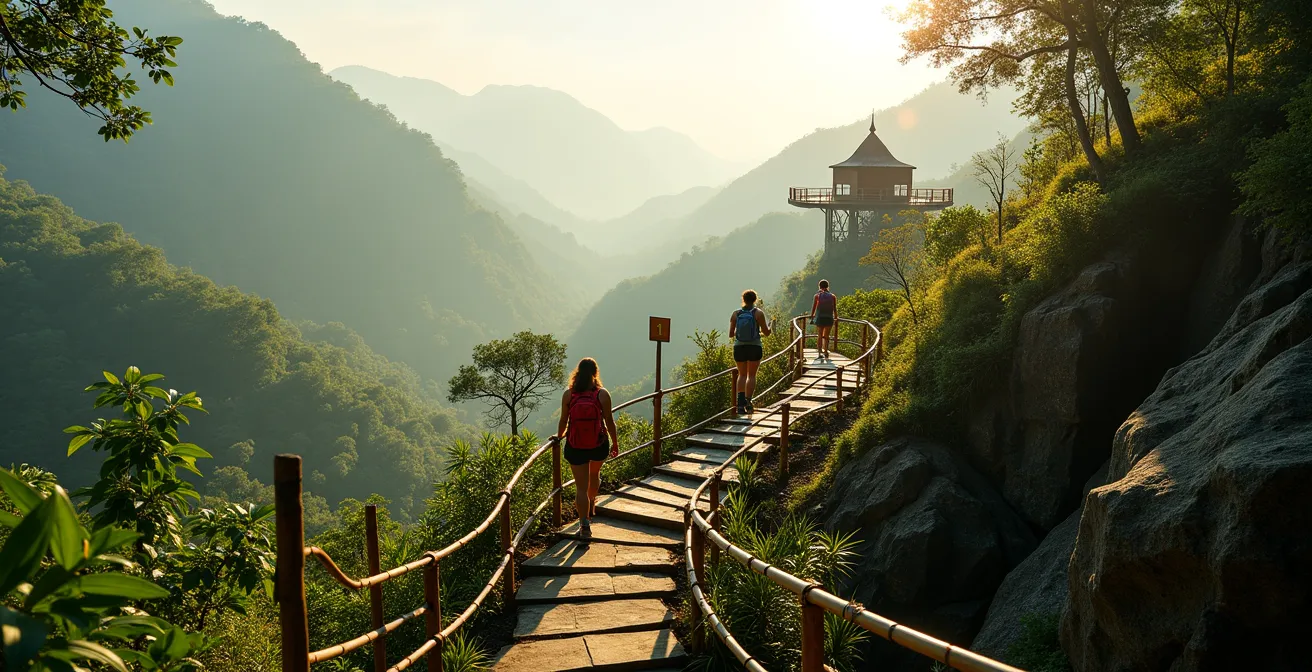
Choosing the right eco-adventure isn’t about how fit you are at the gym, but about understanding the hidden ‘environmental taxes’ a destination will levy on your body.
- Factors like tropical heat, disease risk, and complex logistics can double the physical demand of a trip.
- Verifying ‘accessibility’ claims and preparing for psychological stress are as crucial as physical training.
Recommendation: Shift your focus from “Am I fit enough?” to “What are the specific physical challenges of this environment, and how can I prepare for them?”
The image is vivid: a remote eco-lodge nestled in a lush jungle, the sound of exotic birds, and the promise of adventure. For many, this dream is quickly followed by a nagging question: “Am I physically fit enough for this?” The fear of holding the group back, of not being able to keep up on a steep trail, or simply being exhausted by the journey is a powerful deterrent. We’re often told to “be honest about our fitness” or “read reviews,” but this advice misses the most critical point. It assumes fitness is a static number that can be measured on a treadmill and applied anywhere in the world.
The reality is far more nuanced. A person who can easily hike 10 miles in a temperate climate might struggle with just two in the tropics. The true difficulty of an eco-destination isn’t just about elevation or distance; it’s defined by a series of hidden “environmental taxes” on your body and mind. These are the non-obvious challenges like extreme heat and humidity, logistical hurdles to simply get there, and the psychological load of navigating a completely unfamiliar culture.
But this isn’t a reason to give up on your dream. It’s a call to become a smarter traveler. Instead of vaguely wondering if you’re “in shape,” what if you could learn to identify and prepare for these specific environmental challenges? This guide moves beyond generic fitness advice. It provides a realistic framework for evaluating a destination based on the factors that truly impact your physical and mental stamina, empowering you to choose an adventure that is not just breathtaking, but genuinely right for you.
This article will break down the key environmental and logistical factors you must consider. From the real difficulty of tropical hiking to verifying accessibility and managing health risks, you’ll gain the tools to make an informed and confident decision for your next eco-journey.
Summary: A Realistic Guide to Matching Your Fitness with an Eco-Destination
- Why Is Hiking in the Tropics Twice as Hard as in Temperate Zones?
- How to Verify if an Eco-Lodge Is Truly Accessible for Seniors?
- Yellow Fever or Malaria: Which Risk Should Dictate Your Destination Choice?
- The “Getting There” Cost That Doubles Your Eco-Trip Budget
- How to Prepare Psychologically for Culture Shock in Remote Villages?
- Why Does Exercise in Nature Burn More Stress Than the Gym?
- How to Walk on Suspension Bridges If You Have Vertigo?
- When to Visit Monteverde to See Quetzals Without the Crowds?
Why Is Hiking in the Tropics Twice as Hard as in Temperate Zones?
The first and most significant “environmental tax” on your body is the combination of high heat and humidity. A five-mile hike in the cool, dry air of the Rocky Mountains is a completely different physical experience from a five-mile hike in the Costa Rican rainforest. This isn’t just a feeling; it’s a physiological reality. Your body has to work exponentially harder to cool itself through sweating, a process that is far less efficient when the air is already saturated with moisture. This leads to a faster heart rate, increased fluid loss, and a greater risk of heat exhaustion, making even moderate activity feel intensely strenuous.
This is what we call an “effort multiplier.” The environment itself amplifies the physical demand of the activity. A trail’s difficulty can’t be judged by its length and elevation profile alone. Factors like dense canopy cover (which traps humidity), muddy and slippery terrain (which engages more stabilizer muscles), and constant exposure to the sun all contribute to this multiplier. For travelers who are not accustomed to these conditions, underestimating this effect is the most common mistake, leading to exhaustion and a less enjoyable experience.
The key to managing this is not necessarily to become a super-athlete, but to acclimate intelligently. Giving your body time to adapt to the climate before undertaking major physical challenges is critical. Arriving a few days early and engaging in light activity can make a world of difference, allowing your body to adjust its cooling mechanisms and hydration needs. This proactive approach transforms the challenge from an overwhelming barrier into a manageable variable.
By respecting the power of the tropical environment and preparing for it, you shift from being a victim of the climate to an informed participant in it.
How to Verify if an Eco-Lodge Is Truly Accessible for Seniors?
Eco-lodges often market themselves with beautiful photos of serene pathways and rustic-chic cabins. However, there’s a common trap for travelers with mobility concerns: the “accessibility illusion.” A lodge might be labeled “accessible,” but this can mean anything from having a single ramp to being truly navigable. The term often doesn’t account for the steep, uneven dirt paths between the main building and the rooms, poor lighting after dark, or bathrooms that lack essential grab bars. For seniors or anyone with limited fitness, these details aren’t minor inconveniences; they are deal-breakers.
This is where you must become a detective. Do not take marketing materials at face value. The key is to move beyond vague assurances and ask for specific, verifiable evidence. Your goal is to understand the real-world physical effort required to exist in that space. This means asking for exact distances, photos of specific features, and even video walkthroughs. A truly accessible and confident operator will have no problem providing this information. Hesitation or generic answers should be considered a major red flag.
The image below shows an example of thoughtful design: a wide, well-lit boardwalk with sturdy handrails. This is the kind of feature you should be looking for—one that prioritizes safety and comfort over purely rustic aesthetics. It demonstrates a genuine commitment to accessibility, not just a marketing-friendly label.
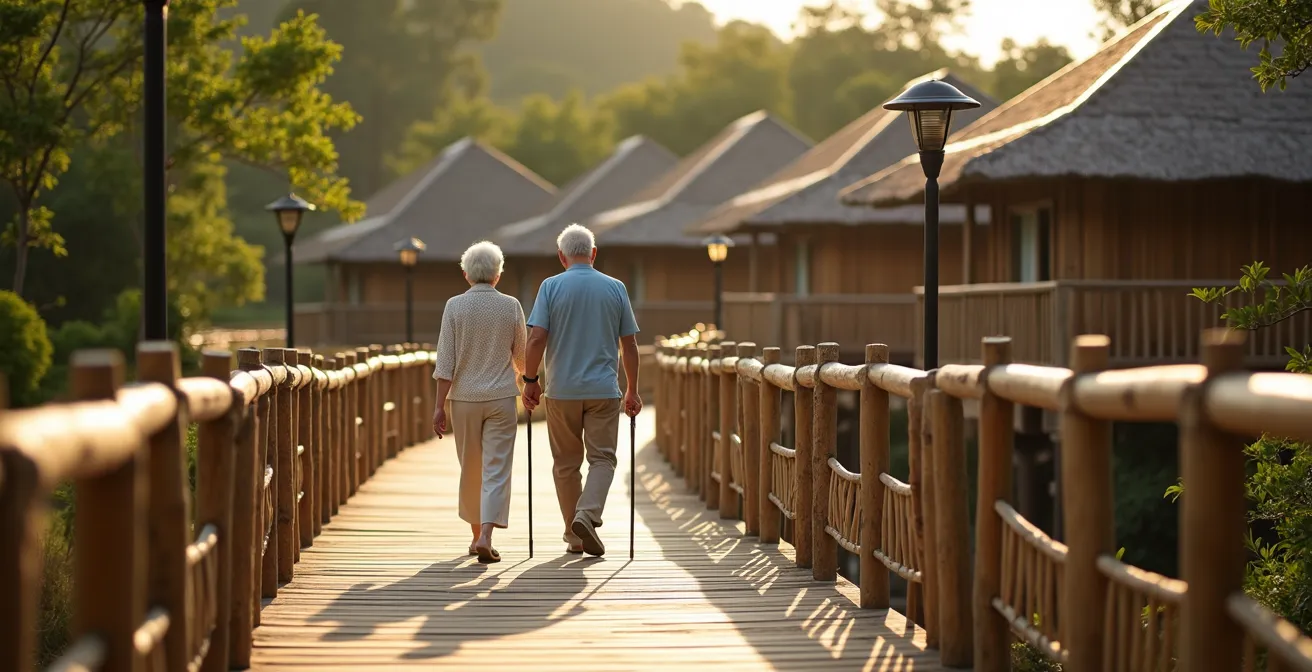
As you can see, features like continuous handrails, a non-slip surface, and gentle slopes are critical. They remove the physical and mental stress of simply getting from your room to dinner, freeing up your energy for the actual adventures you came for. The following checklist provides a concrete action plan for your virtual site inspection.
Your Action Plan: Virtual Site Inspection Checklist for Senior-Friendly Eco-Lodges
- Request unedited photos of bathroom facilities showing grab bars, walk-in shower dimensions, and toilet height.
- Ask for exact distance measurements and elevation changes between your accommodation and main facilities (dining hall, reception).
- Verify the availability of ground-floor rooms or elevator access, and crucially, ask about their backup power systems.
- Confirm the presence of adequate lighting along all pathways for nighttime navigation and inquire about mobility aid rentals (walkers, wheelchairs).
- Request a simple video walkthrough, filmed on a smartphone, showing the route from the main arrival area to the guest rooms.
By taking these proactive steps, you dismantle the “accessibility illusion” and ensure your chosen sanctuary is a place of rest, not a daily obstacle course.
Yellow Fever or Malaria: Which Risk Should Dictate Your Destination Choice?
Beyond physical terrain, another critical “environmental tax” is health risk. For many of the world’s most stunning eco-destinations, this means confronting the reality of mosquito-borne diseases like Yellow Fever and Malaria. This isn’t a topic to be feared, but one to be managed with clear-eyed strategy. The choice isn’t necessarily about avoiding all risk, but about creating a risk-adjusted itinerary. This means understanding the specific threats in a region and evaluating which prevention method best suits your body and travel style.
Yellow Fever and Malaria are often discussed together, but they present very different challenges. Yellow Fever risk is geographically concentrated and can be almost entirely neutralized with a single, highly effective vaccine that provides lifetime immunity. Malaria, on the other hand, is more widespread. In fact, recent sustainable travel data indicates that over 45% of eco-lodges in tropical regions are in malaria-endemic areas. Prevention involves a course of prophylactic medication, which can have side effects and must be taken consistently throughout your trip.
For a traveler concerned about their physical well-being, this is a crucial distinction. Are you more comfortable with a one-time vaccine, or with a daily medication regimen that might cause gastrointestinal issues? Does the thought of potential side effects from antimalarials add a layer of stress that could detract from your trip? Answering these questions helps you filter destinations. A region with a known Yellow Fever risk but no Malaria might be a simpler choice for someone who reacts poorly to medication. The following table breaks down the key differences to help guide your decision.
| Factor | Yellow Fever | Malaria |
|---|---|---|
| Prevention Effectiveness | 95% with single vaccine | 70-90% with prophylaxis |
| Side Effects | Minimal (10% mild symptoms) | Common (30-60% GI issues) |
| Duration of Protection | Lifetime immunity | Only during medication |
| Geographic Risk | Limited to specific regions | Widespread in tropics |
| Seasonal Variation | Year-round stable | Peaks in rainy season |
Ultimately, consulting with a travel medicine specialist is non-negotiable, but going into that conversation with a clear understanding of your own preferences and these factors allows you to be an active partner in planning a safe and healthy adventure.
The “Getting There” Cost That Doubles Your Eco-Trip Budget
The journey to a remote eco-destination is often part of its allure, but it imposes a significant tax on both your budget and your body. The “getting there” cost isn’t just financial; it’s a physical and logistical undertaking that can be as demanding as the hikes you plan to take. The stunning, isolated lodge you see in photos is isolated for a reason. Reaching it often involves a multi-stage relay of transportation: an international flight, followed by a smaller domestic propeller plane, then a bumpy 4×4 ride on unpaved roads, and perhaps even a final transfer by boat.
Each of these stages adds a layer of physical stress: jet lag, motion sickness, the strain of carrying luggage across uneven ground, and simple exhaustion from long travel days. Forgetting to factor this logistical effort into your overall fitness assessment is a critical error. You might arrive at your “relaxing” retreat already physically depleted before your adventure has even begun. This journey is visually represented in the montage below, showing the progression from a large commercial plane to boots on a jungle trail.
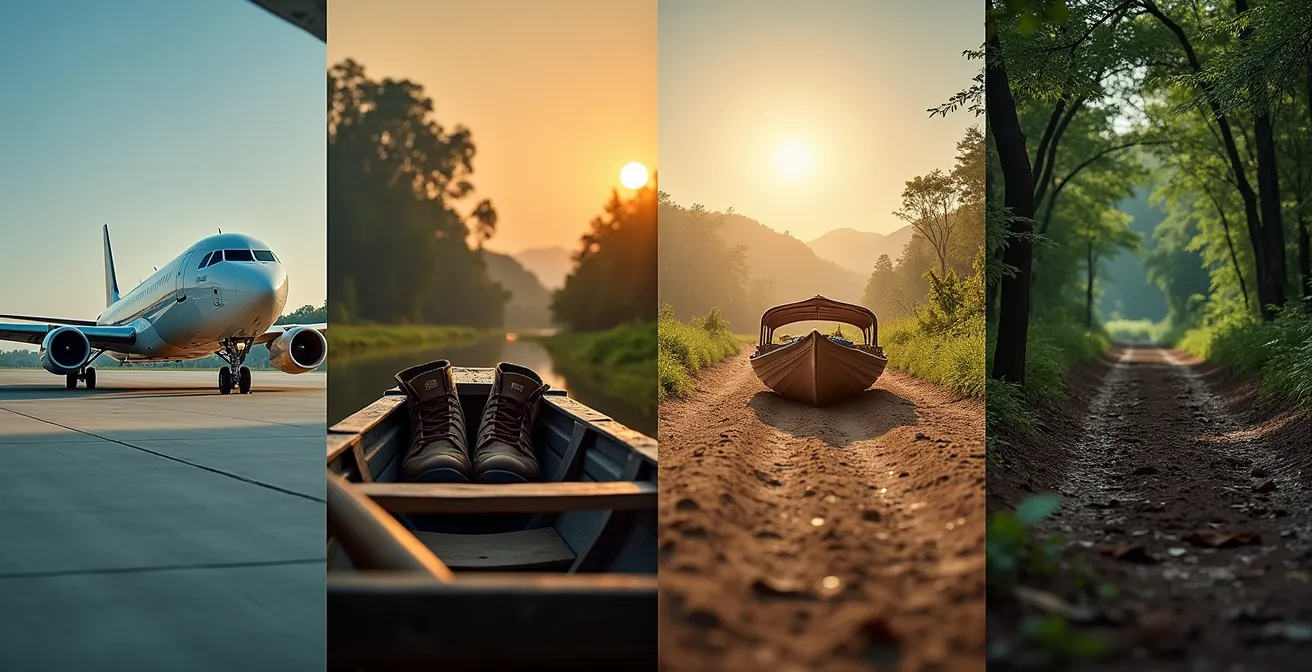
This visual journey underscores the need to budget your energy, not just your money. A real-world example from Central America brings this into sharp focus.
Case Study: The True Cost of Reaching Corcovado, Costa Rica
An analysis of eco-tourism in Costa Rica revealed a stark reality. To reach the remote lodges near Corcovado National Park, a biodiversity hotspot, travelers must anticipate that transport costs will add 35-45% to their base accommodation budget. A typical journey involves an international flight, a domestic flight to a small airstrip like Drake Bay (around $150), a subsequent boat transfer ($50), and often a final 4×4 transport to the lodge itself ($80). This can easily add over $600 in transport costs alone, but it also represents a full day of physically demanding travel before you even check in.
The solution is to plan for decompression. Build an extra, “do-nothing” day into the beginning of your itinerary specifically to recover from the journey. This small buffer can be the difference between starting your trip exhausted and starting it refreshed and ready for adventure.
How to Prepare Psychologically for Culture Shock in Remote Villages?
The final, and perhaps most underestimated, environmental tax is the psychological load. Traveling to remote regions means stepping far outside your comfort zone, not just geographically but culturally. The absence of familiar amenities, different standards of hygiene, language barriers, and new social customs can be mentally taxing. This “culture shock” isn’t just a quaint travel term; it’s a state of mental fatigue that directly depletes your physical energy reserves. When your brain is working overtime to process a new environment, it leaves less energy for physical activities like hiking or exploring.
Many travelers focus exclusively on physical training before a trip, running on treadmills or lifting weights, while completely neglecting to train their minds. Preparing your psyche for the challenges of a remote environment is just as important. The goal is not to eliminate discomfort but to expand your tolerance for it. By practicing being in unfamiliar situations before you leave, you build mental resilience and reduce the shock when you arrive. This can be as simple as intentionally getting lost in your own city or spending a day without your smartphone.
This pre-trip “comfort zone stretching” builds the mental muscles you’ll need on the ground. It turns potential sources of stress into manageable novelties. Rather than being overwhelmed by a lack of Wi-Fi or a squat toilet, you’ll have a frame of reference for adapting to the unexpected. The following exercises are a practical way to begin this mental conditioning weeks before your departure.
Your Action Plan: Pre-Trip Comfort Zone Stretching Exercises
- Week 1: Digital Detox. Spend one full day without your smartphone or internet access. Navigate your day using analog tools and journal the experience of being disconnected.
- Week 2: Non-Verbal Navigation. Go to an unfamiliar neighborhood and try to find a specific location (like a cafe or park) by asking for directions using only gestures and non-verbal cues.
- Week 3: Cultural Immersion. Attend a local cultural event from a community different from your own. Focus on observing and participating respectfully without speaking, absorbing the atmosphere.
- Week 4: Culinary Exploration. Practice eating unfamiliar foods, perhaps trying a cuisine you’ve never had before. If appropriate, practice with different utensils or hand-eating techniques.
- Week 5: Adapt Your Comfort. Sleep outdoors in your backyard or find another way to spend a night in an unconventional setting to adapt to different levels of comfort and quiet.
By training your mind alongside your body, you equip yourself to not just survive the challenges of a remote eco-trip, but to truly embrace and learn from them.
Why Does Exercise in Nature Burn More Stress Than the Gym?
After considering all the challenges—the heat, the logistics, the health risks—it’s easy to wonder, “Is it worth it?” The answer lies in a profound benefit that a gym or urban park can never replicate: nature’s powerful ability to restore the mind. Exercising in a wild, natural environment does more than just work your muscles; it actively reduces psychological stress in a way that indoor environments cannot. This isn’t just a feeling; it’s a measurable physiological phenomenon.
The core reason is a concept called “soft fascination.” In a gym, your attention is often “hard,” directed at a screen, your heart rate monitor, or the clock. This requires focused effort. In nature, your attention becomes soft and involuntary, captured by the fractal patterns of a fern, the movement of clouds, or the sound of a flowing stream. This state allows your brain’s directed-attention mechanisms to rest and recover. The result is a significant reduction in mental fatigue and stress hormones. In fact, physiological research demonstrates a 7% greater reduction in cortisol levels during nature-based exercise compared to its indoor equivalent.
This effect is amplified by the varied, unpredictable terrain of a natural trail, which engages the brain and body in a more holistic way than the repetitive motion of a machine. This dynamic interplay between mental restoration and physical activity creates a powerful, positive feedback loop.
Case Study: Mental Health Outcomes at a Swiss Alps Hiking Retreat
A notable study on fitness retreats in the Swiss Alps provided clear evidence of this effect. It found that participants who engaged in daily mountain hiking showed a 40% greater improvement in stress markers compared to a control group participating in a high-end indoor fitness program. Researchers concluded that the combination of moderate altitude, stunning natural scenery, and varied terrain activated unique neural pathways. This promoted not only physical adaptation but also profound mental restoration through the constant, gentle engagement of “soft fascination” with the natural environment.
So, while the environmental taxes of an eco-trip are real, the psychological dividend is immense. You return not just physically tired, but mentally recharged.
How to Walk on Suspension Bridges If You Have Vertigo?
Many of the most spectacular eco-destinations feature canopy walks and suspension bridges, offering a breathtaking bird’s-eye view of the forest. For a traveler with even a mild fear of heights (vertigo), these structures can feel like insurmountable barriers, turning a dream view into a moment of panic. The wobbly sensation, the height, and the open space can trigger a primal fear response. However, this is a fear that can be managed with concrete, psychological techniques, allowing you to take control of your reaction and safely enjoy the experience.
The key is to redirect your brain. Vertigo is often exacerbated by your senses giving you conflicting information—your eyes see the drop, while your feet feel a (mostly) stable surface. The trick is to give your brain a different, more dominant task to focus on. Techniques like controlling your breathing, engaging your logical brain by counting, and fixing your gaze on a single, stable point are incredibly effective. You are essentially overriding the panic signal with a deliberate, cognitive action. The image below simulates the most important technique: creating tunnel vision to focus only on the end of the bridge, blurring out the distracting and fear-inducing peripheral view.
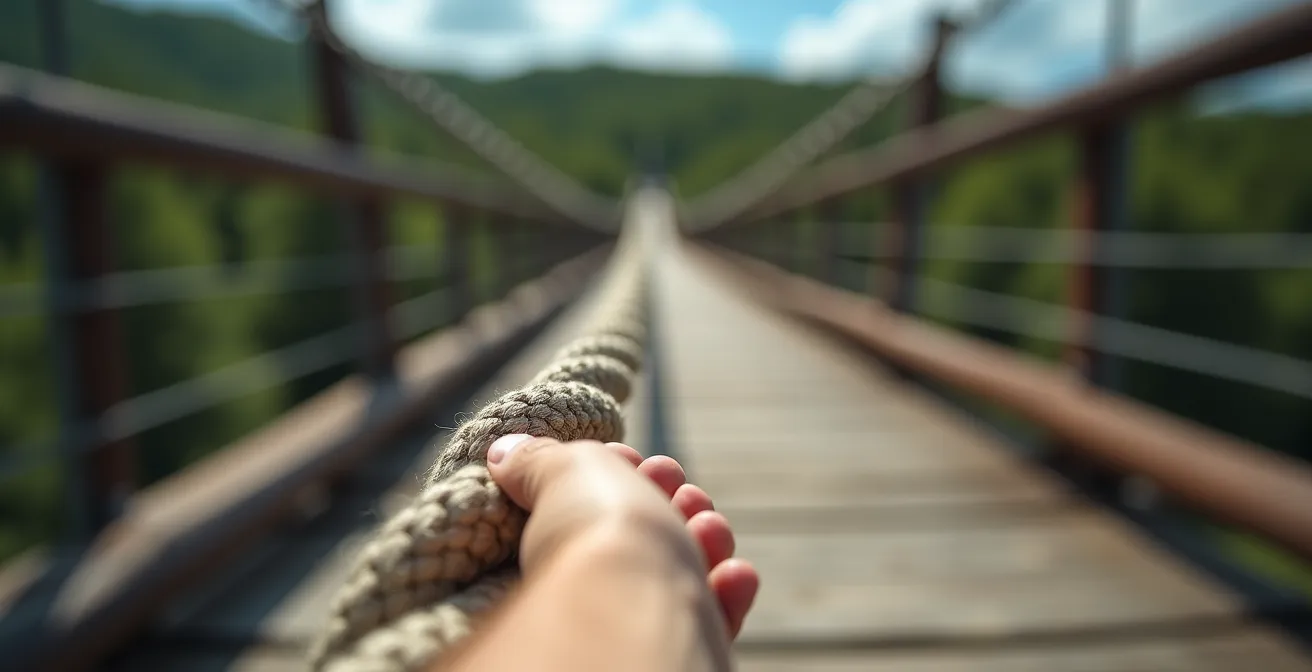
This first-person perspective demonstrates how to narrow your focus. By locking your eyes on your destination, you deny your brain the visual input of the height that triggers fear. Combine this with the following step-by-step protocol to turn a moment of anxiety into a manageable and triumphant crossing.
- Step 1: Anchor and Breathe. Stand at the bridge entrance for 2 minutes. Focus on a steady 4-7-8 breathing pattern (inhale 4 sec, hold 7, exhale 8) to calm your nervous system.
- Step 2: Tactile Grounding. Touch and grip the handrail firmly. Feel its solidity, its texture, and its temperature. This provides a tangible sense of security.
- Step 3: Fix Your Gaze. Lock your eyes onto a non-moving point straight ahead at the far end of the bridge. Commit to not looking down or to the sides.
- Step 4: Engage the Logical Brain. Take your first step while counting “One” aloud. Continue counting with each step. This verbal, rhythmic task occupies the part of your brain that might otherwise spiral into panic.
- Step 5: Lower Your Center of Gravity. Walk with your knees slightly bent. This makes you feel more stable and physically connected to the bridge.
- Step 6: Use Positive Self-Talk. Remind yourself of the bridge’s engineering. A phrase like, “This bridge is built to hold tons; I am safe,” can be powerfully reassuring.
By using these simple but powerful mental tools, you can conquer the bridge and earn the incredible view waiting on the other side.
Key Takeaways
- Your fitness at home doesn’t directly translate to performance in the tropics; heat and humidity are “effort multipliers” that must be respected.
- ‘Accessible’ is a marketing term. Always verify claims by requesting specific measurements, photos, and videos of pathways and facilities.
- Choosing a destination involves a trade-off in health preparations; understand whether a one-time vaccine (Yellow Fever) or daily medication (Malaria) better suits you.
When to Visit Monteverde to See Quetzals Without the Crowds?
Choosing the right destination is only half the battle; choosing the right *time* to visit is just as critical. This is where all the factors we’ve discussed—fitness, crowds, health, and reward—converge. A perfect case study for this is Monteverde, Costa Rica, a world-renowned cloud forest and prime location for spotting the magnificent Resplendent Quetzal. Visiting during the peak dry season (December-April) might seem ideal, but it comes with a trade-off: massive crowds and premium prices. Your “peaceful” nature walk can feel more like a queue.
Conversely, the “green season” (May-November) offers a completely different experience. Crowd levels plummet to 30-40% capacity, accommodation prices drop, and the forest is at its most vibrant. For quetzal seekers, this season is actually when the birds are most active with their dramatic breeding displays. However, this reward comes with a higher physical price. The trails become muddy and slippery, demanding a higher level of fitness, balance, and the right gear. As travel writer Richard Hammond notes, timing also has direct health implications:
Choosing the dry season over the wet season can drastically reduce mosquito-borne disease risk in many destinations, directly linking travel timing to health and safety.
– Richard Hammond, The Green Traveller: Conscious Adventure
This creates a clear decision matrix for the informed traveler. Are you willing to trade easier trails for more people? Or do you prefer solitude at the cost of more challenging physical conditions? There is no single “best” time to visit; there is only the best time for *your* specific fitness level, budget, and priorities. The table below outlines these seasonal trade-offs clearly, allowing you to make a strategic choice.
| Factor | Dry Season (Dec-Apr) | Green Season (May-Nov) |
|---|---|---|
| Quetzal Visibility | Good (nesting season) | Excellent (breeding displays) |
| Trail Difficulty | Easy – dry paths | Challenging – muddy/slippery |
| Crowd Levels | High (80-100% capacity) | Low (30-40% capacity) |
| Physical Fitness Required | Moderate | High |
| Accommodation Prices | Premium (+40%) | Discounted (-30%) |
| Best Visit Time | 6:00-7:30 AM | 5:30-7:00 AM |
This final step brings it all together. By understanding the environmental taxes, assessing your personal trade-offs, and planning accordingly, you move from being a passive tourist to an active, empowered adventurer, ready to experience the world on your own terms.