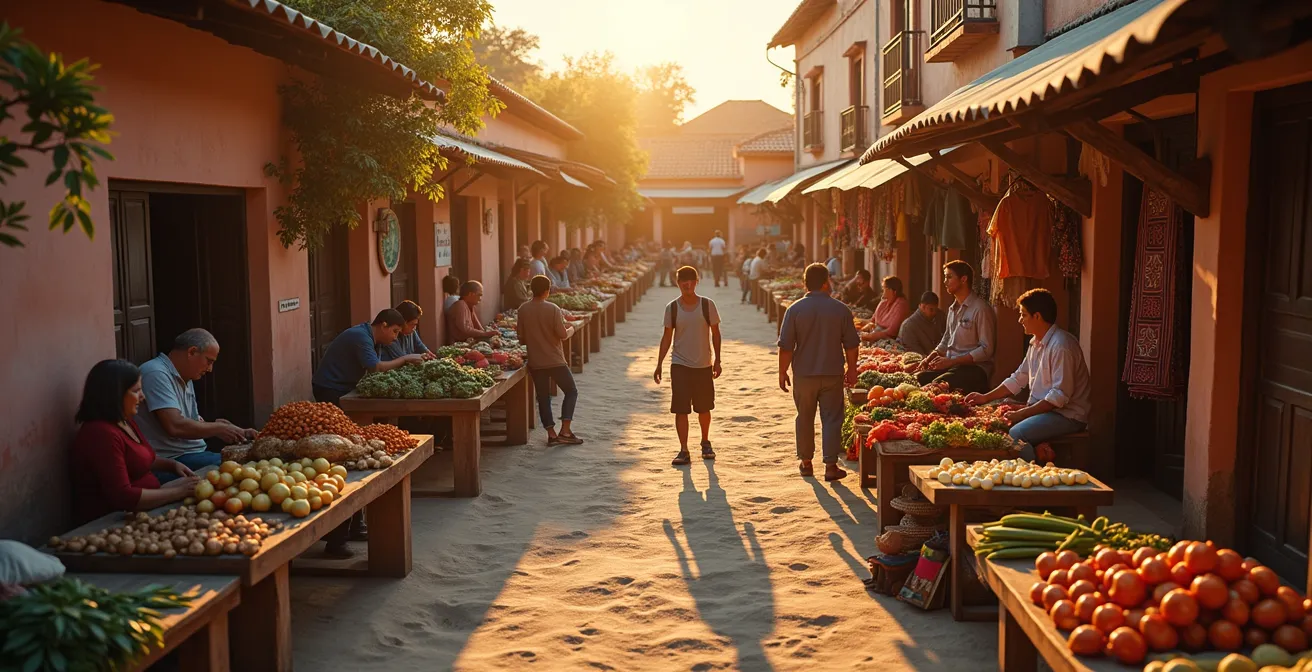
Your vacation spending is a powerful tool for good, but only if it escapes the ‘economic leakage’ that can divert up to 80% of it away from local hands.
- The “multiplier effect” means every dollar spent directly with local businesses can generate two to three times its value for the community.
- Bypassing intermediaries—like large booking platforms, tour operators, and supermarket supply chains—is the single most effective strategy to maximize your impact.
Recommendation: Focus on direct transactions. Book your stay via the guesthouse’s own website, buy produce at the farm gate, and eat at family-run restaurants with handwritten menus.
As a conscious traveler, you want your presence to be a positive force. You choose your destinations with care, respect local customs, and hope that the money you spend supports the vibrant communities you’ve come to admire. It’s a noble goal, but the reality of the modern tourism industry is complex. The common advice—”eat local,” “shop local”—is a good start, but it often fails to account for the hidden economic systems at play.
The truth is, much of the money spent by tourists never reaches the local population. It “leaks” out of the economy through a chain of international corporations, booking platform commissions, and imported goods. This means that even when you think you’re supporting a local business, a significant portion of your bill might be funding a headquarters on another continent. So, if the conventional wisdom is insufficient, what’s the solution?
This guide reframes the challenge. Instead of just “buying local,” we must practice a form of economic forensics. It’s about learning to spot the clues that tell you where your money is truly going. It’s about actively short-circuiting the intermediaries and understanding the powerful “multiplier effect” you unleash when your spending stays within the community. By making a few strategic shifts in how you book, shop, and eat, you can transform your travel budget from a drop in the ocean into a vital current that nourishes the local ecosystem.
This article will provide you with a practical framework to do just that. We will explore the economic principles at work and give you the tools to distinguish authentic, community-benefiting options from their less impactful counterparts, ensuring your next trip leaves a lasting, positive legacy.
Summary: A Conscious Traveler’s Guide to Local Economic Support
- Why Does spending 100€ at a Local Artisan Worth 300€ for the Community?
- How to Distinguish Real Local Crafts from Imported Souvenirs?
- Direct Booking or OTA: Which Saves Money and Helps the Host?
- The “All-Inclusive” Trap That Starves Local Restaurants
- When to Shop at Markets to Get the Best Produce and Prices?
- Why Is Direct-from-Farmer Often Cheaper Than Supermarket Organic?
- Homestays or Chain Hotels: Which Truly Benefits the Local Community?
- How to Eat 100% Local on Vacation Without Blowing Your Budget?
Why Does spending 100€ at a Local Artisan Worth 300€ for the Community?
The idea that €100 can become €300 isn’t magic; it’s a core principle of local economics known as the tourism multiplier effect. When you spend money directly at a locally-owned business, you’re not just completing a single transaction. You are injecting capital into a closed-loop system where it can circulate multiple times, amplifying its value at each step. Research in tourism economics confirms this, showing that a community can see a total economic output of $2 to $3 for every dollar a tourist spends directly with local vendors.
Imagine you buy a hand-woven basket for €100 from a local artisan. The artisan then uses €50 of that money to buy dyes from a local farmer and €30 on food from the village market. The farmer, in turn, uses their new income to pay a local mechanic to fix their cart, and the market vendor pays school fees for their children. That initial €100 has already generated far more than its original value in local economic activity before any of it “leaks” out to pay for imported goods or services.
This is not just a theory. In the area surrounding Zambia’s South Luangwa National Park, nature-based tourism that prioritizes local employment has generated jobs for 30% of the working-age population. Each tourist dollar spent on local guides, lodges, and suppliers directly fuels this cycle of employment and community development. The key is to ensure the first transaction is with a business that is truly local, setting off this positive chain reaction.
How to Distinguish Real Local Crafts from Imported Souvenirs?
One of the most direct ways to support local culture is by purchasing crafts, but the globalized souvenir market is flooded with mass-produced fakes. Telling them apart requires a bit of detective work—your first exercise in economic forensics. An imported keychain may look nice, but the money you spend on it is immediately siphoned out of the local economy. An authentic, handmade item, however, channels your funds directly to the artisan and their community.
The first clue is the context. An authentic artisan is often proud of their work and their workshop. Look for small studios or cooperatives off the main tourist drag, where you might see the creative process in action. The presence of tools, raw materials, and works-in-progress is a strong sign of authenticity. This environment contrasts sharply with generic souvenir shops that stock shelves with identical items.

The object itself also holds clues. Handcrafted items have character; they possess slight imperfections and variations that make each piece unique. Mass-produced goods are uniform. Price can also be an indicator. If an item seems suspiciously cheap for the amount of work that should have gone into it, it’s likely not handmade locally. Your goal is to pay a fair price for the artisan’s time and skill, not to find the cheapest trinket.
This table acts as a practical field guide for your forensic analysis, helping you spot the difference and make a choice that truly supports local craftsmanship.
| Authentic Local Crafts | Mass-Produced Imports |
|---|---|
| Slight imperfections and variations | Identical items in every shop |
| Artisan present in workshop/shop | No maker visible or known |
| Local materials specified | Generic materials, often plastic |
| Higher price reflecting labor | Suspiciously low prices |
| Vendor knows item’s story | Vendor has no background info |
Direct Booking or OTA: Which Saves Money and Helps the Host?
Online Travel Agencies (OTAs) like Booking.com or Expedia are incredibly convenient for discovering accommodation. However, this convenience comes at a high cost to local hosts and, by extension, the local economy. These platforms act as powerful intermediaries, siphoning off a significant portion of the booking revenue before it ever reaches your host. This is a classic example of economic leakage that you can easily prevent.
The impact is substantial. According to industry analyses, OTA platforms typically charge hosts 15% to 25% in commission fees on every booking. For a small, family-run guesthouse, this represents a massive loss of income. By booking directly with the property, you ensure that 100% of your money goes to the people running it. This empowers them to invest more in their business, pay their staff better, and contribute more to the local economy, strengthening the multiplier effect.
Many travelers assume direct booking is more expensive, but it’s often the opposite. With the 15-25% commission removed, hosts have more flexibility. Many are happy to offer a small discount (5-10%) for direct bookings, as they still come out ahead financially. You save a little money, and the host earns significantly more. It’s a true win-win situation. The challenge is simply finding the property’s direct contact information, but a quick search is all it takes.
Your Action Plan: The Hybrid Model for Direct Booking
- Discover: Use OTAs with their powerful filters and reviews to find properties that suit your needs.
- Investigate: Once you’ve chosen a place, search for its name directly on Google or another search engine.
- Connect: Find the property’s official website, social media page, or WhatsApp number.
- Negotiate: Contact the host directly, mention you found them on an OTA, and politely ask if there’s a better rate for booking direct.
- Secure: Use secure and traceable payment methods like PayPal or a credit card link provided by the host to confirm your booking.
The “All-Inclusive” Trap That Starves Local Restaurants
All-inclusive resorts market a dream of hassle-free indulgence: endless food, drinks, and entertainment all for one price. While appealing, this model can be devastating for the local economy. It creates a closed ecosystem where tourist dollars are captured almost entirely by the resort, which is often foreign-owned. This prevents money from circulating to the independent restaurants, cafes, and bars that are the lifeblood of a community’s culinary scene.
This phenomenon is a severe form of tourism leakage. Instead of dining at a family-owned taverna or buying fruit from a street vendor, guests stay within the resort’s walls. The resort may source some supplies locally, but a large portion of its food and beverage budget often goes to large-scale, sometimes international, suppliers to ensure consistency and cut costs. The result is that very little of the guest’s total vacation cost ever touches local hands. Studies have quantified this problem, finding that leakage can be as high as 80% in some Caribbean countries, largely due to the dominance of the all-inclusive model.

Choosing to eat outside a resort is an act of economic redistribution. Every meal you have at an independent restaurant supports a local owner, their staff, and the network of local farmers and fishermen who supply them. It’s also an opportunity for a more authentic cultural experience, allowing you to taste regional specialties and interact with the community in a meaningful way. By venturing out, you’re not just having a meal; you’re casting a vote for a more equitable and sustainable form of tourism.
When to Shop at Markets to Get the Best Produce and Prices?
Local markets are the beating heart of a community, a vibrant intersection of commerce, culture, and cuisine. For a conscious traveler, they are a prime opportunity to channel spending directly to local farmers and producers, completely bypassing the intermediary costs and economic leakage of supermarkets. However, to get the best experience—and the best value—it helps to understand the market’s daily rhythm.
Timing is everything. Arriving at the right time not only affects selection and price but also changes the entire experience. To shop like a local and maximize your positive impact, follow this general guide:
- Early Morning (6-8 AM): This is when you’ll find the best selection and the freshest produce. It’s also when most locals do their shopping, offering an authentic cultural experience. Prices are standard but fair.
- Mid-Morning (10 AM-12 PM): The market becomes busier with tourists. Prices may be slightly higher, and the atmosphere is more bustling than transactional.
- Late Afternoon (After 2 PM): Vendors are looking to sell their remaining stock before closing. This is the best time for bargains, though the selection will be limited.
Beyond timing, observation is key. Before buying, take ten minutes to walk around and gauge the average prices. Follow the lead of residents carrying reusable bags—they know where to find the best quality and value. Often, the most authentic markets are those where prices aren’t displayed, as they cater primarily to locals who already know the going rate.
Each activity takes place in a local setting – often a garden – and tours have generated enough income to grade the 7km dirt road that leads into town, as well as repair two out-of-use boreholes and construct a new one to restore access to clean water. It even pays for high-school scholarships for kids who otherwise couldn’t afford an education.
– As told to Wanderlust Magazine, on community tourism in Uganda
Why Is Direct-from-Farmer Often Cheaper Than Supermarket Organic?
It seems counterintuitive: how can produce grown with care by a small farmer be cheaper than the “organic” equivalent in a gleaming supermarket? The answer lies in the value chain. When you buy from a supermarket, you’re not just paying for the vegetable; you’re paying for a long list of intermediaries: the packer, the transporter, the wholesaler, the distributor, the certifier, and the retailer’s markup. Each of these steps adds cost without adding intrinsic value to the food itself.
When you buy directly from a farmer at a market or farm stand, you short-circuit this entire chain. The farmer receives 100% of the money you pay. This direct transaction model is incredibly efficient. A World Bank analysis in Madagascar found that direct spending on nature-based tourism could generate a $2.48 increase in local income per tourist dollar, largely because it cuts out so many middlemen. That same principle applies to buying a tomato.
Furthermore, the “organic” label in a supermarket is part of an expensive certification system. Many small farmers use traditional, organic methods passed down through generations but cannot afford the costly annual fees to get an official stamp. Their produce is often “naturally organic” without the label’s price inflation. By buying direct, you get fresher food (often picked the same day), support sustainable farming practices, and pay a price that reflects the food’s true cost, not its marketing and distribution journey.
The difference in cost structure is stark, clearly showing how intermediaries absorb a huge portion of the final price paid by the consumer.
| Direct from Producer | Through Intermediaries |
|---|---|
| 100% to producer | 40-60% to producer |
| No certification fees | Certification costs included |
| No transport markup | Transport and storage costs |
| Picked same day | Week-old produce possible |
| Traditional organic methods | Certified organic required |
Homestays or Chain Hotels: Which Truly Benefits the Local Community?
The choice of where to sleep is one of the biggest financial decisions you’ll make on a trip. A large chain hotel, even if locally staffed, often represents a major point of economic leakage. Profits are frequently repatriated to a foreign headquarters, and high-level management positions are rarely held by locals. In contrast, a homestay or a locally-owned guesthouse keeps nearly 100% of your spending within the community.
The benefits go far beyond the room rate. A local host is more likely to hire local staff, use local maintenance services, and source breakfast ingredients from the nearby market. They become a hub in the multiplier effect. This model is a cornerstone of community-based tourism, which aims to empower local populations through direct ownership of tourism enterprises. The results can be transformative. As the World Economic Forum highlights, even small-scale operations have a significant impact:
Garrido’s Lodge in the Brazilian Amazon is one case where sustainable tourism has generated 18 local positions and thousands in annual revenue from craft sales
– World Economic Forum, Community-led sustainable tourism for people and biodiversity
This is not an isolated case. The same report notes that in the Amazon, community-based businesses generated over $20 million in gross revenues for local populations last year. This demonstrates that choosing small-scale, local accommodation isn’t just a quaint option; it’s a powerful economic strategy. While platforms like Airbnb can sometimes benefit individual hosts, it’s crucial to ensure the property is run by a local resident and not an investor who owns multiple properties, which can inadvertently drive up local housing costs.
Key Takeaways
- Book Direct: Always use a search engine to find a hotel’s or guesthouse’s own website to bypass the 15-25% commissions charged by booking platforms.
- Dine Out: Avoid the “all-inclusive trap.” Every meal at a family-run restaurant injects money directly into the local food supply chain and community.
- Be a Souvenir Detective: Use the “Authentic vs. Imported” checklist to ensure your craft purchases support real artisans, not mass-production factories.
How to Eat 100% Local on Vacation Without Blowing Your Budget?
Embracing a 100% local diet on vacation sounds expensive, but it’s one of the biggest myths of conscious travel. In reality, eating like a local is often the most budget-friendly way to travel. The key is to detach from tourist-centric dining and adopt the eating habits of the people who live there. This means seeking out value and authenticity where they naturally coexist, far from the main tourist squares.
Your primary strategy should be to follow the local workforce. Look for eateries bustling with residents during their lunch break. Many countries have a concept like the ‘Menu del Día’ (Menu of the Day)—a fixed-price, multi-course lunch that offers incredible value and a taste of true home cooking. These meals are designed for local budgets, not tourist wallets. A handwritten menu that changes daily is another excellent sign that the restaurant cooks with fresh, seasonal ingredients from the market.
Self-catering is another powerful tool. By combining a stay in an apartment or homestay with regular visits to the local market, you can prepare your own meals for a fraction of restaurant costs. This not only saves money but also provides a deeper connection to the local food culture. To find the best spots, ignore the advice of tourist information centers and instead ask a local shopkeeper or your guesthouse host where they go for a good, affordable meal. By following these simple rules, you can enjoy an authentic and delicious culinary journey while ensuring every bite supports the local community.
- Seek out ‘Menu del Día’ or daily lunch specials that locals eat.
- Look for restaurants with handwritten menus, as they change daily with market availability.
- Follow the ‘no pictures on the menu’ rule to find more authentic spots.
- Shop at local markets for incredible value on self-catering meals.
- Ask locals where they eat, not the tourist information office.
- Eat your main meal at lunchtime, when prices are often significantly lower than at dinner.
By applying these principles of economic forensics to your next trip, you transform from a passive consumer into an active and positive contributor. Your vacation becomes more than just a getaway; it becomes a meaningful exchange that respects and empowers the communities that make our travels so memorable.