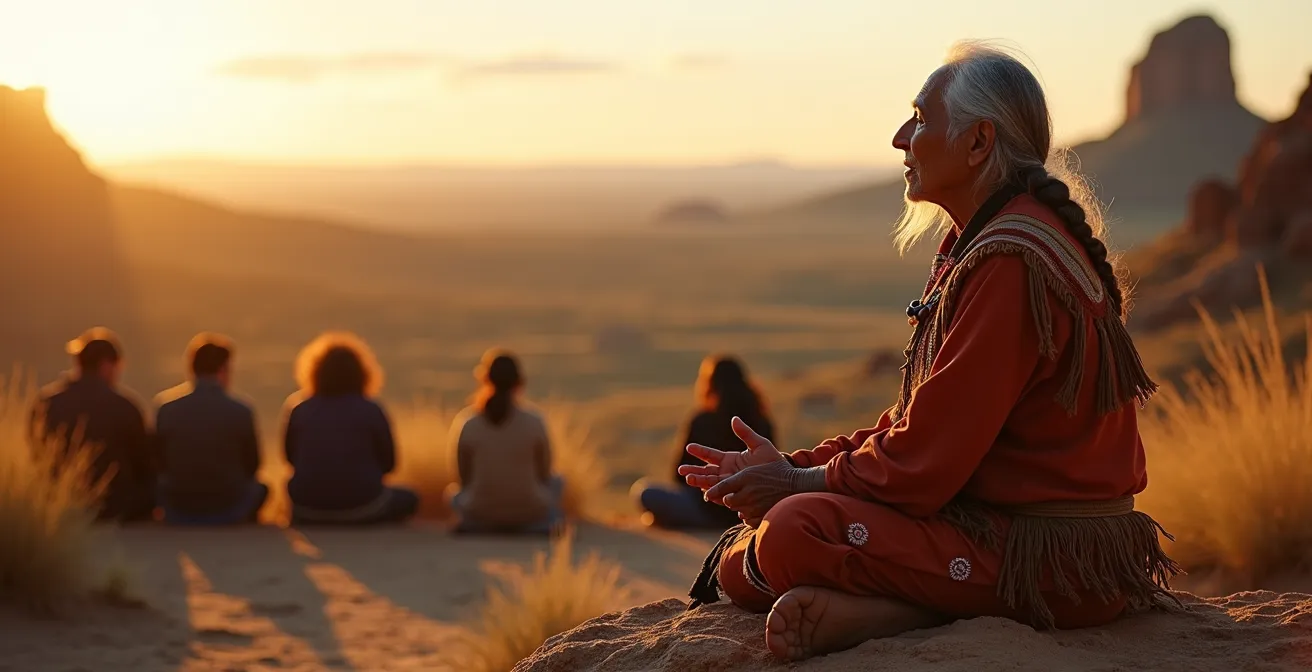
The key to truly experiencing Indigenous territories isn’t about following a checklist of ‘respectful’ actions, but about fundamentally shifting your mindset from transactional tourist to relational guest.
- True respect is demonstrated through reciprocity, not consumption.
- Listening and observing are more powerful for building trust than asking direct, extractive questions.
Recommendation: Start by seeing every interaction as an opportunity for mutual exchange, not a one-way transaction.
Many travelers venture into Indigenous territories with a deep desire for authentic connection, yet they are paralyzed by a fear of causing unintentional offense. The common advice—”be respectful,” “don’t take photos without asking”—is well-meaning but dangerously superficial. It provides a fragile shield of etiquette that does little to bridge the vast cultural gap. These tips treat the interaction like a visit to a museum, where rules are posted to prevent damage to the exhibits. But a living culture is not an exhibit, and its people are not docents.
The core of the issue lies in a fundamental misunderstanding. Western travel is often built on a transactional mindset: you pay for an experience, and you receive it. This framework is efficient for booking a hotel but disastrous for building human connection. But what if the entire premise is wrong? What if the true key to a profound experience is not about what you can *get*, but about what you can *give*? The shift from a tourist to a guest is not about better manners; it’s a profound internal change from a transactional mindset to a relational one, rooted in the ancient principle of reciprocity.
This is not a simple switch. It requires unlearning the default behaviors of a consumer and adopting the posture of a humble student. It means understanding that silence can be a form of communication and that a gift is an opening for a relationship, not a payment for a service. This guide will deconstruct this relational mindset into concrete actions and non-actions. We will explore the deep meaning behind protocols, the power of listening, and why sometimes, the most respectful thing you can do is to leave no trace, not even a memory captured on a camera. It’s time to move beyond the shallow checklist and learn the language of true cultural exchange.
To help you navigate this essential transformation from tourist to guest, this article is structured around key questions and principles. The following summary outlines the path we will take to build a deeper, more meaningful approach to traveling in Indigenous lands.
Summary: A Practical Guide to Becoming a Welcome Guest in Indigenous Territories
- Why Must You Ask the Elder Before Entering Sacred Land?
- Tobacco or Food: What Is the Appropriate Offering for a Host?
- Listening or Asking: Which Behavior Builds Trust Faster?
- The Camera Mistake That Gets You Expelled from a Ceremony
- How to Recognize a Sacred Site Without a Signpost?
- Why Picking Up Other People’s Trash Changes Your Travel Experience?
- Which Question Shifts a Conversation from Small Talk to Real Connection?
- Why Some Traditions Must Change to Survive in the Modern World?
Why Must You Ask the Elder Before Entering Sacred Land?
In the transactional world of tourism, land is property and access is a right granted by a ticket or a fee. In many Indigenous worldviews, land is a living entity, a relative, and sacred sites are places of immense power and history. They are not public parks. Entering without permission is not just trespassing; it’s a profound violation. The Elder is not a gatekeeper in the Western sense, but a guardian responsible for maintaining the balance and safety of the land and its spiritual energies. Their role is to protect the site from harm and to protect the visitor from energies they may not be prepared to encounter.
This is why the request for entry is a formal protocol, not a casual question. The Elder is assessing more than your itinerary; they are evaluating your intention and spirit. They are determining if your presence is safe for the land and if the land is safe for you. This concept of spiritual safety is paramount and completely absent from the typical tourist mindset. A refusal is not a personal rejection; it is an act of protection for all parties involved. Approaching this process with humility and a genuine willingness to accept any answer is the first true test of a guest’s mindset.
Understanding the proper way to make this request is crucial. It is a formal process steeped in tradition, where the “how” is as important as the “what.”
Your Action Plan: The Protocol for Requesting an Elder’s Permission
- Initial Contact: Reach out to the Elder by phone if possible. Oral communication is often preferred over written forms, aligning with the importance of oral tradition.
- Prepare an Offering: Prepare a traditional gift like a tobacco tie or a practical item. As you prepare it, hold clear and good thoughts about your request and your intentions.
- Present Yourself Humbly: When you meet, state your name and the purpose of your visit clearly and respectfully. Avoid entitlement or impatience.
- Allow Time for Assessment: The Elder needs time to evaluate the request. This is not a bureaucratic delay but a necessary spiritual consideration. Do not rush their decision.
- Accept the Decision with Grace: Whether the answer is yes or no, accept it with gratitude. Understand that the decision is made to protect the well-being of the land, the community, and you.
Tobacco or Food: What Is the Appropriate Offering for a Host?
The principle of reciprocity is the bedrock of relational cultures. Unlike a transaction where money is exchanged for goods, reciprocity involves a continuous cycle of giving and receiving that builds and maintains relationships. When you approach a host or knowledge keeper, bringing an offering is not a payment; it is a sign of respect and an acknowledgment of the value of their time and wisdom. It signals that you are there to engage in a mutual exchange, not just to take information or experiences.
The nature of the offering is deeply symbolic. While a gift of food might be appropriate in some social contexts, traditional offerings like tobacco hold a specific and sacred purpose. In many cultures, tobacco is offered when asking for something of significant spiritual or intellectual value: a story, a teaching, a piece of advice, or a prayer. It is a formal request for knowledge. It is essential to understand that this offering does not replace fair compensation or an honorarium if one is expected for professional services. Rather, it is the spiritual key that opens the door to a meaningful exchange.
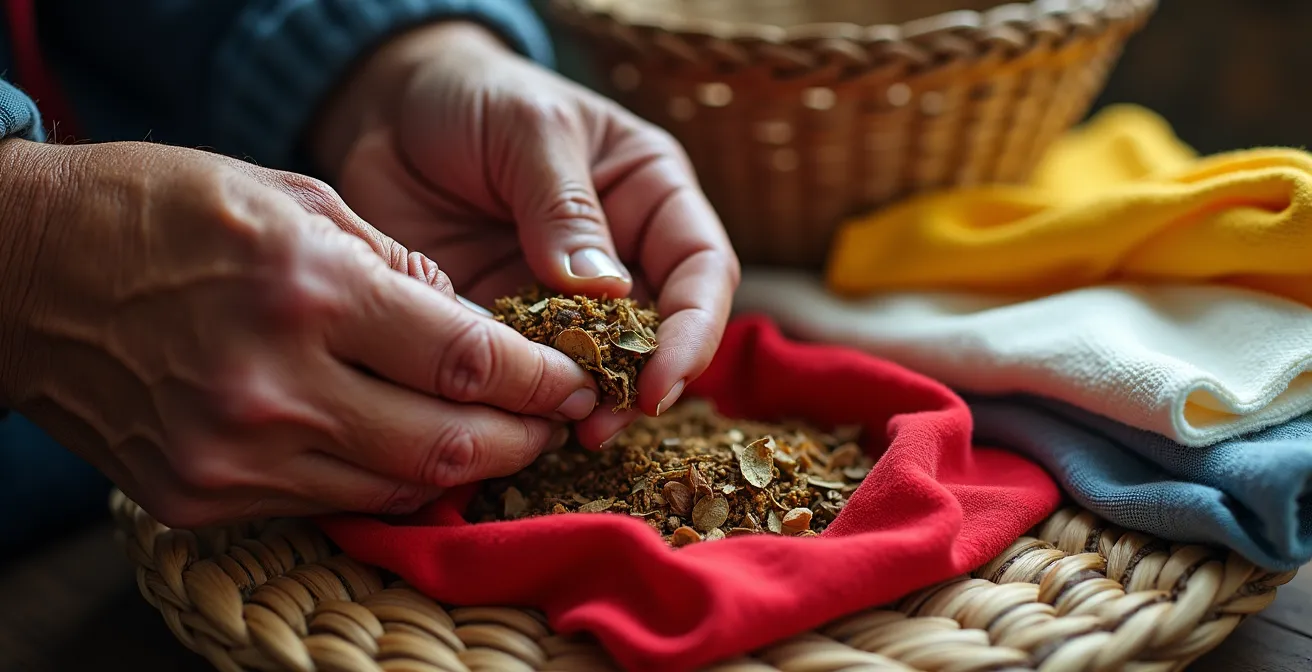
The act of preparing the offering yourself is part of the protocol. By creating a tobacco tie with your own hands, you infuse it with your intention and respect. The best choice is traditional, ceremonial tobacco or, if unavailable, an additive-free loose-leaf tobacco. This thoughtful preparation demonstrates that you have moved beyond the tourist impulse to simply “buy” a solution and have instead invested your own energy into the relationship before it has even begun.
Listening or Asking: Which Behavior Builds Trust Faster?
We have two ears and one mouth for a reason – when in the presence of an elder, make sure to listen more than you speak as an elder’s words come from a place with many decades of experience.
– ICT News, 10 Ways to Respect Your Native Elders
In a world saturated with information on demand, our default behavior is to ask. We have a question, we expect an answer. This approach, however, can be perceived as aggressive and extractive in many Indigenous contexts. It centers the visitor’s need for knowledge above the host’s comfort and willingness to share. True trust is not built through interrogation, but through patient, active listening and observation. The most profound teachings are often not delivered in direct response to a question but emerge naturally from shared time and silence.
A guest learns by watching, by being present, and by allowing knowledge to be offered rather than demanding it. This is a shift from active inquiry to observational learning. Instead of asking “What is that plant for?”, a relational approach would be to observe how the plant is handled and wait for a story to be shared. This demonstrates patience and respect for the host’s agency. It allows them to control the flow of information, sharing what is appropriate, when it is appropriate. This is the difference between a tourist who extracts facts and a guest who is invited into a world of understanding.
The distinction between extractive and relational questions is a critical skill for any guest. An extractive question serves the asker’s curiosity, while a relational question opens the door for connection and shared experience. The following comparison, based on insights from community engagement, illustrates this powerful difference.
| Extractive Questions | Relational Questions | Trust Impact |
|---|---|---|
| What is this plant called? | I noticed you handle that plant with such care; it seems very important. | Builds connection through observation |
| How do you do this ceremony? | Could you show me how you read the weather in the clouds? | Creates shared activity and learning |
| Tell me about your culture. | What is the most important story your grandfather told you? | Honors generational wisdom |
The Camera Mistake That Gets You Expelled from a Ceremony
The camera is the ultimate symbol of the transactional tourist. It is a tool for taking, for capturing, for possessing a moment without being fully present in it. For many Indigenous Peoples who have fought for generations to protect their culture from being misrepresented, commodified, or stolen, an unsolicited camera is not just rude—it is an act of aggression. It represents a long and painful history of having sacred elements taken and displayed out of context. With over 1.4 million international visitors engaged in Indigenous tourism experiences in Australia in 2019 alone, the cumulative impact of this single mistake is immense.
During a ceremony, photography is almost universally forbidden unless explicit, public permission has been granted for a specific purpose. A ceremony is a time of deep spiritual connection, not a performance for an audience. Introducing a camera can disrupt the flow of energy, make participants feel like objects of spectacle, and violate the sacredness of the moment. To some, the act of capturing an image is seen as stealing a piece of the person’s spirit or the ceremony’s power. Being expelled for this mistake is not an overreaction; it is a necessary measure to protect the integrity of a sacred space.
The only safe assumption is that photography and recording are never allowed. Do not ask for an exception. Asking puts the host in the uncomfortable position of having to say no, reinforcing the dynamic of the demanding tourist. The most respectful action is to put your phone and camera away entirely. Your goal is to participate with your senses and your heart, not to document with a lens. The memory you create by being fully present will be infinitely more valuable than any picture. It is a memory you have earned through participation, not one you have taken through observation.
How to Recognize a Sacred Site Without a Signpost?
In the developed world, we expect important places to be clearly marked with signs, fences, and plaques. This is not always the case in Indigenous territories, where the landscape itself is the text. Sacredness is often indicated by subtle, natural markers that are invisible to the untrained or hurried eye. A guest learns to read these signs, not with their intellect, but with their awareness. Recognizing a sacred site without a signpost is a test of your ability to practice observational learning and be truly present in your environment.
These sites are not “undeveloped” tourist spots; they are active places of worship, remembrance, and spiritual power. They may be unusual rock formations, ancient trees that have a palpable presence, or quiet clearings by a river. Disturbing these places, even accidentally, can be a grave offense. Taking rocks, leaving trash, or making loud noises can disrupt the delicate spiritual balance of the area. It requires a fundamental shift in perception: from seeing the land as a backdrop for your adventure to seeing it as a living, sacred space that deserves reverence.
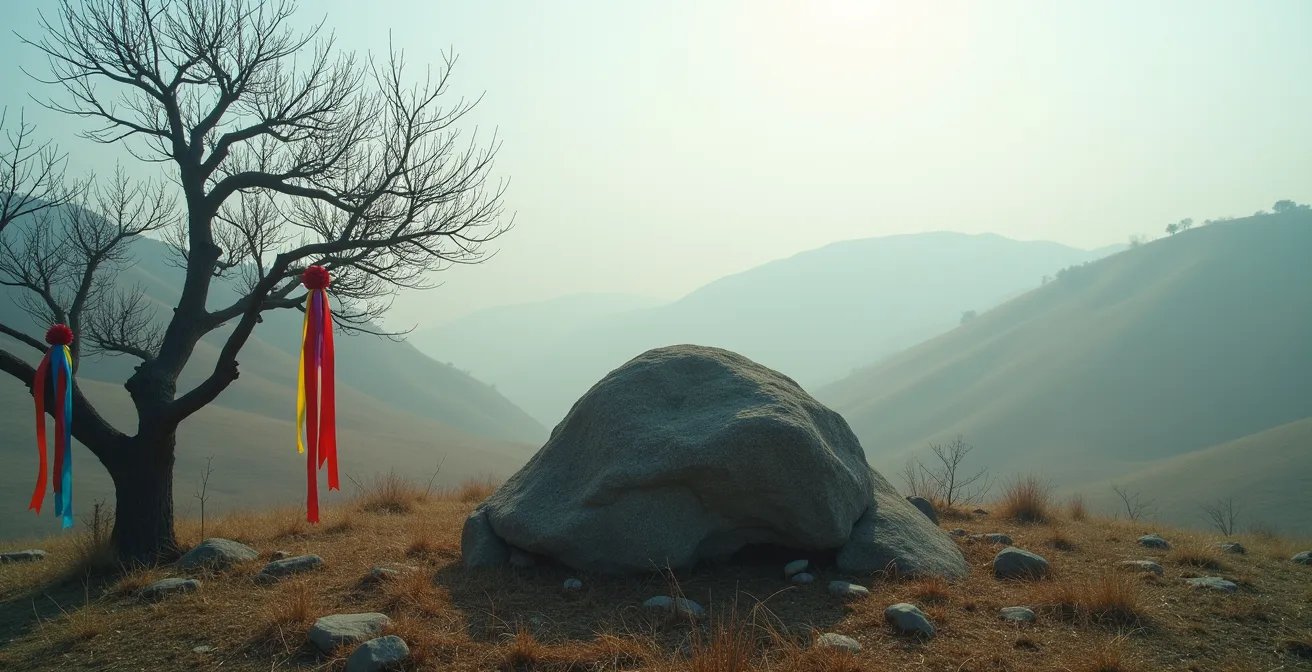
Your local guide is your most important resource, but you also have a personal responsibility to be aware. Pay attention to where your guide leads you and, more importantly, which areas they consistently avoid. These unmarked boundaries are often the most significant. Look for signs of human offerings, which signal that a place is spiritually active.
- Look for offerings left on trees or rocks, such as small bundles of cloth (tobacco ties) or colorful ribbons.
- Notice unusual rock formations or ancient, significant trees that feel different from their surroundings.
- Pay attention to areas your local guide consistently avoids or leads you around without explanation.
- Do not touch, move, or disturb prayer bundles or any other items you may find; they are offerings for ancestors and spirits.
- Always stay back from wildlife and be hyper-aware of your surroundings, paying close attention to any formal signage that does exist.
- If you encounter a ceremony or spiritual custom, observe from a great distance without making your presence known or disturbing the participants.
Why Picking Up Other People’s Trash Changes Your Travel Experience?
At first glance, picking up litter seems like a simple act of good citizenship, something taught in elementary school. But in the context of becoming a guest on Indigenous land, it takes on a much deeper meaning. It is a powerful, non-verbal act of reciprocity and a physical demonstration of the relational mindset. When you pick up trash left by others, you are no longer a passive consumer of the scenery. You become an active caretaker, a temporary steward of the land. This simple action fundamentally changes your relationship with the place, from one of taking (views, photos, experiences) to one of giving back (care, respect, healing).
This act communicates far more than words ever could. It shows your hosts that you see the land as they do: not as a disposable resource, but as a living relative that deserves protection and care. It is a gesture of solidarity and respect for their role as ancestral guardians. For a visitor, it is an opportunity to leave a place better than you found it, a core tenet of responsible travel that aligns perfectly with Indigenous values of stewardship. It is a humble, contributive act in a world of extractive tourism.
This philosophy of stewardship is a sacred responsibility passed down through generations, as eloquently stated by knowledge keepers in the Yukon.
We are the stewards of this land and we all have a responsibility to care for this land for future generations. We honour our ancestors who shared their teachings with us so that we can now share them with you. We care for this land — the plants, water, air and animals — by showing it respect and treating it as an equal.
– Yukon First Nations Knowledge Keepers, Respectful Travel Guidelines
By participating in this stewardship, even in a small way, your experience of the land is transformed. It ceases to be a mere landscape and becomes a place with which you have a relationship, a place you have actively cared for. This is a profound shift that moves you definitively from the category of tourist to that of a welcome guest.
Which Question Shifts a Conversation from Small Talk to Real Connection?
After building a foundation of listening and observation, there may come a time when conversation is appropriate. However, the nature of your questions will determine whether the interaction remains a superficial exchange of facts or deepens into a genuine human connection. The tourist asks questions to satisfy their own curiosity (“Tell me about your culture”). The guest asks questions that honor the host’s life, wisdom, and personal experience.
The goal is not to “interview” someone for cultural data. The goal is to show that you are interested in them as a person, with a unique life story and perspective. Questions about their personal memories, the stories their grandparents told them, or their favorite part of the land create an opening for a real relationship. They are invitations to share a piece of themselves, not a demand for a cultural performance. This approach respects the host’s agency and acknowledges that their personal wisdom is a gift, not a commodity.
This is another facet of reciprocity. When someone shares a personal story, they are giving you a gift. It is appropriate to acknowledge this by listening intently, showing gratitude, and, when fitting, sharing a small piece of your own story. This creates a two-way exchange, the hallmark of a healthy relationship. It is often appropriate to offer a small, tangible gift in gratitude for someone’s time or knowledge, as it acknowledges the worth of what you have received.
Checklist: Asking Questions That Build Connection
- Focus on the Person, Not the “Culture”: Ask about their life, their experiences, and their memories. This shows you care about them as an individual.
- Honor Generational Wisdom: Ask about the stories or teachings they received from their Elders or grandparents. This values their lineage and knowledge.
- Connect to the Land: Ask questions that link their personal experience to the land, such as “What part of this land holds your favorite memory?”
- Invite a Shared Activity: Rather than asking “how,” ask “could you show me?” For example, “Could you show me how you read the weather in the clouds?”
- Show Linguistic Respect: Offer to learn and speak a few words in their language. This is a nod of deep respect for their heritage and ways of being.
Key Takeaways
- Reciprocity Over Transaction: Approach every interaction as a two-way exchange of respect, time, and knowledge, not a purchase of an experience.
- Observation Before Interaction: Prioritize patient listening and observation to learn protocols and show respect before asking questions or taking action.
- Contribution Over Consumption: Shift your goal from consuming a culture or landscape to contributing to its well-being through acts of stewardship and genuine connection.
Why Some Traditions Must Change to Survive in the Modern World?
There’s a common, if romanticized, fear among travelers that their very presence, and the modernity it represents, could somehow tarnish or dilute “pristine” Indigenous traditions. While this concern comes from a place of respect, it often misunderstands the nature of living cultures. Cultures are not static artifacts frozen in time; they have always adapted, evolved, and integrated new tools to survive and thrive. A guest understands that respectful, responsible tourism is not a threat to culture, but can be a powerful force for its preservation and revitalization.
When managed by the communities themselves, tourism provides a vital economic incentive to maintain and celebrate cultural practices. It creates jobs, empowers local communities, and provides a platform for sharing their stories with the world on their own terms. The Indigenous tourism sector supports nearly 2,000 businesses and over 39,000 jobs in Canada, demonstrating its significant economic and social impact. This is not “selling out”; it is a strategic act of self-determination, using a modern industry to ensure the continuity of ancient traditions.
Case Study: Modern Tools for Cultural Preservation
Indigenous communities globally are innovatively blending tradition with modernity. The Sámi people of Northern Europe, for example, have developed the ‘Sámi Duodji’ certification mark to protect the authenticity of their traditional crafts from imitation, ensuring economic benefits flow back to their artisans. In Peru, the innovative Kipi robot was created to help teach and preserve the endangered Kukama language, spoken by only a few thousand people. These examples show that embracing modern tools, from legal certifications to robotics, can be a crucial strategy for safeguarding cultural identity in the 21st century.
As a guest, your role is to support these community-led initiatives. By choosing Indigenous-owned tour operators, buying authentic crafts directly from artisans, and paying fairly for experiences, you are directly contributing to a model of tourism that strengthens, rather than weakens, cultural identity. You become part of the solution, helping to create a world where traditions can not only survive but flourish.
To put these principles into practice, your next step is to start planning your journey not around what you will see, but how you will connect. Begin today by researching the specific protocols of the communities you hope to visit, and prepare to be a guest, not just a visitor.