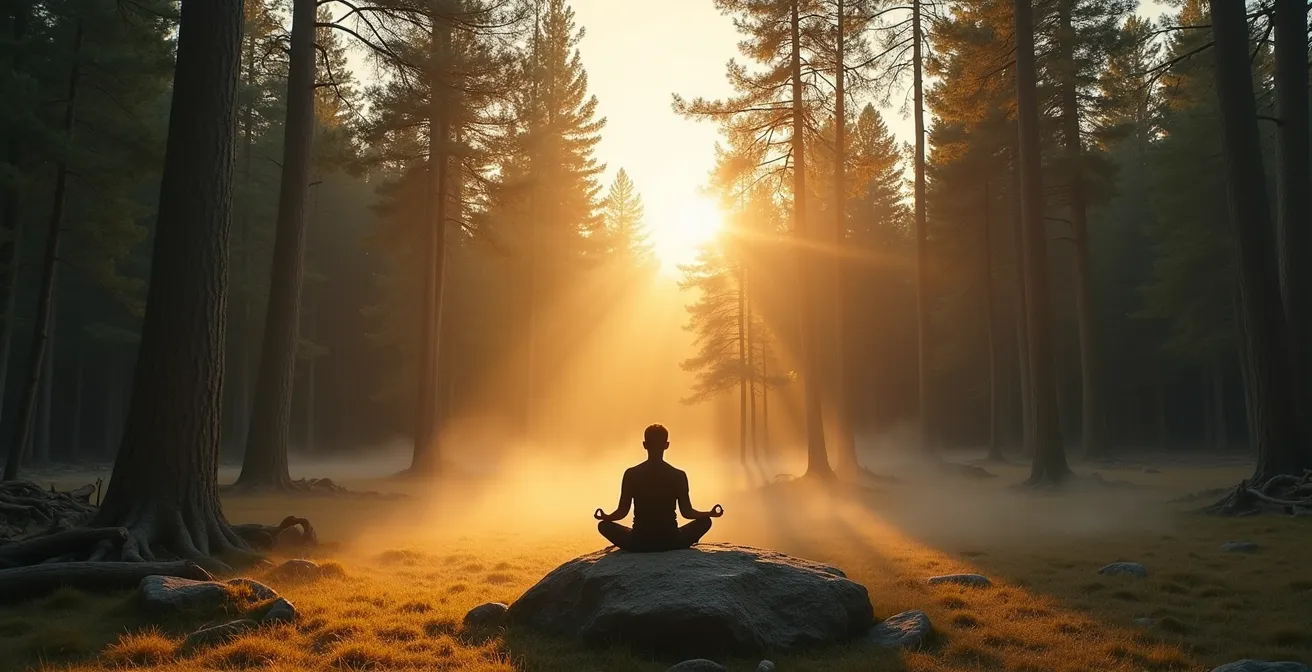
The greatest challenge of a wilderness solo trip isn’t the environment, but the internal “silence panic” you bring with you; mastering this is the key to a true psychological reset.
- A 72-hour period in nature is scientifically shown to quiet the brain’s stress networks and significantly boost creative problem-solving.
- Proactive mental training, like “silence microdosing,” is more critical than any piece of gear for preventing the anxiety that cuts trips short.
Recommendation: Shift your focus from surviving the outdoors to architecting the mental conditions for your mind to heal. Plan your psychological journey as meticulously as you plan your route.
For the stressed urban professional, the promise of a digital detox often feels like the ultimate solution: escape the city, turn off the phone, and find peace. Yet, many return just as frazzled, their minds having simply replaced email notifications with an internal monologue of anxieties. The common advice—pack the right gear, check the weather—addresses the body’s survival but completely ignores the mind’s turmoil. We’re told to find a good tent, but not how to build a mental container for our thoughts.
What if the real preparation for solitude wasn’t about the physical world at all? What if the key to a profound psychological reset lay not in what you pack, but in how you prepare your brain for the abrupt absence of noise? The true barrier to tranquility isn’t a lack of comfort, but the onset of “silence panic”—that wave of restlessness and anxiety that floods the void when external stimuli disappear. This is the error that derails most attempts at finding peace.
This guide reframes wilderness solitude from a logistical challenge to a psychological practice. We will explore the scientific basis for a 72-hour reset, provide a framework for creating a mentally secure base camp, and offer concrete strategies to train your mind for silence. By understanding and preparing for the internal journey, you can transform a simple three-day trip into a powerful tool for recovery and mental clarity.
To truly grasp the transformative power of this experience, the following video of Dick Proenneke, a master of intentional solitude, offers a powerful visual immersion into a life lived in harmony with the wilderness.
This article is structured to guide you through the essential psychological stages of preparing for, executing, and integrating a solo wilderness retreat. Each section addresses a critical question you’ll face on this journey from urban chaos to inner calm.
Table of Contents: Your Guide to a 72-Hour Mental Reset in Nature
- Why Does Your Brain Need 72 Hours in Nature to Fully Reset?
- How to Set Up a Comfortable Base Camp for Extended Solitude?
- Solo Immersion or Group Retreat: Which Is Better for Burnout Recovery?
- The “Silence Panic” Error That Cuts Wilderness Trips Short
- How to Reintegrate into Urban Life Without Losing Your Wilderness Calm?
- Why Does Exercise in Nature Burn More Stress Than the Gym?
- How to Lock Your Phone Away for 24 Hours Without Panic?
- Where to Find Silence and Solitude in France’s Most Popular Regions?
Why Does Your Brain Need 72 Hours in Nature to Fully Reset?
The idea of a “three-day reset” isn’t a wellness myth; it’s a documented neurological phenomenon. Your brain, bombarded by the constant, high-frequency stimuli of urban life, operates in a state of chronic stress. Immersing it in a natural environment for an extended period allows it to shift from a state of directed, fatiguing attention to one of “soft fascination,” triggering a profound psychological reset. This isn’t just about feeling better; it’s about measurable cognitive improvements.
Neuroscientist David Strayer’s research famously uncovered what he calls the “three-day effect.” His work demonstrated a stunning 47% improvement in creative problem-solving after just a few days of nature immersion without technology. This happens because the prefrontal cortex, the brain’s overworked command center, finally gets a chance to rest and recharge. When it’s not busy filtering traffic, emails, and social media feeds, it can dedicate its resources to deeper, more creative thought processes.
The 72-hour timeline is crucial because the reset occurs in distinct phases:
- Day 1 (0-24 hours): Your body and mind begin recovering from acute stress. The immediate pressures of city life fade, and your nervous system starts to return to a baseline state of calm. This is the initial “unwinding” phase.
- Day 2 (24-48 hours): The brain’s attention network begins to quiet down. You’ll notice your sensory awareness increasing—the sounds of the forest, the feel of the wind, the subtle changes in light become more vivid. This is the start of sensory recalibration.
- Day 3 (48-72 hours): With the “noise” of directed attention fully silenced, your brain’s Default Mode Network (DMN) becomes highly active. This is the network associated with daydreaming, memory consolidation, and creative insight. It’s during this phase that breakthroughs and moments of clarity often occur.
Understanding this timeline helps manage expectations. You may not feel a profound shift on day one. The real magic requires patience, allowing your brain the full 72 hours it needs to complete its natural reboot sequence.
How to Set Up a Comfortable Base Camp for Extended Solitude?
Your base camp is more than just a shelter; it’s a mental container for your solitude. Its setup dictates your psychological state. A chaotic, uncomfortable camp creates low-grade stress that prevents your mind from settling. A well-organized camp, however, provides a sense of safety and order, freeing your mental energy for introspection. Think of it not as building a campsite, but as designing a temporary sanctuary for your mind.
Instead of a random arrangement of gear, consciously design your camp around three functional zones, creating a triangle of purpose. This physical structure helps to structure your days and thoughts without a clock.
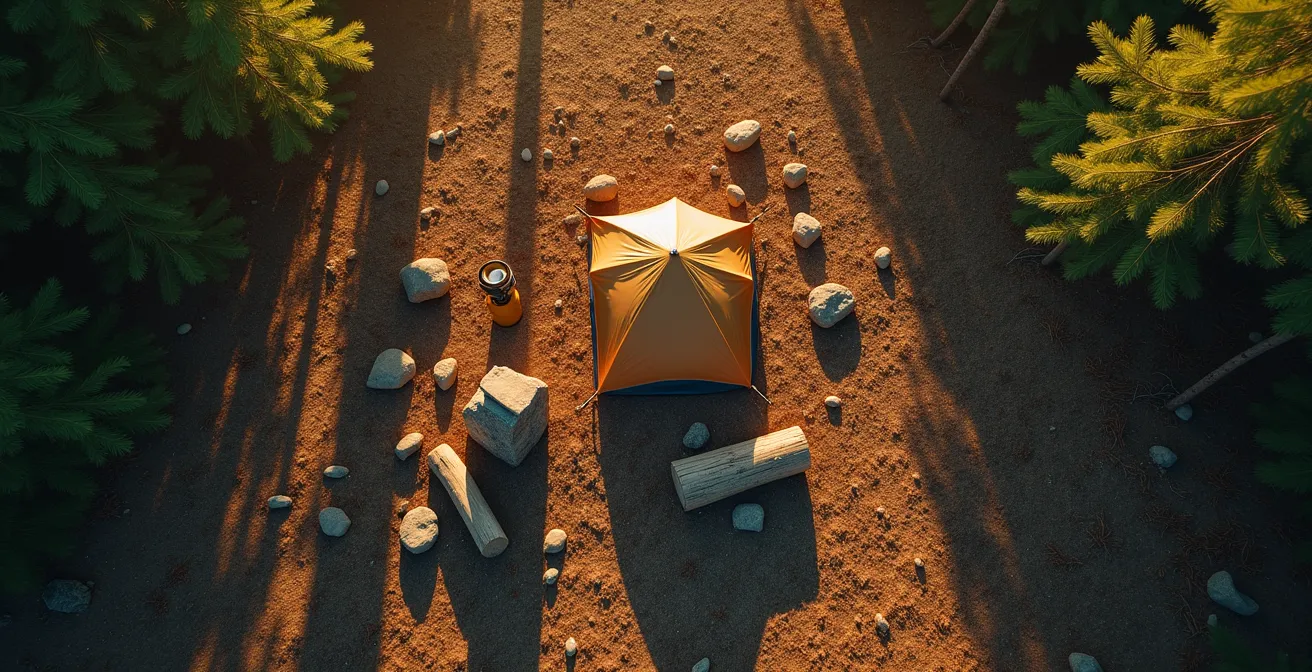
As the illustration above suggests, these three zones form the foundation of a psychologically secure camp:
- The Rest Zone (Your Tent): This is your sanctuary of safety and recovery. It should be used for sleeping and shelter only. Keep it clean, organized, and free from food to maintain a feeling of security. This physical boundary helps your brain associate this space with deep rest, not with chores or anxiety.
- The Nourishment Zone (Your “Kitchen”): Designate a specific spot, ideally a flat rock or cleared area a safe distance from your tent, for all cooking and eating. This contains the “work” of survival. By separating this activity, you prevent the mental load of chores from spilling into your rest and contemplation spaces.
- The Contemplation Zone (Your “Porch”): This is the most crucial, yet often overlooked, zone. Find a spot with a view—a fallen log, a smooth boulder, a clearing facing the sunset. This is your space for doing nothing: for watching the clouds, journaling, or simply being. It’s a physical destination for your introspective work.
By moving between these three distinct zones, you create a natural rhythm to your day. This external structure provides a comforting scaffold for your mind, allowing it to relax into the unstructured time of solitude without feeling lost or aimless.
Solo Immersion or Group Retreat: Which Is Better for Burnout Recovery?
The path to recovering from burnout isn’t one-size-fits-all, and the choice between a solo immersion and a group retreat depends entirely on the psychological work you need to do. Both offer the healing power of nature, but they serve very different functions. A group retreat is about co-regulation and shared release, while a solo trip is about deep introspection and self-reliance.
A group retreat is often the better choice for the initial stages of severe burnout. When you’re emotionally and physically depleted, the logistics and potential anxiety of a solo trip can be overwhelming. A group setting provides a crucial safety net. The presence of others normalizes the experience of stress, creating a sense of “we’re in this together” that reduces feelings of isolation. The shared laughter, communal meals, and guided activities offload the mental burden of decision-making, allowing for passive recovery and decompression. It’s an excellent way to dip your toes into nature-based healing without the pressure of full self-reliance.
A solo immersion, on the other hand, is the tool for deeper, more transformative work. It’s best suited for those who have moved past the acute phase of burnout and are ready to confront the underlying patterns of thought and behavior that led to it. Without the social dynamics of a group, you are left with only yourself. This can be confronting, but it’s where true self-discovery happens. The silence compels you to listen to your own inner voice. The challenges of self-reliance rebuild a sense of agency and competence that burnout erodes. It’s not about being lonely; it’s about learning to be your own good company.
Ultimately, the best approach might be sequential. Start with a group retreat to decompress and recharge your batteries in a supportive environment. Then, once you feel more stable, undertake a solo journey to do the deeper work of recalibrating your relationship with yourself and your life.
The “Silence Panic” Error That Cuts Wilderness Trips Short
The most common reason a solo wilderness retreat fails isn’t a gear malfunction or bad weather; it’s a psychological phenomenon called “silence panic.” It’s that sudden, overwhelming wave of anxiety, boredom, and restlessness that hits when the constant stream of external stimuli is cut off. Your brain, accustomed to a diet of notifications, noise, and distractions, goes into withdrawal. This discomfort is often misinterpreted as a sign that the retreat “isn’t working,” causing many to pack up and leave just as the real benefits are about to begin.
This panic is a predictable neurological response, not a personal failing. As experts in the field of wilderness therapy have noted, many people are simply unpracticed in the art of being alone. This is highlighted in research on the subject:
Many people do not know how to be alone, finding solitude frightening, boring, or unproductive, emphasizing the importance of preparation and leadership.
– Smith, T.E., Frontiers in Psychology – The Wilderness Solo Experience Study
The key to overcoming silence panic is not to fight it during the trip, but to train for it beforehand. Just as you’d train your muscles for a long hike, you must train your “solitude muscle.” This is done through a process of gradual acclimatization, or “silence microdosing.”
Your Pre-Trip Solitude Acclimatization Plan:
- Week 1 – Foundational Stillness: Sit in a quiet room in your home for 10 minutes each day. No phone, no book, no music. Your goal is simply to tolerate the absence of input.
- Week 2 – Public Quiet: Practice for 20 minutes in a low-stimulus public space, like a quiet park bench. Resist the urge to pull out your phone. Observe your surroundings without judgment.
- Week 3 – Nature Immersion: Extend your practice to 30 minutes in a more natural setting. Actively focus on your five senses to anchor yourself in the present moment. What can you see, hear, smell, feel?
- Week 4 – Silent Movement: Complete a 1-hour walk in nature without any audio input (no music, no podcasts). Let the rhythm of your walking and the sounds of nature be your only companions.
- Week 5 – Extended Practice: Spend a 2-3 hour block of time alone outdoors. You can bring a book or a journal, but the phone stays off and in your bag (for emergencies only). This tests your ability to self-entertain and manage longer periods of quiet.
By following this protocol, you gradually increase your brain’s tolerance for lower levels of stimulation. When you finally embark on your 3-day retreat, the silence will feel less like a void and more like a welcome, familiar space.
How to Reintegrate into Urban Life Without Losing Your Wilderness Calm?
The calm and clarity gained during a wilderness retreat are incredibly fragile. Returning to the high-stimulus environment of the city can feel like a shock to the system, quickly erasing the benefits you worked so hard to achieve. This jarring transition is a form of re-entry friction. The key to preserving your inner peace is not to try and hold onto the wilderness experience, but to manage your re-entry with the same intentionality you applied to your preparation.
Your brain has been operating at a different frequency. A sudden plunge back into digital noise, social obligations, and work pressures can trigger a “rebound effect,” leaving you feeling more stressed than before you left. To prevent this, you need a “buffer zone”—a structured protocol to ease your transition back into urban life.
A gradual re-entry allows the insights and new neural pathways formed in nature to solidify. The goal is to integrate the wisdom of the wilderness into your daily life, not just leave it behind on the trail. This can be achieved by bringing small, intentional pieces of your retreat back with you.

This integration can follow a simple, day-by-day protocol to smooth the re-entry friction:
- Day 1: Maintain a media blackout. No social media, no news. Only essential communication (e.g., letting loved ones know you’re back safely). Try to maintain your wilderness sleep/wake cycle.
- Day 2: Journal for at least 30 minutes. Before your mind is cluttered with new information, capture the key feelings, insights, and resolutions from your time away.
- Day 3: Choose one single habit from the wilderness to continue. This could be watching the sunrise, eating one meal without a screen, or a short, device-free walk. The consistency is more important than the duration.
- Day 4: Make one deliberate decision using the clarity you’ve gained. Instead of reacting to demands, proactively choose one action that aligns with your post-solitude perspective.
- Day 5: Schedule your next “nature micro-dose.” Put a weekly visit to a local park or green space in your calendar, treating it as a non-negotiable appointment.
By managing your return with a conscious, gentle approach, you build a bridge between your wilderness self and your urban self, ensuring the peace you found is not a fleeting memory but a lasting transformation.
Why Does Exercise in Nature Burn More Stress Than the Gym?
While any form of exercise can reduce stress, physical activity in a natural setting has a uniquely powerful effect on the brain. The repetitive, predictable environment of a gym—the same machines, the same walls, the same music—does little to quiet the ruminating mind. In contrast, exercising in nature engages the mind in a way that actively combats stress and anxiety on a neurological level.
The difference lies in a concept called Attention Restoration Theory (ART). Urban environments and focused tasks (like working on a spreadsheet or lifting weights to a rep count) require “directed attention,” a finite cognitive resource that is easily depleted, leading to mental fatigue and stress. Natural environments, however, engage “involuntary attention” or “soft fascination.” The ever-changing scenery, the fractal patterns in leaves and branches, and the unpredictable sounds of the forest gently capture your attention without requiring any cognitive effort. This process allows your directed attention network to rest and recover.
This isn’t just a theory; it’s backed by measurable changes in brain activity.
Case Study: The Stanford Study on Nature Walking and Rumination
A landmark Stanford-led study investigated the psychological effects of walking in different environments. One group of participants walked for 90 minutes in a natural, park-like area, while another group walked for the same duration along a busy urban road. The results were striking: the nature walkers showed significantly reduced activity in the subgenual prefrontal cortex, a brain region associated with rumination and the risk of depression. The urban walkers, however, showed no such change. This provides strong evidence that the natural environment itself plays an active role in shutting down the brain’s cycle of negative self-focused thought.
When you hike a trail, your brain is lightly engaged in navigating the terrain—stepping over roots, balancing on rocks, adjusting to inclines. This low-level focus on the external world is just enough to prevent your mind from spiraling into the internal loops of worry and stress that often plague us during a treadmill session. In nature, your body and mind are working in concert, burning not just calories, but the very neural patterns of stress.
How to Lock Your Phone Away for 24 Hours Without Panic?
For many, the thought of being without their phone for 24 hours induces more anxiety than the thought of a wilderness encounter. This is a form of digital-age panic, rooted in the brain’s addiction to the dopamine hits provided by notifications and constant connectivity. The good news is that overcoming this is not only possible but also profoundly rewarding, leading to measurable positive changes in your brain.
Research shows that abstaining from your phone can actually reshape your brain’s reward system. A study from Germany found that after just a short period of phone-free time, the brain shows heightened sensitivity to real-world rewards. Specifically, German researchers from Heidelberg University discovered that participants who went without their phones for 72 hours showed increased activity in the nucleus accumbens—a key reward center—when presented with non-digital social rewards. In short, going without your phone makes real life feel more rewarding.
The key to achieving this without panic is to create a “communication air-lock.” This is a protocol designed to address legitimate safety concerns and manage others’ expectations, freeing you to disconnect without guilt or anxiety. It’s a series of practical steps that replace your phone’s functions with analog alternatives.
Here is a simple protocol to make the disconnection feel safe and manageable:
- Designate an Emergency Contact: Choose one reliable person. Give them your exact location, your planned route, and your expected return time. They are your sole point of contact with the outside world.
- Provide a True Emergency Line: If you are carrying a satellite messenger or personal locator beacon, give this number or contact method *only* to your designated emergency contact. Stress that it is for true life-or-death emergencies only.
- Set an “Away” Message: Before you turn off your phone, set an auto-response on your email and a voicemail message that clearly states you are offline, unreachable, and when you expect to return. This manages expectations and prevents a flood of “are you okay?” messages.
- Embrace Analog Replacements: Systematically replace each of your phone’s functions with an analog tool. Use an analog watch for time, a physical map and compass for navigation, and a disposable film camera or a sketchbook and pencil to capture memories. This act of replacement is psychologically powerful.
By creating this air-lock, you address all the “what if” scenarios that fuel phone separation anxiety, allowing you to fully immerse yourself in the experience with peace of mind.
Key Takeaways
- True wilderness preparation is psychological, focusing on managing internal anxiety rather than just external survival.
- A 72-hour period in nature allows the brain’s prefrontal cortex to rest, measurably improving creative problem-solving by nearly 50%.
- The biggest obstacle is “silence panic,” a neurological withdrawal from constant stimuli, which can be overcome with pre-trip “silence microdosing.”
Where to Find Silence and Solitude in France’s Most Popular Regions?
Now that we’ve explored the psychological framework for solitude, the question becomes practical: where can one find this restorative silence? It can seem impossible in a world of shrinking wilderness. To make this concrete, let’s look at how you can find profound solitude even in a popular, densely visited country like France. It proves that with the right knowledge, silence is more accessible than you think.
The key is to look beyond the famous trails and peak-season hotspots, seeking out designated reserves, shoulder seasons, and less-traveled plateaus. France, despite its popularity, contains vast areas of protected, low-density land perfect for solo immersion. A prime example is the Réserve des Hauts Plateaux in the Vercors Regional Natural Park. Covering 17,000 hectares, it is the largest terrestrial natural area in metropolitan France with no permanent roads or villages. The park even has designated “zones de silence” where absolute quiet is protected, and bivouacking (setting up a temporary camp from evening to morning) is permitted, offering a legal and safe way to experience true solitude.
Beyond this flagship reserve, pockets of profound quiet can be found across the country if you know where to look. The strategy is to trade iconic names for lesser-known-but-equally-beautiful alternatives.
Here are some hidden gems for solitude seekers in France:
- Massif des Maures (Provence): While tourists crowd the Calanques, this inland mountain range offers wild, rugged terrain with a fraction of the foot traffic. Bivouac is often tolerated outside of high fire-risk season.
- Plateau de Millevaches (Limousin): Nicknamed the “water tower of France,” this high plateau is a region of forests, peat bogs, and lakes with an extremely low population density, guaranteeing minimal human contact.
- Queyras Alps: A quieter, more authentic alternative to the bustling Chamonix valley, this regional park offers stunning high-altitude scenery with specific zones dedicated to tranquility.
- Plateau de Beille (Pyrenees): At an altitude of 1800m, this vast plateau is a cross-country ski paradise in winter but offers absolute calm and stunning panoramic views for summer bivouacking (permitted from 7pm to 9am).
These examples show that finding solitude is not about discovering uncharted land, but about making informed choices to step just slightly off the beaten path. Every country has its own “Vercors” or “Millevaches”—you just have to look for them.
By shifting your focus from finding a place without people to finding a place designed for silence, you can begin to plan your own psychological reset, wherever you are in the world.