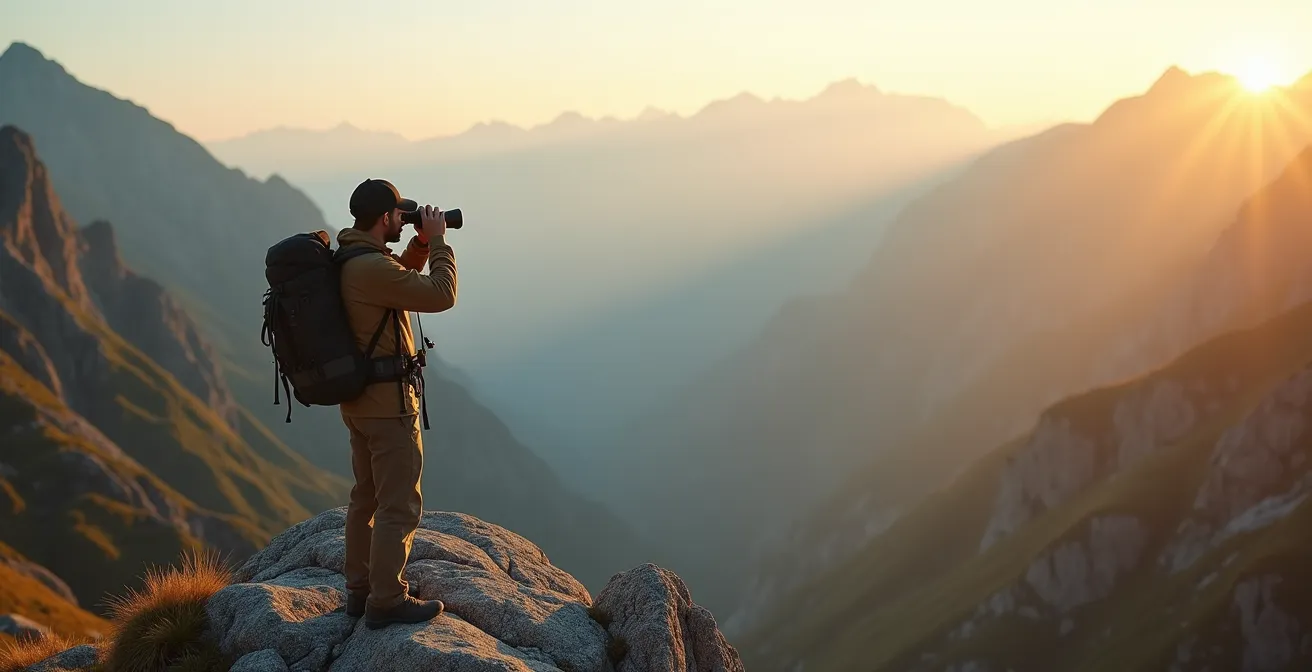
In summary:
- Successful ethical wildlife spotting goes beyond being quiet; it requires understanding an animal’s superior senses of sight and smell.
- Instead of just choosing dawn or dusk, learn to use the mountain’s invisible thermal wind currents to hide your scent.
- Many human behaviors, like a direct approach or bringing a dog, are perceived as predator threats and cause immediate stress and flight.
- The goal is not just to see an animal, but to become an unnoticed part of the landscape, ensuring the encounter is respectful and stress-free for the wildlife.
The moment is pure magic. High on a rocky outcrop, an ibex stands silhouetted against the sky, its powerful form a symbol of the wild, untamed Alps. For a fleeting second, you are a guest in its world. Then, it turns its head, and in a flash, it’s gone, bounding effortlessly over terrain you could barely scramble across. This experience is what draws so many nature lovers, photographers, and families to the mountains. Yet, it often ends in frustration, with wildlife vanishing before a good view is even possible.
Common advice tells us to be quiet, keep our distance, and wear neutral colors. While these tips are valid, they only scratch the surface. They are a list of rules, not a framework for understanding. They don’t explain *why* an ibex saw you from a kilometer away, or why a marmot whistled an alarm call when you thought you were completely hidden. These methods treat wildlife observation as a checklist to follow rather than a skill to develop.
But what if the real key to respectful, rewarding wildlife encounters lies not in what we do, but in what we understand? The secret is to shift our perspective from that of a human intruder to that of a mindful observer who grasps the invisible forces at play: the animal’s sensory world, the subtle language of its behavior, and the powerful dynamics of the mountain environment itself. It’s about learning to read the wind, to break up your silhouette, and to think like prey, not like a predator.
This guide will move beyond the basic rules. We will explore the science behind an animal’s perception, the strategies for using the environment to your advantage, and the critical importance of predators in shaping the very behaviors we observe. By the end, you will have a new framework for entering the world of alpine animals with the patience and respect they deserve, transforming your fleeting glimpses into meaningful, prolonged observations.
To help you navigate these ethical techniques, this article breaks down the essential principles of respectful wildlife observation. Explore the topics below to build your skills step by step, from understanding animal senses to mastering your approach.
Summary: A Guide to Ethical Observation Without Disturbing Their Habitat
- Why Can an Ibex See You Before You Even Spot It?
- How to Choose Binoculars for Mountain Wildlife Observation?
- Dawn or Dusk: Which Time Is Best for Spotting Chamois?
- The Approach Mistake That Puts You in Danger with Rutting Stags
- How to Use Wind Direction to Remain Invisible to Wildlife?
- Why Are Wolves Essential for the Health of French Forests?
- Why Are Domestic Dogs Banned from Core National Park Zones?
- Why Hiring a Guide in Vanoise National Park Is Crucial for Spotting Ibexes?
Why Can an Ibex See You Before You Even Spot It?
The primary reason an ibex detects you long before you see it lies in its exquisitely adapted senses, designed for survival in a “landscape of fear” shaped by predators. Unlike humans, whose vision is forward-focused, an ibex has wide-set eyes providing a panoramic field of view. This allows it to scan vast mountain slopes for the slightest hint of danger without turning its head. Their eyes are not built to see in high-definition color like ours, but they are masters at detecting one thing: motion. A slow, deliberate walker is background noise; a sudden gesture, like raising binoculars too quickly, is a red flag that screams “predator.”
Furthermore, their survival isn’t just about sight. Their sense of smell and hearing are far more acute than ours. Your scent can be carried for hundreds of meters on the wind, announcing your presence long before you are visible. The snap of a twig underfoot can sound like an alarm bell in the quiet alpine environment. To remain unnoticed, you must operate within their sensory bubble, a concept that extends far beyond simple physical distance. It requires a fundamental shift in behavior from being a passive walker to an active observer who constantly manages their visual profile, their sound, and, most importantly, their scent.
Thinking about your own visibility is the first step. The human form is a distinct, upright silhouette that stands out against the natural, irregular lines of a mountain. By using natural cover like rocks and vegetation, or simply by crouching to lower your vertical profile, you begin to blend into the landscape rather than contrasting with it. It’s not about perfect camouflage, but about breaking up that tell-tale human shape.
Action Plan: How to remain undetected by mountain wildlife
- Avoid sudden movements: Move slowly and deliberately, as wildlife detects motion far more effectively than detail or color.
- Break up your silhouette: Use natural cover like large rocks, trees, and dense vegetation to mask your distinct human outline.
- Approach from downwind: Always be aware of the wind direction to ensure your scent is carried away from the animals, not towards them.
- Wear neutral, earthy colors: Choose clothing in shades of brown, green, and grey that blend in with the mountain environment.
- Stay low when possible: Reduce your vertical profile by crouching or sitting behind natural features, making you less conspicuous.
How to Choose Binoculars for Mountain Wildlife Observation?
While understanding animal behavior is key, the right equipment is a force multiplier, allowing you to observe from a respectful distance without sacrificing detail. Binoculars are the single most important tool for any wildlife enthusiast. However, the market is flooded with options, and choosing the right pair can be confusing. The numbers on binoculars, such as 8×42 or 10×50, are not arbitrary. They represent the two most critical factors: magnification and objective lens diameter.
The first number (e.g., 8x) is the magnification power. It means the object will appear 8 times closer than it is. While it might be tempting to go for the highest magnification possible, this comes with trade-offs. Higher power magnifies your hand-shake, making the image unstable, and it narrows your field of view, making it harder to locate and track moving animals. For general mountain wildlife viewing, an 8×42 configuration is often rated best, offering a perfect balance between a stable, wide image and sufficient magnification.
The second number (e.g., 42mm) is the diameter of the objective lenses (the large lenses at the front). The larger the lens, the more light it can gather. This is crucial for spotting animals during the prime viewing hours of dawn and dusk, when light is low. A 42mm lens provides bright, clear images without being excessively heavy or bulky, a significant consideration when hiking. Investing in a quality pair with good glass and coatings will make a world of difference in image clarity and color fidelity, turning a distant brown speck into a clearly identifiable chamois.
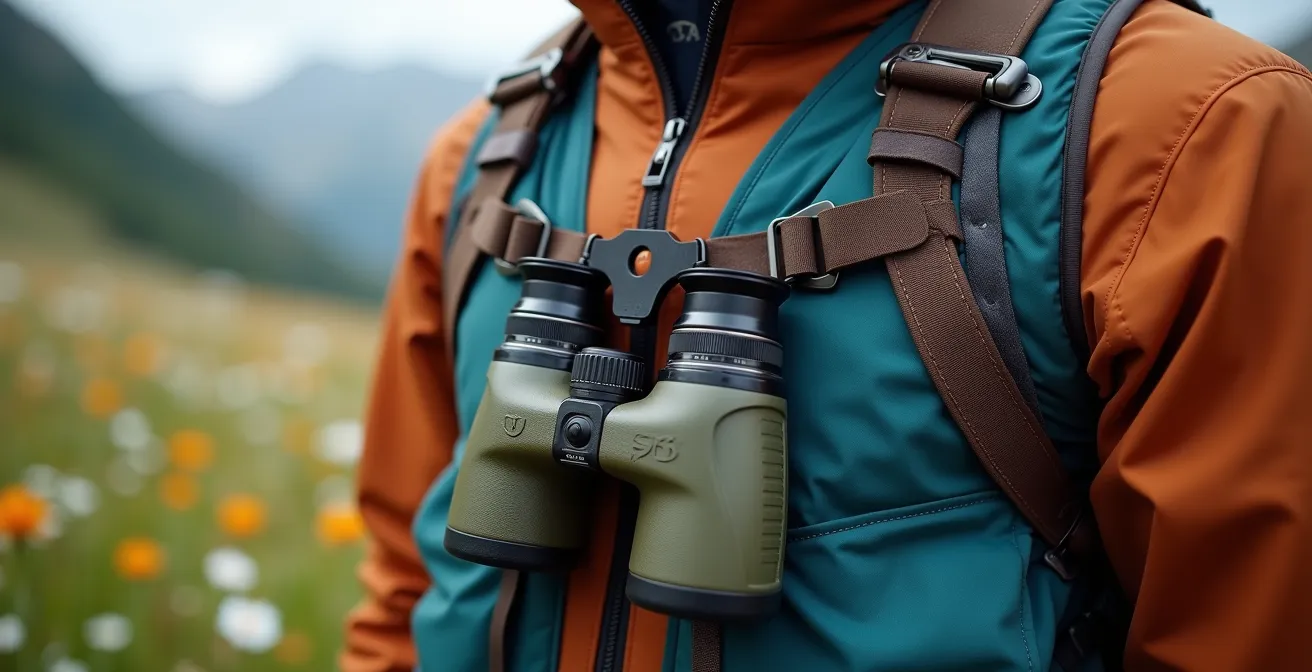
Finally, consider how you will carry them. Stuffing binoculars into a backpack makes them inaccessible for quick glances. A binocular harness system, as shown in the image, distributes the weight on your shoulders and keeps the optics protected yet instantly available. This small accessory dramatically improves the experience, encouraging you to scan your surroundings frequently and increasing your chances of spotting wildlife.
Dawn or Dusk: Which Time Is Best for Spotting Chamois?
The common wisdom to go out at dawn or dusk is correct, but understanding *why* these times are optimal elevates your strategy from simple advice to a tactical advantage. Most alpine animals, including chamois, ibex, and marmots, are crepuscular. This means they are most active during the twilight hours of early morning and late afternoon. This behavior is a survival mechanism driven by two factors: predator avoidance and thermal regulation. Midday sun can be harsh, forcing animals to seek shade and rest, while the dead of night offers cover for nocturnal predators.
Observations from French Alpine regions confirm that wildlife shows peak activity from spring to autumn, with activity spikes in the morning and late afternoon. For marmots, in particular, morning is a time of social interaction and sunbathing near their burrows, making them highly visible. Chamois and ibex often descend from their high-altitude nighttime refuges to graze in lower alpine meadows during these cooler periods. Therefore, your timing should be less about a specific hour and more about anticipating this daily migration pattern from high ground to feeding areas and back again.
The true expert, however, combines this knowledge of timing with an understanding of thermal winds. The morning strategy is not just about being early; it’s about positioning yourself above the animals’ predicted paths before sunrise. As the sun heats the slopes, it creates upslope (anabatic) winds. By being above the animals, your scent is carried up and away from them, rendering you invisible to their keenest sense. Conversely, the dusk strategy involves anticipating their descent to feeding grounds. As the slopes cool in the evening, the air flows downwards, creating downslope (katabatic) winds. Approaching from above ensures your scent is once again carried away from your subjects.
While dawn and dusk are prime times, don’t discount overcast, cool days. On such days, animals may remain active at lower altitudes for longer periods, providing extended observation opportunities. The key is to think dynamically, adapting your plan based on time of day, weather, and the all-important wind direction.
The Approach Mistake That Puts You in Danger with Rutting Stags
Observing large ungulates like red deer or ibex, especially during the autumn rutting season, is an awe-inspiring experience. It is also a time when the risk of a dangerous encounter is highest. The most common and dangerous mistake an observer can make is misinterpreting the animal’s behavior and failing to respect its personal space. A stag pumped with testosterone is not a docile creature; it is aggressive, territorial, and unpredictable. The critical error is the direct approach. Walking straight towards a rutting stag is perceived as a direct challenge, an act of aggression that can provoke a charge.
Wildlife safety experts emphasize the importance of non-threatening movements. As they note, your actions are a form of communication.
Sudden movements and loud noises can startle or frighten the animal, causing it to flee or become aggressive
– Wildlife observation safety experts, Hammock Universe Wildlife Observation Guide
This is especially true during the rut. Sounds that mimic antler clashes, such as snapping branches, can attract a rival stag’s attention in the worst way. Instead of a direct approach, use a tangential or zigzag pattern, never walking straight at the animal. This signals a lack of confrontational intent. Crucially, avoid direct eye contact, which is a universal sign of a challenge in the animal kingdom. Glance away frequently, and observe the animal’s reaction through your peripheral vision or quick looks.
Recognizing signs of agitation is non-negotiable for your safety. Watch for pinned-back ears, wide, staring eyes, or “false grazing,” where the stag repeatedly lowers and raises its head without actually eating. These are clear indicators that you are too close and causing stress. During the rut, a minimum distance of 100 meters is an absolute must. Before settling in to watch, always identify your escape routes. Know where you can quickly put a large rock or a patch of dense trees between you and the animal if the situation changes. Your safety, and the animal’s well-being, depends on your ability to read its signals and retreat before a line is crossed.
How to Use Wind Direction to Remain Invisible to Wildlife?
If an animal’s eyes are its sentinels, its nose is its intelligence network. Scent is the most reliable source of information for most mountain wildlife, and learning to manage your scent is the single most effective technique for close, ethical observation. This is not about using scent-blocking sprays; it’s about understanding and exploiting the mountain’s thermal dynamics. The wind is not a random force; it follows predictable patterns that you can use to your advantage.
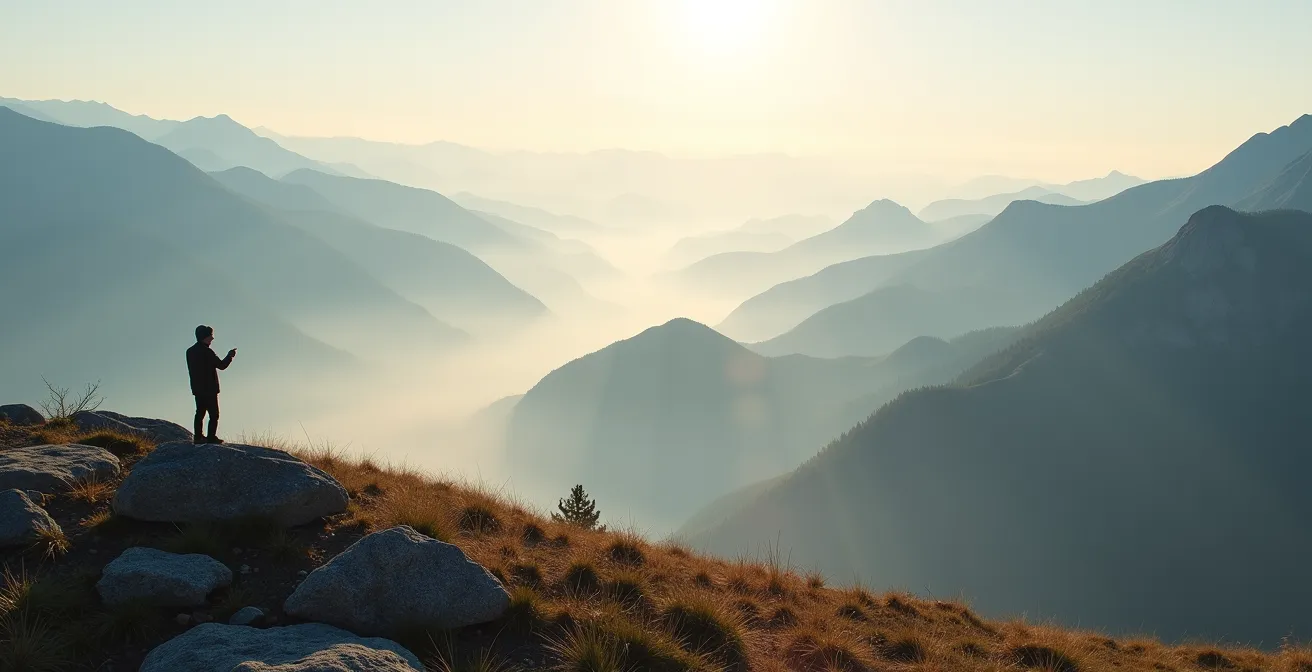
Research confirms that mountain winds are complex, but they are governed by a daily cycle. During the day, the sun warms the slopes, causing the air to rise. This creates an upslope, or anabatic, wind. At night, the ground cools, and the denser, cold air flows down into the valleys, creating a downslope, or katabatic, wind. This fundamental principle of thermal winds dictates where your scent travels. Being “downwind” is not a static position; it changes with the time of day. In the morning, you must approach from below your subject. In the evening, you must approach from above.
Mastering this involves constant awareness. Mountain winds are fickle and can shift in an instant, swirling in eddies around ridges and gullies. You should check the wind direction frequently, perhaps every 30 minutes, by tossing a small pinch of dust or dry grass into the air. Position yourself so the wind is blowing from the animals’ location towards you. This ensures your scent cone—the trail of odor you leave in the air—is being carried away from them. It’s also wise to avoid using any scented products, from sunscreen to deodorant, as these artificial smells are jarring and instantly recognizable in a natural environment.
By learning to read the subtle movements of mist in a valley or the sway of tall grasses, you can start to visualize these invisible currents. This is the art of becoming a ghost in the landscape, a silent observer whose presence is never even registered. It transforms the encounter from an intrusion into a truly intimate glimpse of an animal behaving naturally, completely unaware you are there.
Why Are Wolves Essential for the Health of French Forests?
The hyper-vigilance of ibex and chamois is not an accident; it is an evolutionary response forged over millennia by the presence of large predators. Understanding the role of animals like the wolf is essential to fully appreciating the wildlife you observe. For over a century, the absence of these apex predators in many parts of the Alps led to profound ecosystem imbalances. Without the pressure of predation, herbivore populations like deer and chamois could grow unchecked.
This overpopulation had cascading effects. The animals would overgraze certain areas, particularly valley floors and young forests, preventing saplings from growing and reducing biodiversity. They became less vigilant, more sedentary, and more susceptible to disease. The ecosystem lost a critical dynamic. The reintroduction and natural return of predators are not about adding a single species; it’s about restoring a fundamental ecological process known as a trophic cascade. The wolf, by hunting herbivores, initiates a chain reaction that revitalizes the entire landscape.
The mere presence of wolves creates a “landscape of fear” that changes herbivore behavior. Deer and chamois stop congregating in open, vulnerable areas. They move more, browse more lightly, and venture into steeper, more rugged terrain. This allows vegetation to recover. Young trees can grow, which in turn provides habitat for songbirds. Healthier riverbanks lead to more stable water systems, benefiting insects and amphibians. The successful reintroduction programs in protected areas like Gran Paradiso and the Aiguilles Rouges have demonstrated these effects clearly. Today, as 19 large predator species now inhabit Alpine regions, these natural dynamics are slowly being restored.
When you observe an ibex constantly scanning the horizon, you are not just seeing a nervous animal. You are witnessing a healthy, functioning ecosystem at work. You are seeing an animal that is playing its part in a complex web of life, a web where the wolf is not a villain, but an essential architect of biodiversity and resilience.
Why Are Domestic Dogs Banned from Core National Park Zones?
The rule banning dogs from the core zones of most national parks, like the Vanoise or Mercantour in France, often causes confusion and frustration among visitors. Many responsible dog owners feel their well-behaved, leashed companion poses no threat. However, this rule is not about a specific dog’s behavior; it’s about the innate, hard-wired perception of wildlife. To a marmot or a chamois, there is no difference between a wolf and a golden retriever.
This concept of predator mimicry is fundamental. Wildlife does not have the luxury of giving a potential threat the benefit of the doubt. Any canine shape, scent, or sound triggers an immediate and intense stress response. As wildlife management experts state, the perception is the reality.
Even a perfectly leashed dog is perceived by wildlife as a wolf. Its mere presence triggers a high-stress predator response
– National Park Wildlife Management, Wildlife observation safety guidelines
This stress is not trivial. It has significant physiological and ecological consequences for the wild animals. The energy they expend fleeing from a perceived predator is energy they cannot use for foraging, raising their young, or surviving a harsh winter. Repeated stress can weaken their immune systems and lower reproductive success. A single dog’s passage through a territory can disrupt the animals for hours or even days.
The impact goes beyond direct encounters. A dog’s scent markings (urine) can interfere with the complex territorial communication of wild animals for weeks. It’s like a stranger shouting over a private conversation. There is also a tangible risk of disease transmission between domestic dogs and wild canids like foxes or wolves. For all these reasons, the ban is a crucial measure for protecting the fragile balance of the park’s ecosystem. The impacts are numerous and significant:
- Predator Stress: The mere presence of a dog, leashed or not, triggers an instinctual and high-stress flight response in prey species.
- Scent Disruption: Canine scent marking can overwrite the natural territorial signals used by wildlife, causing confusion and conflict.
- Disease Risk: Domestic dogs can carry and transmit diseases to vulnerable wild populations, such as canid distemper to foxes.
- Energy Depletion: Repeatedly fleeing from perceived threats forces animals to burn vital energy reserves needed for survival.
- Behavioral Disruption: The perceived presence of a predator can interrupt critical activities like mating, feeding, and caring for young.
Key takeaways
- Ethical observation is less about rules and more about understanding an animal’s sensory world and reacting to it respectfully.
- Mastering the use of thermal winds to manage your scent is the single most effective technique for getting close without causing disturbance.
- Your behavior matters: a direct approach, sudden movements, or the presence of a dog are all perceived as predator threats, causing stress and flight.
Why Hiring a Guide in Vanoise National Park Is Crucial for Spotting Ibexes?
The Vanoise National Park is a true conservation success story. The Alpine ibex, once hunted to near-extinction, has made a remarkable comeback. Thanks to decades of protection and reintroduction efforts, conservation success stories reveal that over 40,000 ibex now thrive across the Alps. The animals are there, often in plain sight, yet many visitors leave having seen nothing more than a distant silhouette. This is where the expertise of a professional mountain guide becomes invaluable.
A guide is far more than someone who simply knows “the good spots.” A qualified mountain leader is a trained naturalist who has spent thousands of hours in the field. They are masters of the very principles this article has outlined. They have an intuitive understanding of thermal winds, an encyclopedic knowledge of animal behavior through the seasons, and an uncanny ability to spot a camouflaged creature that the untrained eye would overlook a hundred times. They don’t just point out animals; they interpret the landscape and teach you how to see it through their eyes.
Hiring a guide transforms a simple walk into an educational, immersive experience. They carry professional-grade equipment like high-power spotting scopes, allowing you to witness incredible details—the texture of an ibex’s coat, the watchful eye of a marmot—from a distance that guarantees zero disturbance. An experienced guide adapts the outing to your group’s level, ensuring the experience is safe, enjoyable, and rewarding for everyone from seasoned photographers to families with young children. They provide a narrative to the landscape, explaining the geology, the flora, and the complex relationships within the ecosystem.
Ultimately, a guide’s greatest value is in maximizing your chances of a magical encounter while ensuring your presence has a minimal impact. They are ambassadors for the park and its wildlife, teaching a deeper form of respect through practice. Investing in their expertise is an investment in a richer, more meaningful connection with the wild heart of the mountains.
To put these ethical principles into practice and maximize your chances of a memorable encounter, consider engaging a professional who can offer a safe, respectful, and deeply educational wildlife observation experience.