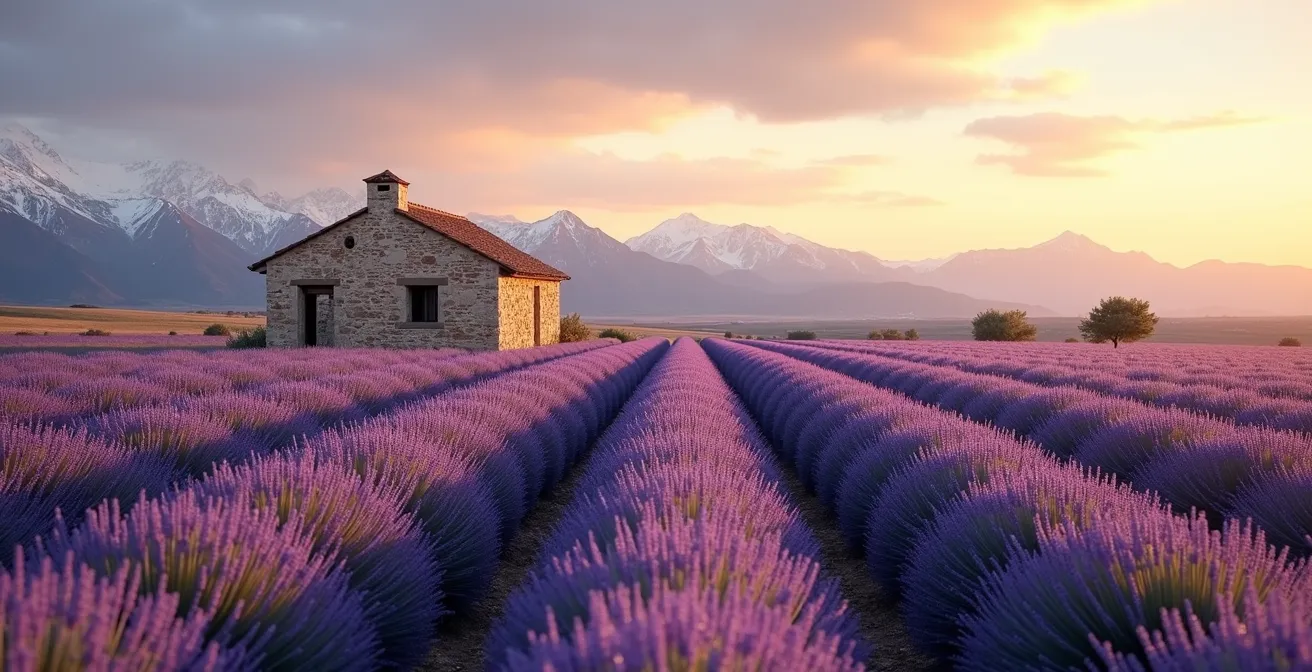
The perfect Valensole trip isn’t about finding an empty field in July; it’s about shifting your perspective from the visual peak to the complete agricultural cycle.
- Authenticity lies in the farm’s biodiversity and the farmer’s craft, not just the purple bloom.
- The post-harvest distillation season (late July-August) offers a far richer and less crowded sensory experience.
Recommendation: To truly escape the crowds and have an authentic moment, plan your visit to coincide with the harvest and distillation process, and engage directly with the farmers who sustain this landscape.
That perfect, symmetrical shot of an endless sea of purple under a golden sun—it’s the image that launches a thousand trips to Valensole. For photographers and couples seeking a romantic backdrop, the allure is undeniable. The common advice is predictable: go at sunrise, brave the ‘golden hour’ traffic, and hope for a brief moment between tour bus arrivals. This frantic chase for an empty frame has become the standard Provence experience, a race against the very crowds you’re trying to escape.
But this focus on a few weeks of peak bloom overlooks the soul of the landscape. It treats the fields as a static backdrop, ignoring the living, breathing agricultural system that powers the entire region. What if the most authentic, memorable, and photographically unique moments weren’t found during the peak bloom at all? What if the real secret wasn’t about *when* to dodge the crowds, but about understanding the entire lavender lifecycle to find experiences the tourist hordes completely miss?
This guide offers a different approach. It’s an insider’s look at Valensole, designed for those who want to connect with the place, not just capture it. We will explore the vital role of lavender in Provence’s biodiversity, master the art of ethical photography, and reveal why the true sensory peak of the season happens long after the Instagrammers have gone home. Forget the clichés; it’s time to discover the real Valensole.
This article provides an in-depth look at a more conscious way to travel. Follow along as we uncover the secrets that lie beyond the purple horizon.
Summary: A New Perspective on Provence’s Lavender
- Why Lavender Cultivation Is Crucial for Provence’s Biodiversity?
- How to Frame the Perfect Lavender Shot Without Stepping on the Bushes?
- Luberon or Verdon: Where to Find the Most Authentic Lavender Experience?
- The Souvenir Mistake That Costs Farmers Thousands of Euros Each Season
- How to Sync Your Trip with the Distillation Process for a Sensory Experience?
- Beaune or Dijon: Which City Is the Better Hub for Exploring Vineyards?
- Why Do Water Systems Fail in Tourist Towns During August?
- How to Plan a Cycling Wine Tour in Burgundy Without Getting Exhausted?
Why Lavender Cultivation Is Crucial for Provence’s Biodiversity?
Before the first photo is taken, it’s essential to understand that the lavender fields are not a wild, natural landscape; they are the heart of a complex agricultural ecosystem. This is a working countryside, central to a $55 million industry involving 1,700 producers. But its value extends far beyond the economic. The health of the lavender is intrinsically linked to the biodiversity of the entire Provençal landscape, a fact that pioneering farmers are now leveraging to protect their crops from climate change and disease.
The real story isn’t in the endless purple rows, but in what grows between them. Traditional monoculture has made lavender vulnerable, but a new wave of agroecology is changing the game. This approach treats the farm as a complete ecosystem rather than just a crop factory.
Case Study: The Agroecological Revolution in Valensole
Yann Sauvaire, a producer in the Valensole region, is a leader in this movement. Instead of sterile soil between his lavender, he plants sainfoin (a legume that naturally fixes nitrogen in the soil), allows native grasses to flourish, and integrates trees into his fields. The results are a model of sustainability: bird populations have soared, sheep can graze between the plants, and the improved soil health provides a natural defense against the cixiidae pest, which transmits the devastating stolbur phytoplasma disease. This method proves that a healthy ecosystem is the best form of crop insurance.
For the discerning visitor, this adds a new layer of appreciation. The most “authentic” fields are not necessarily the most pristine or uniform, but those buzzing with life. Look for the presence of other plants, the sound of birds, and the hum of diverse insect life. This is the sign of a thriving agricultural system, one where lavender is a partner with nature, not its master. Choosing to support farms that practice these methods is a direct investment in the long-term health of the landscape you’ve come to admire.
How to Frame the Perfect Lavender Shot Without Stepping on the Bushes?
The desire for that iconic photograph is powerful, but it’s the single biggest source of tension between tourists and farmers. Every stepped-on bush is damaged machinery and lost income. The secret to getting stunning, crowd-free photos isn’t about trespassing; it’s about changing your creative approach and embracing ethical photography techniques. The goal is to capture the essence of the lavender without harming it, using what can be called “photographic proxies.”
This means moving beyond the wide-angle “sea of purple” shot. Instead, focus on the details that tell a richer story. A macro lens can turn a single bee on a lavender sprig into a world of its own, while a telephoto lens allows you to compress the rows from a distance, creating a sense of immersion without ever leaving the designated path. The texture of a stone ‘borie’ hut against a purple backdrop or the way the light filters through a glass of local rosé with the fields in the distance can be far more unique and evocative.

As the illustration of the bee suggests, the most compelling images are often the most intimate. Here are some insider guidelines for respectful and creative photography:
- Use a telephoto lens (100mm+): Stand on the path and use the lens to compress the perspective. This makes the rows appear dense and full, giving the illusion of being deep within the field.
- Embrace the “Blue Hour”: This is the magical 15-20 minute window *after* the sun has set. Most tourists leave, but a soft, even light remains, perfect for capturing the deep purple hues without harsh shadows.
- Focus on proxies: Capture details like bees on flowers, the texture of dried lavender bundles, or shots through a glass of wine. These tell a more personal story.
- Support photo-friendly farms: Some farms now charge a small entry fee for a designated, safe photo area. This is the best way to get your shot while directly contributing to the farmer’s income.
- Leave the drone at home: Never fly a drone without explicit, written permission from the landowner. Regulations are strict, and the noise is highly disruptive to both farmers and other visitors.
Luberon or Verdon: Where to Find the Most Authentic Lavender Experience?
Not all lavender regions in Provence offer the same experience. The choice between the Valensole Plateau (part of the Verdon region) and the Luberon highlands is a strategic one, defining the entire character of your visit. It’s a choice between epic scale and intimate charm, and understanding the difference is key to finding the “authenticity” you seek.
The Valensole Plateau is the heart of industrial-scale lavandin production. This is where you find the world-famous “ocean of purple”—vast, rolling fields that stretch to the horizon. It’s visually stunning and perfect for dramatic, wide-angle photography. However, this scale also attracts the highest density of tourists. The Luberon, by contrast, offers a more dispersed, “garden-like” experience. Here, smaller fields of true lavender (Lavandula angustifolia) are nestled among vineyards, olive groves, and hilltop villages. The experience is less about overwhelming vistas and more about slow travel and discovery.
The following comparison breaks down the key differences to help you choose the right base for your style of travel.
| Criteria | Verdon/Valensole Plateau | Luberon Highlands |
|---|---|---|
| Elevation | 500m (lower altitude) | Higher altitude locations |
| Bloom Period | Mid-June to mid-July | Extends into late July, sometimes early August |
| Lavender Type | Mainly lavandin (hybrid) | True lavender (Lavandula angustifolia) |
| Field Character | ‘Ocean’ – vast, industrial scale | ‘Garden’ – smaller, intimate fields among vineyards |
| Tourist Density | Higher – most photographed location | Lower – more dispersed attractions |
| Best For | Epic scale photography, dramatic vistas | Slow travel, village exploration, wine pairing |
But the most overlooked secret for the sensory tourist is to rethink the timing entirely. As one local expert advises, the period after the main bloom offers a completely different, and arguably more authentic, experience.
Position late July and August, the distillation period, as an alternative trip for the ‘sensory tourist’ who wants to avoid the bloom-chasers.
– Local Tourism Expert, Valensole Tourism Planning Guide
This idea of a “second season” is the ultimate insider tip. While others are chasing the last fading flowers, you can be immersed in the intense, aromatic process of distillation, the true culmination of the lavender harvest.
The Souvenir Mistake That Costs Farmers Thousands of Euros Each Season
It seems harmless: picking a small handful of lavender stems as a fragrant souvenir. But when multiplied by thousands of visitors, this small act becomes a significant economic problem for farmers. It’s not just the loss of the flowers themselves, which are sold by weight for distillation; it’s the physical damage to the plants, which can impact future yields and require costly repairs to harvesting machinery. The scale of the problem is staggering; calculations from lavender farmer associations show that if just 1,000 tourists pick 10 stems each, that’s 10,000 stems lost from a single area in a single day.
This is the souvenir mistake that quietly costs the farming community thousands. The authentic way to support the landscape is not to take from it, but to participate in its economy. The solution is simple: buy, don’t pick. Farmers are not anti-tourist; they are business owners who rely on the harvest. Many have adapted by creating a direct bridge to visitors, offering a way to get a piece of Provence that is both ethical and supportive.
Case Study: Les Grandes Marges and Sustainable Souvenirs
Les Grandes Marges, a family-run farm for four generations, exemplifies the solution. Facing pressure from tourism, they opened an on-site boutique. Here, visitors can buy the farm’s own organic almonds, olive oil, and, of course, authentic lavender essential oil. This model transforms the dynamic: tourists become patrons. They leave with a genuine product of the land and the satisfaction of knowing their purchase directly supports the family who cultivates it, ensuring the fields are preserved for years to come.
When you buy directly from a farm stall or a local cooperative, you are casting a vote for sustainable tourism. You’re not just buying a product; you’re investing in the future of the very landscape you came to admire. Look for products with the AOP (Appellation d’Origine Protégée) label for “Haute-Provence Lavender Essential Oil” to guarantee its origin and quality. This is the true, authentic souvenir.
How to Sync Your Trip with the Distillation Process for a Sensory Experience?
This is the ultimate secret for the traveler seeking authenticity over aesthetics: visit during the “second season.” While everyone else plans their trip for the peak bloom in early July, the real magic for the senses happens from late July through August. This is the distillation period, a time of intense work, incredible aromas, and minimal crowds. It’s a shift from a purely visual experience to a deeply olfactory and immersive one.
During this time, the air in the valleys is thick with the scent of lavender as farmers harvest the fields and transport the cuttings to local distilleries. Witnessing this process is far more intimate than navigating selfie sticks. You can see the traditional copper stills steaming alongside modern machinery, watch the golden essential oil slowly separate from the floral water, and experience the complete “olfactory timeline” of the plant—from the green, sharp scent of fresh-cut stems to the deep, honey-like aroma at the peak of distillation.
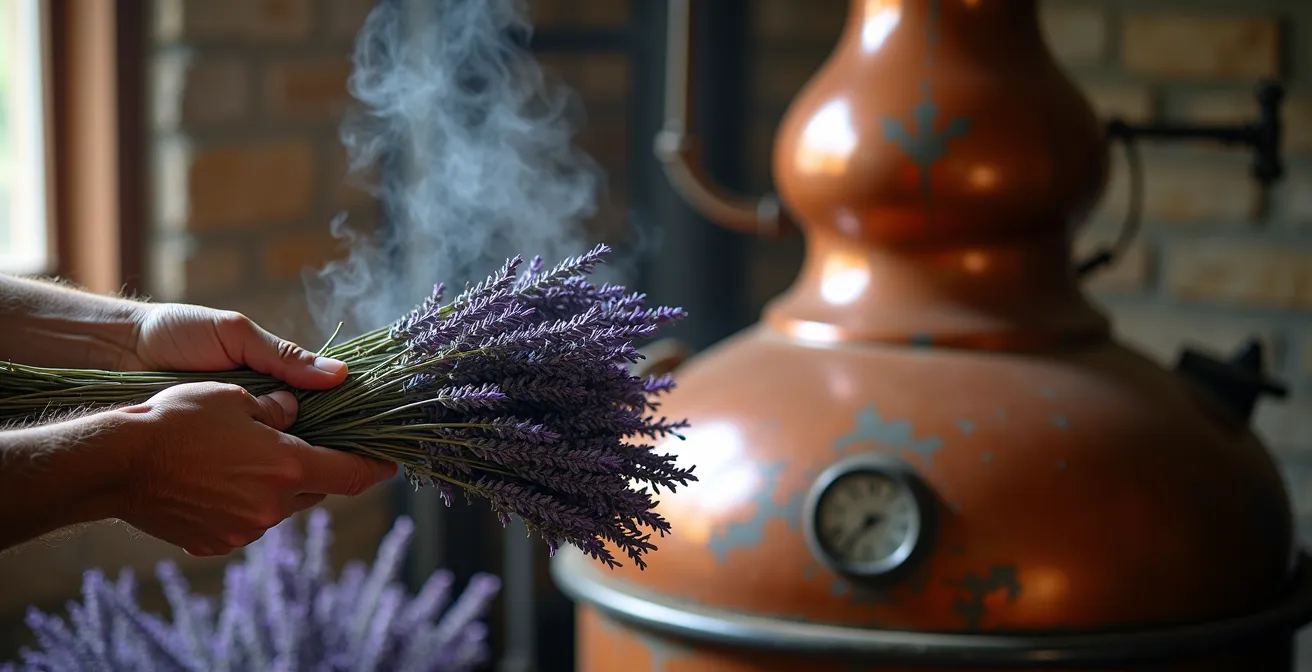
Planning for this experience requires a different mindset. Unlike the widespread blooms, distillation is site-specific and time-sensitive. You need to map out small, family-run distilleries that welcome visitors and be aware of the “préfanage” period—the 1-3 days the lavender is left to dry in the sun after being cut, which concentrates its oils. This is slow travel at its best, following the rhythm of the harvest, not a tour bus schedule.
I visited Valensole during COVID-19 which gave me the possibility to enjoy these magical lavender fields without the crowds. The distillation period offered a completely different sensory experience – the air was thick with lavender essence, and watching the traditional process at small family distilleries was far more intimate than battling photographers during peak bloom.
– Visitor Experience, Our Planet in My Lens
This testimony captures the essence of the “second season.” It’s an opportunity to connect with the craft and the people behind the iconic landscapes, an experience that lingers long after the fragrance has faded from your clothes.
Beaune or Dijon: Which City Is the Better Hub for Exploring Vineyards?
Just as choosing between the Luberon and Valensole defines a lavender trip, selecting a home base in Burgundy is the most critical decision for any wine tour. The two main contenders, Beaune and Dijon, offer vastly different experiences. Your choice depends on whether you want total immersion in the world of wine or a more balanced city experience with vineyards within reach.
Beaune is, without a doubt, the epicenter of Burgundy wine tourism. A small, walkable town, it sits directly in the heart of the Côte de Beaune and offers immediate access to the prestigious vineyards of Pommard, Volnay, and Meursault. Everything in Beaune revolves around wine, from the shops and restaurants to the daily rhythm of life. It’s the ideal choice for the purist who wants to live and breathe wine for the duration of their stay. Its main drawback is that life quiets down significantly after the tasting rooms close.
Dijon, on the other hand, is a true city. As the capital of the region, it boasts a wider array of dining, cultural activities, and nightlife. Its position at the northern end of the Côte de Nuits makes it an excellent base for exploring the fabled vineyards of Gevrey-Chambertin and Vosne-Romanée. However, accessing the vineyards from Dijon requires transportation, whether by car, train, or a longer bike ride. It offers more flexibility for a trip that isn’t solely focused on wine.
| Factor | Beaune | Dijon |
|---|---|---|
| Location | Heart of Côte de Beaune, central to both wine regions | Northern position, closer to Côte de Nuits |
| Size & Character | Small ‘Vineyard Town’ – walkable, wine-focused | True city with diverse dining, TGV access |
| Wine Access | Walking distance to premier vineyards | Requires transport to vineyard areas |
| Cycling Routes | Direct access to Voie des Vignes (80km wine trail) | Good access but requires initial transit |
| Evening Life | Quiet, restaurant-focused after 5PM | Active nightlife and cultural options |
| Flexibility | Everything revolves around wine schedule | More options for non-wine activities |
Ultimately, the decision is a trade-off: Beaune offers immersion, while Dijon offers diversity. For a short, intensely-focused wine trip, Beaune is unparalleled. For a longer stay with a mix of activities, Dijon provides a more dynamic and practical hub.
Why Do Water Systems Fail in Tourist Towns During August?
For visitors in peak season, a sudden drop in water pressure or restrictions on use can seem like a frustrating anomaly. But for many popular tourist destinations, especially in sun-drenched regions like Provence, it’s a predictable crisis rooted in a fundamental mismatch between infrastructure and demand. The systems simply weren’t designed to handle the massive summer influx of people.
The core of the problem is a seasonal demand spike that collides with the driest time of the year. In France, for example, the French Ministry of Ecology reports that an astonishing 60% of all water consumption occurs between June and August. This surge is driven almost entirely by tourism and seasonal agriculture. Small towns whose water infrastructure was built to support a winter population of a few thousand can suddenly be required to serve tens of thousands, placing an impossible strain on local reservoirs and aquifers.
This isn’t a hypothetical issue; it’s a yearly reality for which authorities must plan far in advance.
Case Study: The PACA Region’s Water Balancing Act
The Provence-Alpes-Côte d’Azur (PACA) region is a prime example of this tourist-driven water stress. An official analysis reveals that 40% of its areas exceed their water resource capacity during the peak tourist season. To compensate, a massive and complex water management strategy is deployed. The Serre-Ponçon dam, originally built for hydroelectric power, now functions as a critical lifeline, slowly releasing its vast Alpine water reserves throughout the summer to supplement the over-strained systems in the densely populated coastal towns. It’s a large-scale solution to a problem created by the concentration of tourism.
As a conscious traveler, being aware of this hidden infrastructural strain is important. Simple actions like taking shorter showers, reusing towels, and avoiding wasteful water use are not just eco-friendly gestures; they are practical measures that help alleviate the pressure on a system pushed to its absolute limit. It’s a small but meaningful way to reduce your impact on the local community.
Key Takeaways
- The most authentic Valensole experience often lies outside the peak bloom, during the less crowded but more sensory distillation season.
- Ethical photography (using telephoto lenses from paths, focusing on details) produces unique images without damaging crops.
- Supporting farmers by purchasing AOP-certified products directly from them is the most sustainable way to take a piece of Provence home.
How to Plan a Cycling Wine Tour in Burgundy Without Getting Exhausted?
A cycling tour through the vineyards of Burgundy sounds idyllic, but the reality can be a grueling mix of steep hills, hot sun, and the dehydrating effects of wine tasting. The secret to an enjoyable and safe tour is not physical endurance, but strategic planning. A well-designed itinerary prevents exhaustion and allows you to focus on the pleasure of the ride and the tastings.
The most common mistake is planning a point-to-point marathon, cycling with luggage from one town to the next. A far more civilized approach is to establish a single base, like Beaune, and plan circular day routes. This eliminates the burden of luggage and allows for greater flexibility. Another critical element is pacing. The “90-minute rule” is a guideline used by experienced guides: after each wine tasting, allow at least 90 minutes for your body to process the alcohol and for you to rehydrate with water before getting back on the bike. And of course, using the ‘crachoir’ (spittoon) during tastings is not rude; it’s the mark of a serious taster and an essential safety practice for anyone cycling.
The rise of e-bikes has also been a game-changer, acting as an “equalizer” that opens up the scenic but challenging ‘Hautes-Côtes’ routes to cyclists of all fitness levels. As one avid cyclist noted, the change has been dramatic.
Five or six years ago, it was rare to see an e-bike over here, and now at least half the cyclists on the Voie des Vignes were on e-bikes.
– Travel Blogger, Biking France Blog – Burgundy Tour Review 2024
This technology allows you to save your energy for the parts of the ride that matter most. By combining smart logistics with the right gear, you can create a tour that is relaxing and rewarding, not a test of stamina.
Your Action Plan: The Exhaustion-Proof Burgundy Bike Tour
- Base & Routes: Establish a single home base (e.g., Beaune) and plan circular day trips to avoid carrying luggage.
- Pacing & Safety: After a tasting, wait 90 minutes and rehydrate before cycling. Always use the crachoir.
- Gear Strategy: Consider an e-bike to conquer hills and extend your range without exhaustion, allowing access to more scenic routes.
- Route Selection: Mix challenging vineyard climbs with easy rides on the flat Voie des Vignes (a former railway line) for a balanced itinerary.
- Tasting & Riding Balance: Plan shorter morning rides (15-25km) on days with scheduled afternoon tastings to conserve energy.
With this insider knowledge, you are now equipped to plan a trip that goes beyond the surface, whether it’s finding the soul of a lavender field or the perfect rhythm for a vineyard tour. The next step is to transform this understanding into your own unique journey.