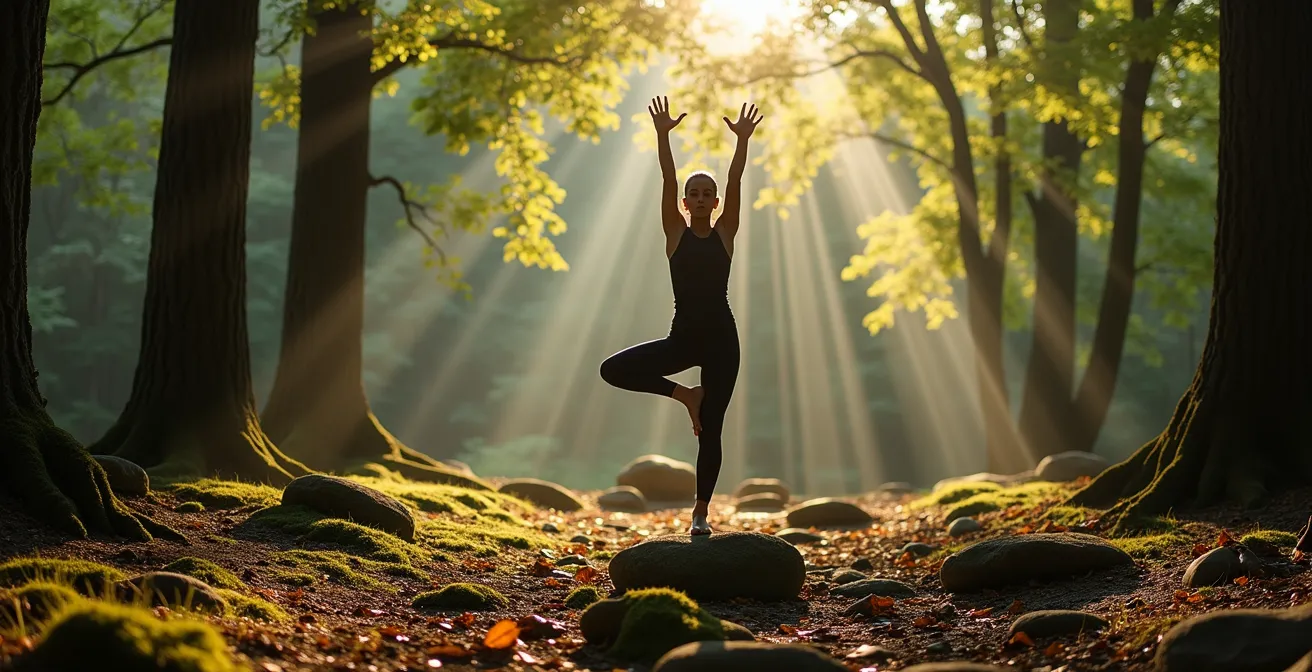
The key to outdoor yoga isn’t finding a flat, stable surface; it’s learning to use the unpredictable terrain to unlock a deeper level of balance and body awareness.
- Uneven ground forces your body into a “proprioceptive dialogue,” strengthening stabilizer muscles far more than a studio floor can.
- Natural distractions like sounds and temperature changes aren’t obstacles but tools for “sensory anchoring” and enhanced mindfulness.
Recommendation: Stop fighting the environment. Start your practice by accepting the terrain as your new teacher, not an inconvenience.
That first step from the predictable, polished floor of a yoga studio onto the yielding surface of grass or sand can be a humbling experience. Your perfectly aligned Warrior II suddenly wobbles, your balance feels compromised, and the serene focus you cultivated indoors is shattered by the buzz of an insect or a sudden gust of wind. For many yogis accustomed to a controlled environment, the transition to outdoor practice feels less like a blissful return to nature and more like a frustrating battle against the elements. It’s no surprise that while the appeal is strong, a recent wellness survey shows that only 32% practice outdoors.
Common advice often misses the mark, suggesting you simply “find a flat spot” or “use a thicker mat,” essentially encouraging you to recreate the studio environment you just left. But what if the true potential of outdoor yoga lies not in avoiding nature’s unpredictability, but in embracing it? Practitioners like Erin Sampson of Five Parks Yoga have built a global community by demonstrating that consistent practice on varied terrain strengthens stabilizing muscles and improves proprioception. The goal isn’t to tame the wilderness; it’s to let the wilderness train you.
This guide reframes the challenge. We’ll explore how to stop fighting the ground beneath you and start a new proprioceptive dialogue with it. You’ll learn to transform instability from a frustrating bug into a powerful feature, using the earth itself as a tool to deepen your practice. We will cover everything from choosing the right surface-to-mat interface and adapting your asanas for temperature, to mastering balance and syncing your breath with the rhythm of the natural world.
This article provides a complete roadmap for moving your practice outdoors. The following sections break down the specific skills you need to transform your flow and find stability in nature’s beautiful chaos.
Summary: Adjusting Your Yoga Practice for the Great Outdoors
- Travel Mat or Rug: Which Grip Works Best on Sand?
- How to Meditate When Flies Are Buzzing Around You?
- Hot Sun or Cool Breeze: How to Change Your Asanas for Temperature?
- The Balance Mistake That Causes Injuries on Uneven Grass
- How to Practice in a Park Without Being a Nuisance?
- How to Practice Walking Meditation in a Forest Setting?
- Why Does Exercise in Nature Burn More Stress Than the Gym?
- How to Sync Your Breath with Your Steps in the Woods?
Travel Mat or Rug: Which Grip Works Best on Sand?
Your mat is the interface between your body and the earth, and on an unpredictable surface like sand, its role changes dramatically. In a studio, you want stickiness. Outdoors, you’re battling sand, moisture, and texture. A standard sticky mat can become a sandy, abrasive nightmare. The choice is a trade-off between grip, weight, and how well the material sheds debris. For sand, a material like cork is excellent because it repels sand well, while natural rubber offers superior grip but can hold onto more grit. The goal is to find a surface that allows for a proprioceptive dialogue rather than muting the feedback from the ground.
A microfiber towel might seem like a lightweight option, but it offers poor grip on its own and can bunch up on sand. A jute mat provides a more natural, breathable feel but may offer only moderate grip. Your choice depends on your priority: are you doing a powerful vinyasa flow that demands maximum grip, or a gentle practice where feel and portability are more important? Analyzing the performance of different materials helps make an informed decision.
| Material Type | Sand Performance | Grass Performance | Rock Performance | Weight (lbs) |
|---|---|---|---|---|
| Natural Rubber | Good grip, moderate sand absorption | Excellent stability | Good traction | 4-7 |
| Cork | Fair grip, repels sand well | Good stability | Excellent on dry rock | 2-4 |
| Microfiber Towel | Poor grip, lightweight | Fair when damp | Not recommended | 0.5-1 |
| Jute | Moderate grip, natural feel | Good breathability | Fair durability | 2-3 |
Ultimately, selecting the right gear is the first step in adapting your practice, not just enduring the outdoors. A surface that works with the environment allows you to focus on your flow instead of fighting your equipment.
How to Meditate When Flies Are Buzzing Around You?
Nature demands your attention. The rustle of leaves, the feel of sunlight on your skin, the song of birds overhead—these sensory inputs ground you in the present. Outdoor yoga strengthens your focus, adaptability, and balance. The elements become teachers, inviting you to flow with change instead of resisting it.
– Lauren Leduc, True Love Yoga Founder
Nothing tests a meditator’s focus like a persistent fly. In the sterile quiet of a studio, the goal is often to eliminate distractions. Outdoors, this is impossible. The secret is to shift your mindset from resisting distractions to integrating them. This is the art of sensory anchoring. Instead of treating the buzzing as a nuisance that pulls you away from your breath, you can learn to use it as the very object of your meditation. By observing the sound with detached curiosity—noting its pitch, volume, and movement—you transform an annoyance into a point of focus. This trains the mind to remain calm and centered amidst chaos, a skill far more applicable to daily life than meditating in a soundproof room.
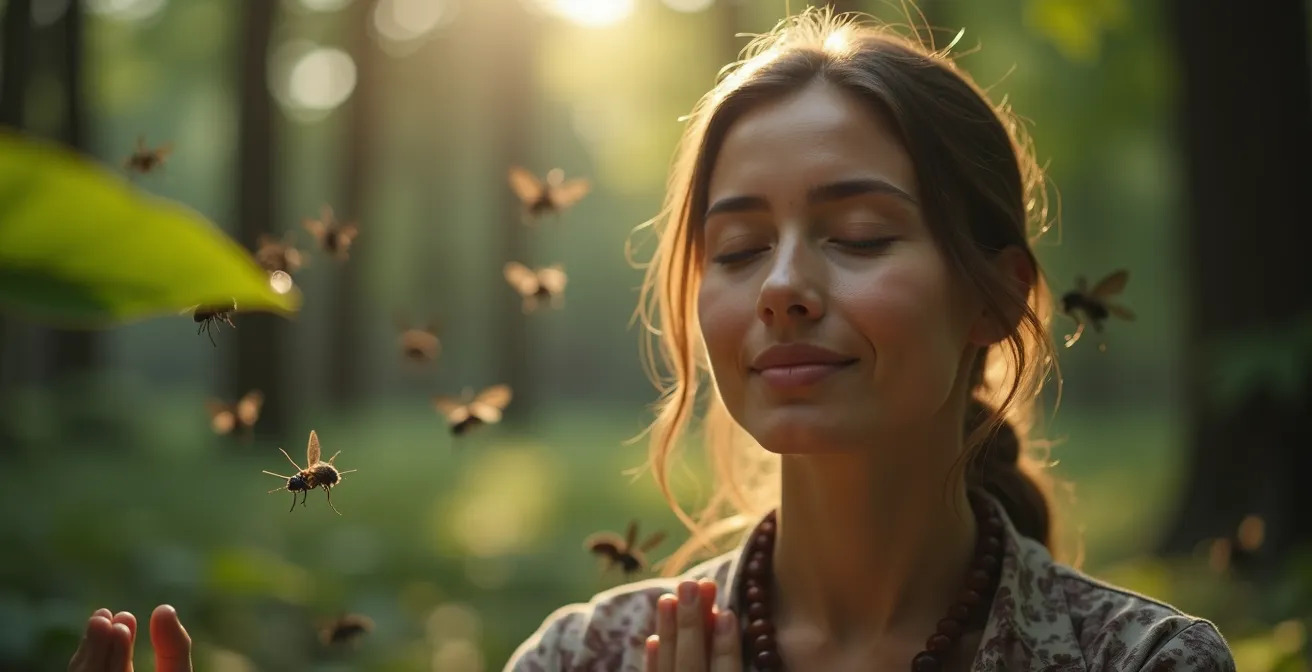
This approach applies to all sensory input: the feeling of wind on your skin, the shifting light through the trees, the distant sound of traffic. Each one is an invitation to practice acceptance and expand your awareness. Instead of building a wall around your practice, you dissolve the boundaries and allow the entire environment to become part of your meditative experience. True peace isn’t the absence of noise; it’s maintaining inner stillness regardless of the external environment.
Your Action Plan: The Acoustic Integration Method
- Begin with a ‘sensory scan’ – acknowledge all sounds, including insects, without judgment.
- Choose one consistent sound (like buzzing) as your meditation anchor, similar to using your breath.
- Track the sound’s movement and pitch variations with curiosity rather than irritation.
- When your mind wanders, gently return your attention to the chosen sound anchor.
- End by expanding your awareness to include all natural sounds as part of your practice.
Hot Sun or Cool Breeze: How to Change Your Asanas for Temperature?
The thermostat in a yoga studio is set for optimal comfort. Nature offers no such luxury. Practicing outdoors requires you to become your own thermostat, actively modifying your sequence to balance internal and external temperatures. A common mistake is performing a fiery, heat-building Vinyasa flow under the midday sun. This can quickly lead to exhaustion or overheating. Conversely, a slow, restorative practice on a cool, breezy day may leave you feeling chilled and stiff. The key is to adapt your asanas and breathwork to harmonize with the weather, making the temperature a partner in your practice rather than an adversary.
On hot days, your sequence should be grounding and cooling.
- Focus on a Solar Sequence with Yin and restorative poses that are low to the ground.
- Keep holds short, perhaps for a maximum of 3-5 breaths, to avoid building excessive heat in the muscles.
- Incorporate cooling pranayama like Sitali breath (curling the tongue and inhaling through it) between poses.
On cool days, the goal is to generate internal warmth.
- Begin your Lunar Sequence with several rounds of dynamic Sun Salutations to build heat quickly.
- Maintain continuous movement with minimal static holds, linking breath to motion.
- Use Ujjayi breath (the “ocean breath”) throughout your practice to stoke your internal fire.
This conscious adaptation not only ensures safety and comfort but also deepens your connection to the elements. Smart yogis listen to their bodies and the environment, and according to 73% of outdoor yoga instructors surveyed, the simplest adaptation is to practice in the early morning or evening when temperatures are milder.
The Balance Mistake That Causes Injuries on Uneven Grass
By trying tree pose on uneven terrain or downward-facing dog with hands pressed into the sand, you can challenge yourself both mentally and physically. Uneven, natural surfaces such as sand, grass, or the woodland floor can intensify a yoga posture and its physical benefits.
– Hilary Kimblin, Yoga Under the Trees
The single biggest balance mistake studio yogis make on uneven grass is trying to be static. On a flat floor, you can lock your joints and “find” a pose. On grass, the ground is alive with subtle dips and mounds. Trying to hold a rigid Tree Pose is a recipe for a wobbly ankle. The key is to shift from seeking static stability to cultivating dynamic stability. This means engaging in a constant, fluid conversation with the ground. Your feet, ankles, and legs must perform thousands of unconscious micro-adjustments to maintain equilibrium. This isn’t a sign of poor balance; it’s a sign of highly intelligent, responsive balance.
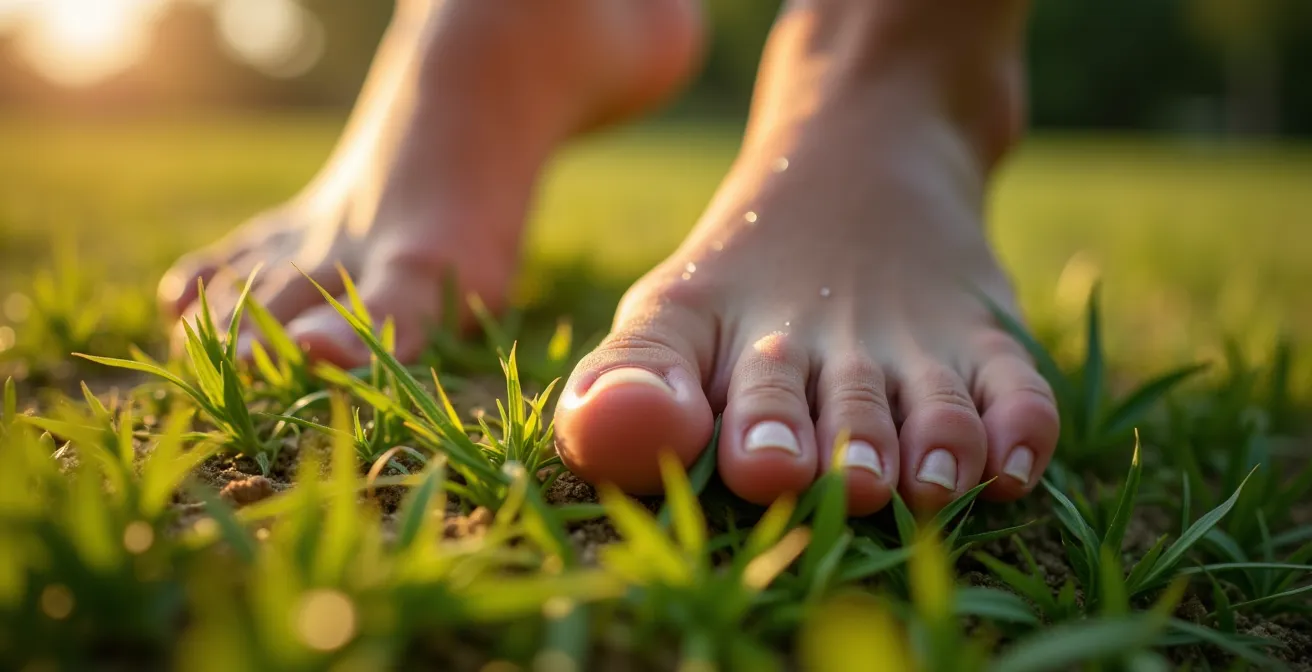
Instead of locking your standing leg, keep a micro-bend in the knee. Feel your toes spreading and gripping the earth. Think of your foot not as a solid block but as a sensitive receptor, constantly sending feedback to your brain. This proprioceptive dialogue is what makes outdoor practice so beneficial. You are actively retraining your nervous system and strengthening the tiny stabilizer muscles around your joints. It’s challenging, but the payoff is immense. One study found that practitioners who trained on natural surfaces showed a 40% improvement in ankle stability and a significant reduction in balance-related injuries compared to those who only practiced indoors. The terrain becomes your teacher, forcing you to find a more resilient, adaptable form of balance.
How to Practice in a Park Without Being a Nuisance?
Taking your practice into a public park introduces a new layer of awareness: social etiquette. The goal is to share the space respectfully, not to claim it as your private studio. The primary principle is mindfulness of others. This starts with choosing your location. Avoid high-traffic areas, designated sports fields, or spots directly next to picnic benches or playgrounds. Look for a quiet corner or a less-frequented patch of grass where you can create a natural buffer zone of at least 15-20 feet between you and other park-goers. This space communicates that you are in your own world and respects their right to enjoy the park without feeling like they are intruding on your practice.
Sound is another critical consideration. While music can enhance your personal experience, playing it through speakers is a public nuisance. If you rely on audio guidance or a playlist, use headphones. For safety, consider keeping one earbud out to remain aware of your surroundings—approaching people, dogs, or park vehicles. Your presence should add to the park’s peaceful ambiance, not detract from it. Think of your practice as a quiet, moving meditation that harmonizes with the environment. By being considerate, you not only ensure a peaceful session for yourself but also act as a positive ambassador for outdoor yoga, showing that it can coexist beautifully within public spaces.
How to Practice Walking Meditation in a Forest Setting?
Outdoor practice isn’t confined to a mat. A forest path offers a perfect opportunity to practice walking meditation, taking the principles of mindfulness and proprioception on the move. Unlike walking on a sidewalk, a forest trail demands your full attention. Each step is different—over a root, onto soft pine needles, across a patch of damp earth. This is an ideal setting to deepen your proprioceptive dialogue, feeling how your feet adapt to the changing terrain. The goal is to synchronize your movement, your breath, and your sensory awareness into a single, flowing experience.
A structured way to approach this is through a protocol of sensory layering. This method guides you to build your awareness incrementally, preventing overwhelm and fostering a deep connection with your environment. By focusing on one sense at a time before integrating them all, you can transform a simple walk into a profound meditative practice. The steps are as follows:
- Minutes 1-5: Focus on Foot Sensations. Pay exclusive attention to the feeling of your feet connecting with the ground. Notice the texture, temperature, and pressure changes with each and every step.
- Minutes 6-10: Add the Auditory Layer. While maintaining awareness of your feet, open your hearing to the sounds of the forest—the birds, the wind in the leaves, the crunch of your footsteps.
- Minutes 11-15: Integrate Scent Awareness. Continue with foot and sound awareness, and now consciously add the sense of smell. Breathe in the scent of damp earth, pine, and decaying leaves.
- Minutes 16-20: Achieve Full Sensory Integration. Let go of focusing on any single element. Allow all your senses—touch, sound, sight, and smell—to merge, creating a holistic experience of walking through the forest.
This practice does more than just calm the mind; studies on forest therapy have demonstrated tangible benefits, including significant reductions in anxiety and improvements in attention span when compared to urban walking.
Key Takeaways
- Embrace instability: Uneven terrain isn’t a flaw; it’s a feature that builds superior balance and stabilizer strength.
- Use your senses: Anchor your focus on natural sounds and sensations instead of fighting them to deepen your meditation.
- Adapt your flow: Modify your sequence for temperature and terrain, using dynamic movement rather than seeking static perfection.
Why Does Exercise in Nature Burn More Stress Than the Gym?
While any form of yoga can reduce stress, taking your practice outdoors amplifies the benefits in ways a gym cannot replicate. The reason lies in how the natural environment interacts with our brains and bodies. A gym is a predictable, often over-stimulating environment with artificial lights, repetitive music, and screens. In contrast, nature engages our minds through a process known as “soft fascination.” A landscape with trees, water, and clouds holds our attention effortlessly without demanding intense focus, which allows our minds to wander, reflect, and recover from mental fatigue. This is a powerful antidote to the “directed attention” required by modern urban life and work.
Physically, the constantly changing terrain provides a more complex and effective workout. As an analogy, research shows trail runners burn up to 10% more calories than treadmill runners on a flat surface, thanks to the continuous micro-adjustments required. The same principle applies to yoga. Holding a pose on uneven ground recruits more stabilizer muscles and improves cardiovascular health more effectively than on a flat floor. Mentally, studies show that spending time on trails reduces stress hormones like cortisol and calms the mind by lowering activity in brain regions linked to rumination and anxiety. The combination of a gentle mental engagement and a heightened physical challenge makes outdoor exercise a uniquely potent tool for melting away stress.
How to Sync Your Breath with Your Steps in the Woods?
The final layer of integrating your practice with the outdoors is syncing your internal rhythm—your breath—with the external rhythm of your movement. This practice, often used in walking meditation, turns a simple hike into a seamless flow state. The goal is to create a simple, repeating pattern that anchors your mind and calms your nervous system. By focusing on the coordination of breath and steps, you leave little room for distracting thoughts, achieving a state of active mindfulness. This is not just a niche technique; breathwork is a central pillar of modern yoga. In fact, CDC health statistics reveal that among those who practiced yoga, over 57.4% practiced meditation as part of yoga, and breathwork is the bridge between the physical and meditative aspects.
The technique is simple in principle. You start by finding a comfortable, natural walking pace. Then, you begin to match your breath to your steps. There is no single “correct” ratio; the key is to find a rhythm that feels sustainable and calming for you.
- A simple starting point is a 2:2 ratio: take two steps for every inhale, and two steps for every exhale.
- If you are moving more slowly or want to deepen your breath, you can try a 3:3 or 4:4 ratio: three steps on the inhale, three on the exhale.
- On an uphill section where your heart rate increases, you might naturally shift to a 2:1 ratio: two steps on the inhale, one on the exhale, or vice-versa.
The specific numbers are less important than the act of consistent, conscious coordination. This practice transforms walking from an unconscious activity into a deliberate, rhythmic dance with nature, fully immersing you in the present moment.
To put these principles into practice, start with a single, simple pose in your backyard or a quiet park corner. The next step is not to perfect the pose, but to simply begin the conversation between your body and the world around you.
Frequently Asked Questions About Practicing Yoga in Public Parks
How far should I position myself from other park users?
Choose a place that boasts safety and comfort for everyone. Maintain at least 15-20 feet from paths and picnic areas to create a respectful buffer zone.
Is it acceptable to play music during outdoor practice?
No, playing music on speakers in public spaces disrupts others. If you need audio guidance, use headphones with one ear free for environmental awareness.
What if people stop to watch my practice?
Acknowledge observers with a brief, peaceful smile that communicates awareness without invitation, then return your focus to your practice.