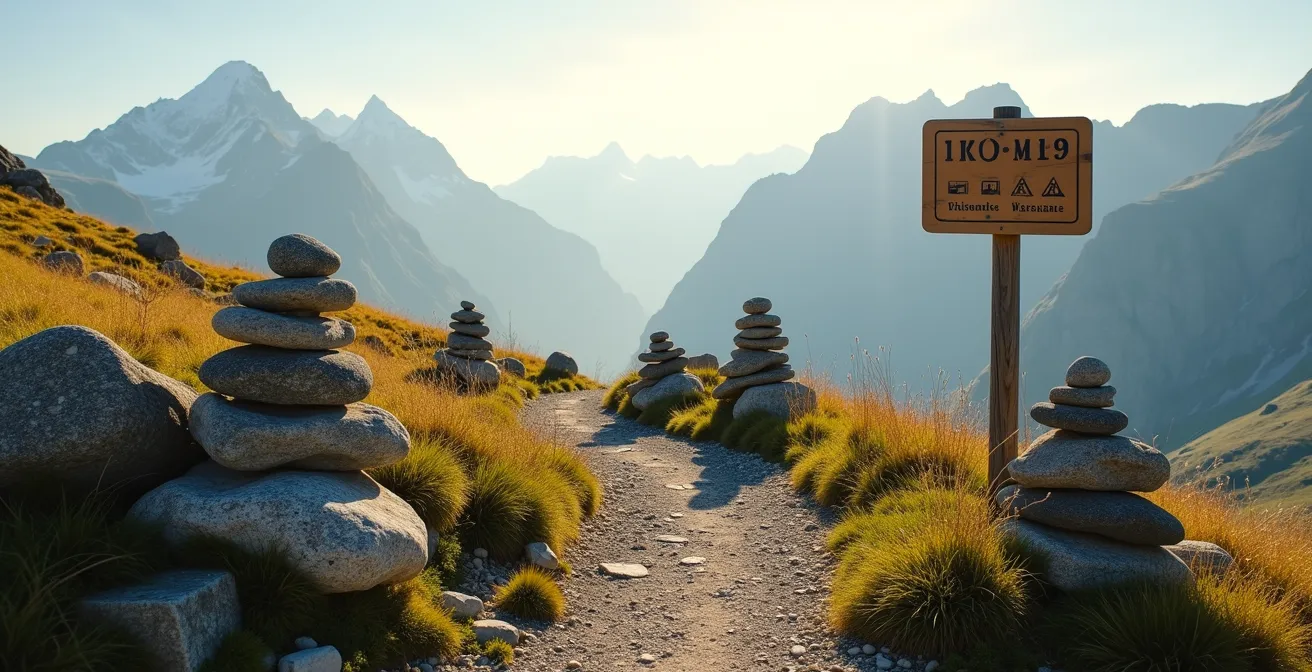
Contrary to the open wilderness policies in many countries, France’s national parks operate under a strict, centralized regulatory philosophy. Understanding this is not just about avoiding fines; it’s about respecting a conservation model that legally distinguishes between highly protected “core zones” and peripheral “adhesion zones.” This guide deciphers the non-obvious rules on dogs, overnight stays, and even noise, so you can hike with confidence and respect.
The allure of the French Alps or the Pyrenees is undeniable for any serious hiker. You imagine vast, open landscapes, the freedom to pitch a tent under the stars, and your faithful dog by your side. For those accustomed to the wilderness ethos of North America or Scandinavia, these expectations seem natural. Yet, arriving in a French National Park with this mindset can lead to confusion, frustration, and even significant fines. The rules here are not merely suggestions; they are stringent, legally-enforced regulations born from a unique conservation history.
Most guides will tell you the basics: don’t litter, don’t pick flowers. But they often fail to explain the fundamental concepts that govern everything else. The French system is built on a crucial distinction between a park’s “zone cœur” (core zone), where nature has absolute priority, and its “aire d’adhésion” (adhesion or peripheral zone), where human activities are managed in partnership with local communities. This distinction dictates everything from where you can walk your dog to where you can sleep.
This article moves beyond the obvious prohibitions. Instead of just listing rules, we will delve into the regulatory philosophy behind them. Why are domestic dogs, even on a leash, strictly forbidden in core zones while guard dogs roam free? What is the legal difference between “bivouac” and “wild camping,” and why does it matter? By understanding the ‘why,’ you transform from a potential rule-breaker into a respectful and informed visitor, able to navigate these protected territories with the confidence of a local.
To navigate these specific regulations effectively, it’s essential to understand each component of the park’s protective framework. This guide breaks down the most critical and often misunderstood rules you will encounter, ensuring your adventure is memorable for all the right reasons.
Summary: What Are the Strict Prohibitions in French National Parks You Must Know?
- Why Are Domestic Dogs Banned from Core National Park Zones?
- How to Pack for a Multi-Day Hike Where Refuges Are the Only Option?
- Bivouac or Camping: What Is Actually Allowed in the High Mountains?
- The Noise Error That Scares Wildlife Away Before You See It
- When to Book Mountain Refuges to Secure a Bed for the Summer Season?
- Why Are Some Reserves Completely Closed to the Public?
- Why Was Vanoise Created as France’s First National Park?
- Why Is Access to Nature Reserves Often More Restricted Than National Parks?
Why Are Domestic Dogs Banned from Core National Park Zones?
For many hikers, leaving their canine companion behind is unthinkable. However, in the core zones of French National Parks, it is a non-negotiable rule: domestic dogs are strictly prohibited, even on a leash. This isn’t an arbitrary decision but a critical measure to protect fragile alpine ecosystems. Domestic dogs, no matter how well-behaved, are perceived as predators by native wildlife like marmots, chamois, and ibex. Their mere presence and scent can cause significant stress, disrupting feeding and breeding patterns and forcing animals to flee, wasting precious energy reserves.
Furthermore, dogs can be carriers of parasites and diseases that can decimate vulnerable wildlife populations which lack immunity. The rule aims to prevent ecological contamination and maintain the natural behavior of the fauna. This creates a stark contrast for visitors who may see large, white Pyrenean Mountain Dogs, or ‘Patous’, roaming freely. These are not pets; they are working livestock guardian dogs protecting flocks from wolves and bears. They are an integral part of the pastoral economy and are exempt from the ban, but they are fiercely protective and should be given a wide berth.
The ban is most absolute in the strictly protected core zones of French national parks, which represent only 0.45% of the country’s surface area. In the peripheral ‘adhesion zones’ and in most Regional Natural Parks, dogs are often permitted on a leash. A few exceptions exist, such as the path to the Hostellerie du Cirque in Gavarnie, but these are rare. Always verify the specific zoning of your intended route before setting out with a dog.
How to Pack for a Multi-Day Hike Where Refuges Are the Only Option?
Once you accept that free camping is largely forbidden, the French mountain ‘refuge’ (hut) becomes the cornerstone of any multi-day trek. This system requires a shift in packing strategy from self-sufficiency to minimalist, communal living. Forget the heavy tent and cooking stove; your pack should be optimized for a shared dormitory and a ‘demi-pension’ (half-board) meal plan. The most critical item is a ‘sac à viande’ or sleeping bag liner. It is mandatory for hygiene reasons, as the refuges provide blankets or duvets but do not launder them daily.
Electricity is a luxury, not a given. Sockets are scarce, often reserved for the guardian’s use, or require payment. A fully charged power bank is essential for your phone or GPS device. Similarly, do not rely on credit cards. Many refuges, particularly the more remote ones, lack the reliable connectivity for payment terminals. Carrying sufficient cash in Euros is a fundamental requirement to pay for your stay, drinks, and any extra snacks. While the demi-pension provides a hearty dinner and a simple breakfast, you are responsible for your own lunches and high-energy snacks for the trail.
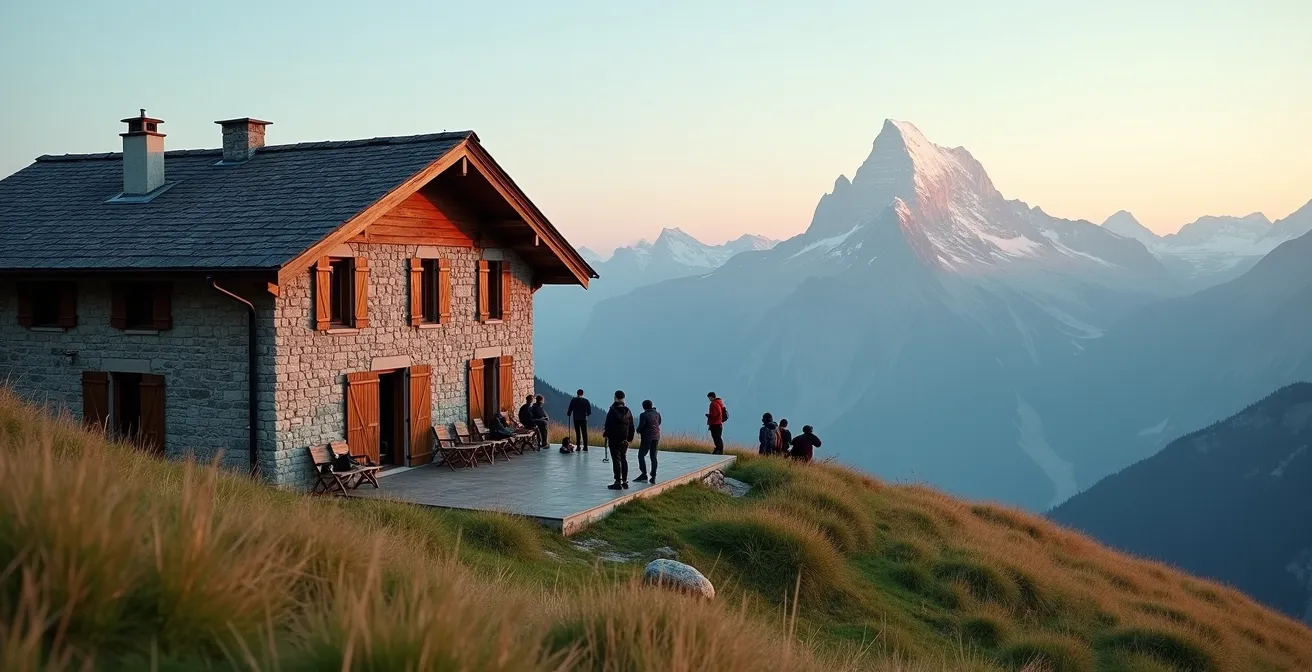
As the image of a refuge nestled in the mountains suggests, these are places of disconnection. Wi-Fi is almost universally unavailable, so pack lightweight entertainment like a deck of cards or a book for the evenings. Embracing this low-tech, communal atmosphere is part of the unique charm of the French hut-to-hut hiking experience. With a network as extensive as that found in Vanoise National Park alone, which offers 53 refuges for hikers, mastering this packing style opens up vast territories for exploration.
Bivouac or Camping: What Is Actually Allowed in the High Mountains?
The terms “bivouac” and “wild camping” are often used interchangeably, but in the context of French law, they are distinctly different concepts. Wild camping—setting up a multi-night camp with extensive gear—is strictly forbidden in the core zones of all national parks. However, ‘le bivouac’ is often tolerated under a specific set of unwritten but widely understood rules. It refers to a temporary, minimalist overnight shelter, intended for a single night’s rest as part of a longer journey.
The governing philosophy is “dusk till dawn.” This generally means you can pitch a small, lightweight tent after 7 p.m. and must have it packed away by 9 a.m. The location is also critical: the bivouac must be set up at least an hour’s walk from any road access or park boundary. This ensures that it is used by genuine long-distance hikers, not for casual roadside camping. Campfires are universally prohibited to prevent wildfires and soil damage. It is also important to know that there is no admission fee for any of France’s national parks, making access free but highly regulated.
The table below clarifies the essential differences between these two practices. Understanding this distinction is fundamental to respecting park regulations and avoiding penalties.
| Aspect | Bivouac | Camping |
|---|---|---|
| Duration | Single night (7pm-9am) | Multiple nights |
| Equipment | Lightweight tent only | Full camping gear |
| Location | 1+ hour from roads/boundaries | Designated areas only |
| Fire | Prohibited | Prohibited |
| Permission in core zone | Sometimes tolerated | Strictly forbidden |
Even where bivouacking is tolerated, some parks have designated bivouac areas near refuges, sometimes for a small fee. It is always the hiker’s responsibility to check the specific regulations for the park they are visiting, as rules can vary. The Mercantour and Vanoise parks, for example, have stricter rules than the Pyrenees. Failure to comply can result in on-the-spot fines from park rangers (‘gardes-moniteurs’).
The Noise Error That Scares Wildlife Away Before You See It
Many hikers enter a national park hoping for a glimpse of its iconic wildlife, whether it’s a majestic ibex, an agile chamois, or a whistling marmot. Yet, they often make a critical, unconscious error that ensures the animals are gone long before they arrive: they are too loud. In the vast, natural amphitheaters of mountain valleys, sound travels with surprising clarity and distance. The metallic click of trekking poles on rock, the crinkle of a snack wrapper, or a loud conversation can alert wildlife from a kilometer away.
Animals in these protected zones are not habituated to human noise. They associate it with danger and will retreat to higher, inaccessible ground at the first sign of it. Flying a drone, for example, is not only a disturbance but is strictly prohibited in national parks for this very reason. The high-pitched whine is extremely stressful for wildlife, especially nesting birds. To maximize your chances of an encounter, you must actively manage your sound profile. This means adopting a stealthy mindset and paying attention to the small details.
The silence is not just for the animals; it’s for you. By moving quietly, you also become a better observer, more attuned to the natural sounds of the park, such as the alarm call of a marmot or the sound of a rock dislodged by a chamois above you. This is essential in a place like the Vanoise National Park, which hosts over 125 bird species and a rich diversity of mammals.
Action Plan: Sound Management for Wildlife Observation
- Listen actively for marmot warning whistles – a high-pitched alarm call indicating your presence is detected.
- Secure trekking poles with rubber tips or straps to prevent metallic clanking sounds.
- Pre-unwrap all snacks before entering sensitive zones to avoid crinkling plastic noise.
- Set phones to airplane mode to prevent notification sounds that carry across valleys.
- Walk on established trails to minimize stone dislodging that alerts chamois and ibex.
When to Book Mountain Refuges to Secure a Bed for the Summer Season?
The freedom of hiking in French National Parks is paradoxically enabled by a highly structured system of mountain refuges. Securing a spot in these huts, especially on popular routes like the Tour du Mont Blanc or the GR20, requires strategic, advance planning. The peak season aligns with the French ‘grandes vacances’ in late July and August. During this period, demand far outstrips supply, and showing up without a reservation is a recipe for disappointment, potentially leaving you without shelter for the night.
For the most sought-after refuges, the booking window opens much earlier than one might expect. Many huts managed by the FFCAM (French Alpine Club) and private guardians open their online reservation systems for the entire summer season as early as January or February. Key dates, especially around the August 15th public holiday, can be fully booked within hours of the booking system going live. It is crucial to identify your target refuges and monitor their websites or the central FFCAM portal during the winter.
If you have flexibility, aiming for the shoulder seasons can dramatically increase your chances. Late June or early September offer a sweet spot of generally stable weather, fewer crowds, and better availability. September, in particular, is a favorite among seasoned hikers for its stunning autumn colors and tranquil atmosphere. For those planning at the last minute, a viable tactic is to call refuge guardians directly two or three days before your intended stay. Cancellations are common, and guardians often manage a waiting list or can inform you of last-minute openings.
Why Are Some Reserves Completely Closed to the Public?
While national parks aim to balance conservation with public access, some protected areas in France take preservation to its absolute extreme: they are completely closed to the public. These are often designated as ‘Réserves Biologiques Intégrales’ (Integral Biological Reserves). The prohibition on entry is not a punishment or an inconvenience; it serves a vital scientific purpose. These reserves function as open-air laboratories, providing a baseline for understanding how ecosystems evolve without any human interference whatsoever.
In these no-go zones, natural processes—forest succession, erosion, natural selection—are allowed to unfold entirely on their own. Scientists use these pristine areas as control groups to measure the impact of human activities, climate change, and pollution on the managed landscapes outside the reserve. By studying an ecosystem in its purest state, researchers can develop more effective conservation and restoration strategies for the wider environment. This is a long-term vision of conservation that prioritizes scientific knowledge over recreational access.
These integral reserves are the strictest form of protection within a wider network of protected areas. France has a strong commitment to conservation, and these zones, though inaccessible, play an outsized role in the nation’s environmental strategy. They are a tangible representation of the principle that some parts of nature should be left entirely to themselves, for their own sake and for the knowledge they can provide. For hikers, it means respecting the clear signage and physical boundaries, understanding that the ‘do not enter’ sign protects a priceless scientific and natural asset.
Why Was Vanoise Created as France’s First National Park?
The creation of Vanoise, France’s first national park, in 1963 was not a general environmental gesture but a targeted, urgent rescue mission for a single species: the Alpine ibex. By the mid-20th century, this majestic creature had been hunted to the brink of extinction in the French Alps. The last remaining viable population in all of Europe survived just across the border in Italy’s Gran Paradiso National Park, which had been established as a royal hunting reserve in 1856.
Inspired by the success of their Italian neighbors, French naturalists and even former hunters recognized that only a complete hunting ban and a protected habitat could save the species in France. The primary goal of creating the Vanoise National Park was to establish a contiguous protected territory with Gran Paradiso. This would create a “wildlife corridor,” allowing the successfully re-established ibex population to naturally cross the high mountain passes and repopulate the French side. The strategy was a resounding success.
The park was created in 1963 specifically to form a contiguous protected area with Italy’s Gran Paradiso National Park, home to the last surviving population, to allow the species to naturally cross the border and repopulate France.
– French National Parks Authority, Vanoise National Park Historical Documentation
From a perilously low number, the park’s conservation efforts have yielded spectacular results. Today, the Vanoise is a sanctuary not only for ibex but for a whole suite of alpine fauna. The data speaks for itself: in a stunning recovery, the Alpine ibex population in Vanoise has recovered from 40 to over 2,000 individuals, with some estimates putting the current number even higher. The story of Vanoise is the foundational case study for the French national park system, proving that strict, targeted protection can reverse even the most dire ecological declines.
Key Takeaways
- France’s park system legally distinguishes between a “core zone” with absolute protection and an “adhesion zone” with managed activities.
- ‘Bivouac’ (temporary, dusk-to-dawn shelter) is sometimes tolerated, while ‘wild camping’ (multi-night stays) is strictly forbidden in core zones.
- Refuges are the primary accommodation, requiring advance booking (often months ahead) and specific gear like a sleeping bag liner and cash.
Why Is Access to Nature Reserves Often More Restricted Than National Parks?
While national parks have a dual mandate of conservation and public enjoyment, ‘Réserves Naturelles’ (Nature Reserves) often have a much narrower and stricter purpose: preservation above all else. This fundamental difference in mission is why their access rules are frequently more stringent. A national park is designed to protect a large, representative landscape while managing sustainable tourism. A nature reserve, on the other hand, is typically created to protect a specific, often small and highly fragile, habitat, species, or geological feature.
The management and scale also differ significantly. National parks are state-run entities with a relatively standardized set of regulations across the country. Nature reserves can be managed by various bodies, including the state, local authorities, or non-profit organizations. This leads to bespoke rules tailored to the specific conservation challenge of each site. If a reserve protects a rare ground-nesting bird or a fragile wetland, public access may be completely forbidden or limited to a single, guided boardwalk to prevent any disturbance.
The following table outlines the key differences in the management philosophy between these two types of protected areas, explaining why a hiker might find they have less freedom in a small reserve than in a vast national park.
| Aspect | National Parks | Nature Reserves |
|---|---|---|
| Mandate | Dual: Conservation + Public access | Single: Strict preservation |
| Scale | Large landscapes | Small, specific sites |
| Management | State-run, standardized | Various bodies, tailored rules |
| Protection approach | Proactive, preventive | Reactive, urgent |
| Public access | Encouraged in certain zones | Often completely restricted |
Ultimately, a national park manages a living landscape that includes human activity, whereas a nature reserve often acts as an intensive care unit for a specific natural heritage element. For the visitor, this means paying even closer attention to local signage. While France has 359 reserves, the rules are not uniform, and assuming the regulations are the same as in a national park is a common mistake.
By internalizing the specific philosophy behind France’s protected areas, you move from being a simple tourist to an enlightened visitor. This understanding not only ensures compliance but also deepens the appreciation for the landscapes you traverse. Plan your trip with these regulations in mind to fully and respectfully enjoy the unparalleled beauty of France’s natural heritage.