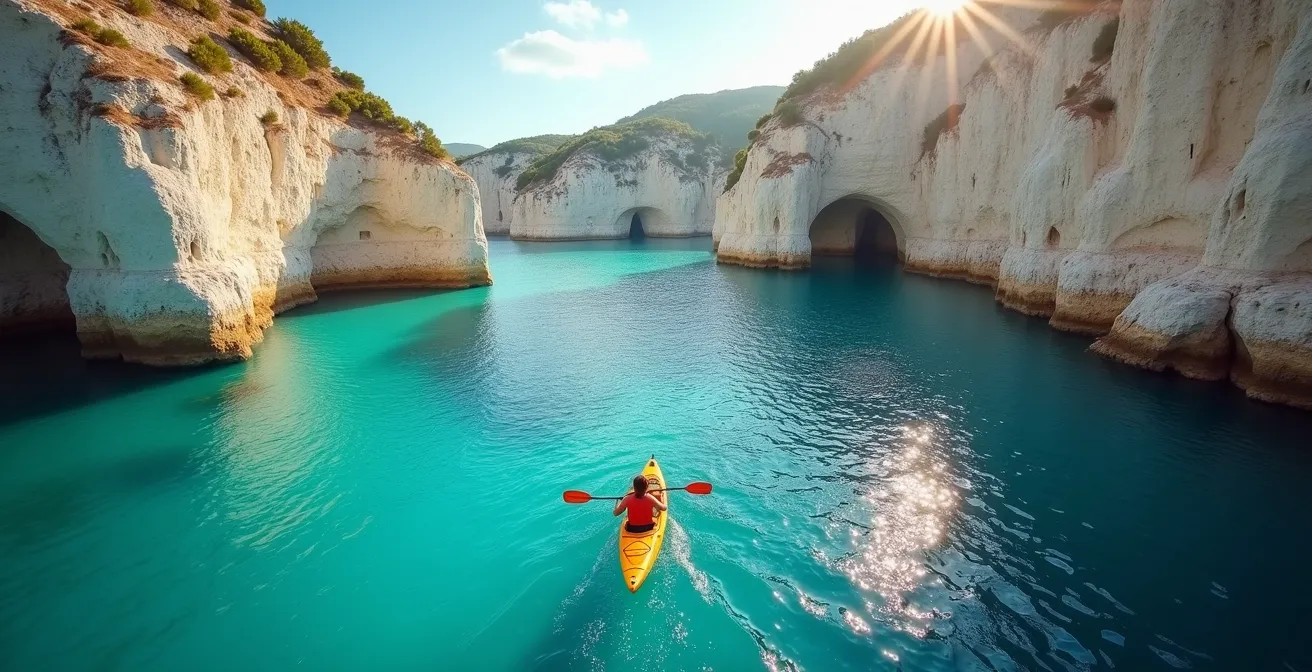
The secret to a peaceful Calanques kayaking trip isn’t about choosing a month; it’s about mastering the park’s specific rules and natural rhythms.
- True solitude comes from understanding the park’s strict conservation rules, not just avoiding July and August.
- Safety depends on your ability to read local weather phenomena like the Mistral and the subtle dangers of the limestone landscape.
Recommendation: Plan your visit based on your readiness to become a guardian of the park, not just a date on the calendar. This guide shows you how.
The image is iconic: a lone kayak gliding across impossibly turquoise water, dwarfed by magnificent white limestone cliffs. This is the dream of the Calanques National Park. The reality, however, is often a “summer flotilla”—a traffic jam of motorboats, rental kayaks, and tourist ferries jostling for space, their noise echoing off the rock walls. The common advice is to simply avoid the high season, to visit in spring or autumn. While sound, this advice barely scratches the surface.
It misses the fundamental point. Escaping the crowds is not just a matter of timing; it is a matter of knowledge. It requires a deeper understanding of this unique environment, which is as fragile as it is beautiful. The real question isn’t just *when* to go, but *how* to go. How do you read the moods of the Mistral wind? Where is it strictly forbidden to land your kayak to protect a delicate ecosystem? Why does that sunscreen you diligently applied still leave your legs scorched?
This guide offers a different perspective. It’s an insider’s briefing, designed for the nature lover who seeks not just a beautiful paddle, but a respectful communion with the landscape. We will shift the focus from the calendar to the environment itself. By understanding the geology, the regulations, the weather patterns, and the fragile life within the park, you unlock the ability to find solitude and safety, even when the world seems to be descending on this corner of paradise. You will learn to think like a guardian of the Calanques, and in doing so, earn the truly exclusive experience you seek.
This article will explore the unwritten rules and hidden knowledge of the park, section by section, to prepare you for a mindful and unforgettable journey. The following summary outlines the key areas of expertise you will develop.
Summary: How to Kayak the Calanques Like an Insider
- Why Are the Calanques White and Vertical: A Geological Explanation?
- Where Is It Strictly Forbidden to Beach Your Kayak in the Park?
- How to Paddle Safely When the Mistral Wind Exceeds 40 km/h?
- The Sunscreen Error That Burns Legs Despite Application
- Rental Freedom or Guided Insight: Which Is Best for First-Timers?
- Why Touching Stalactites in Caves Causes Irreversible Damage?
- Why Is Posidonia Seagrass Crucial for Oxygenating the Mediterranean?
- Why Climbing on Fragile Limestone Is Banned in Specific Zones?
Why Are the Calanques White and Vertical: A Geological Explanation?
To paddle the Calanques is to navigate a geological masterpiece. Understanding its origins is the first step towards respecting its fragility. The cliffs are not just a dramatic backdrop; they are a story written in stone over 100 million years. The brilliant white limestone was formed during the Urgonian period, when this entire region lay under a warm, shallow tropical sea. The rock is composed of over 95% calcium carbonate, the compacted remains of countless marine organisms, which gives it its signature dazzling white colour.
The sheer verticality of the cliffs, some rising 400 meters, is the result of immense geological forces. Tectonic uplift pushed these ancient seabeds skyward, and millennia of erosion by wind, rain, and the sea carved out the deep, fjord-like inlets we see today. This geology dictates your entire experience. The white rock acts as a powerful reflector, intensifying the sun’s rays from above and below, and it gives the water its famous turquoise hue by reflecting light through the clear water.
But this beauty comes with a warning. The limestone is not uniformly solid. You must learn to “read the cliffs” for safety. Solid, compact grey sections indicate stable rock, safe to paddle near. However, watch for yellow or orange-tinged areas; this is friable limestone, weathered and crumbly, prone to rockfall. It’s critical to maintain a safe distance from these zones, especially after rain when the rock is saturated. Your geological awareness is your first line of defence.
Where Is It Strictly Forbidden to Beach Your Kayak in the Park?
The freedom of a kayak seems absolute, but in a protected area like the Calanques, that freedom comes with firm boundaries. These rules are not arbitrary; they are the bedrock of the park’s conservation strategy, which classifies over 10% of its marine territory as no-fishing zones to protect marine life. Knowing where you cannot land is more important than knowing where you can. The temptation to pull your kayak onto a secluded, empty pebble beach is immense, but doing so in a restricted area can cause significant disturbance to wildlife and habitats.
The primary no-go zone for beaching is the Riou archipelago. While you can paddle around the islands, landing is strictly forbidden on all but a few designated spots, and only from sunrise to sunset. During days of high fire risk (often announced as “Red Alert” days in summer), all disembarkation is forbidden throughout the park. You may be on the water, but you cannot come ashore. Furthermore, certain areas are subject to seasonal closures to protect nesting birds like the Peregrine Falcon. These zones are dynamic and require checking the official park website before you launch.
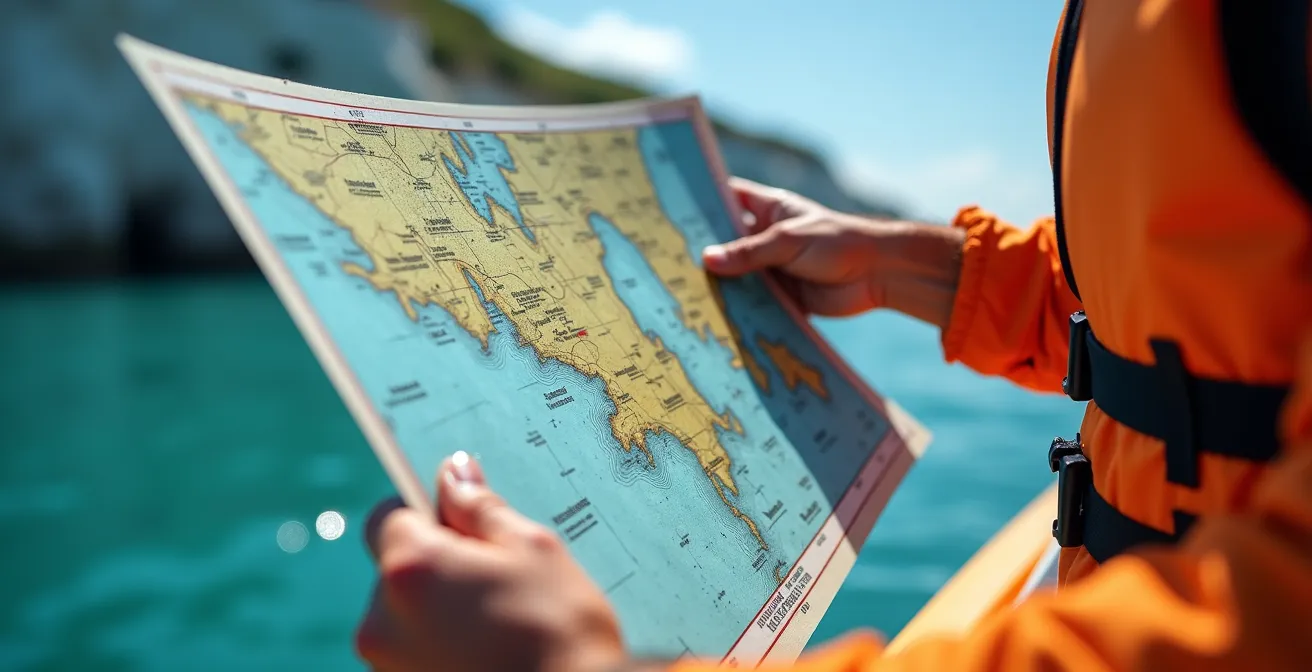
A waterproof map isn’t just for navigation; it’s your contract with the park. The table below outlines the primary access rules. Committing them to memory is essential for any responsible paddler.
| Zone Type | Kayak Access | Beaching Allowed | Key Restrictions |
|---|---|---|---|
| General Park Waters | Yes | Yes (except specific areas) | Must respect 300m navigation zones marked by yellow buoys |
| Riou Island | Yes (navigation) | No – Strictly Forbidden | Landing prohibited except northwest/west coasts sunrise-sunset |
| Fire Risk Days (Red Alert) | Yes (by sea only) | No – All Beaches | Disembarkation forbidden when park closed for fire risk |
| No-Fishing Zones (ZNP) | Yes | Yes (with restrictions) | No anchoring on Posidonia seagrass beds |
| Bird Nesting Areas (seasonal) | Limited | No (April-July) | Dynamic closures for Peregrine Falcon & European Shag protection |
How to Paddle Safely When the Mistral Wind Exceeds 40 km/h?
If the cliffs are the bones of the Calanques, the Mistral is its breath—and it can be ferocious. This strong, cold, north-westerly wind is the single greatest environmental risk for kayakers. It is not a gentle sea breeze; it can appear suddenly and transform a calm bay into a dangerous cauldron of whitecaps. The key is not to fight it, but to understand its behaviour and respect its power. When the forecast calls for winds over 40 km/h, the safest decision is often not to go out at all. Indeed, meteorological data shows the Mistral can persist with speeds over 30 km/h for more than 65 hours straight.
However, if you are caught out, or if you are an experienced paddler navigating moderate conditions, you need a strategy. The first warning sign is often an unnaturally clear, sharp horizon and the formation of “moutons” (whitecaps) far out at sea. The wind funnels violently down the valleys of the Calanques, creating powerful offshore gusts. Another hidden danger is katabatic wind at dawn or dusk, when cool air from the hills accelerates down the steep cliffs, creating sudden, localized squalls.
Your strategy should be one of shelter and evasion. Hug the coastline, using headlands for protection. This “cape hopping” technique allows you to move from one wind shadow (the lee side) to the next. The calanques of the Côte Bleue, to the west of Marseille, generally offer better protection from a classic northwest Mistral. Knowing your escape routes and emergency landing spots—ideally sandy beaches over rocky shores—is a critical part of pre-trip planning.
Your Action Plan: Emergency Strategies for Mistral Conditions
- Seek immediate shelter: The Côte Bleue calanques (west of Marseille) offer better protection from northwest winds. Identify them on your map beforehand.
- Use cape hopping: Paddle in the wind shadow (lee) of headlands, moving methodically from one protected zone to the next.
- Recognize early warnings: Watch for whitecaps forming far offshore and an unusually clear, “flattened” horizon. These are classic Mistral signs.
- Beware of katabatic winds: Be extra vigilant at dawn and dusk, when cool air can accelerate down valleys, creating sudden offshore gusts.
- Know your emergency landing protocol: If you must land, aim for sandy beaches. Approach the shore by surfing sideways to the waves, using your paddle as an outrigger for stability.
The Sunscreen Error That Burns Legs Despite Application
In the Calanques, the sun is a formidable opponent. The combination of direct overhead sun, intense reflection off the white limestone, and a third wave of UV bouncing off the water surface creates an extreme exposure environment. Yet, many paddlers end their day with painfully scorched legs, despite having applied what they believed to be waterproof, high-SPF sunscreen. This isn’t just bad luck; it’s a predictable outcome of a fundamental misunderstanding of the kayaking environment.
The problem lies at the intersection of your seated position and the gear. While kayaking, your thighs, knees, and shins are pointed directly at the sun for hours. At the same time, they are constantly splashed with salt water. This water, combined with the friction from the cockpit rim or your shorts, systematically wears away sunscreen. A case study on Mediterranean kayakers revealed a stark reality: the tops of thighs and shins account for a staggering 70% of severe sunburns, even when sunscreen was applied at the start of the day.
The solution requires a multi-layered defence. First, choose the right sunscreen: a mineral-based formula with at least 20% zinc oxide is far more durable and reef-safe than chemical sunscreens. Second, adopt a strict reapplication discipline. Set a timer on your phone and reapply every 90 minutes, period. Third, and most importantly, do not rely on sunscreen alone. The most effective strategy is a physical barrier. A spray skirt or cockpit cover provides a personal shade tent for your legs. Investing in UPF 50+ paddling leggings and a long-sleeve rash guard is the single best decision you can make. They provide constant, reliable protection that won’t wash or rub off.
Rental Freedom or Guided Insight: Which Is Best for First-Timers?
The choice between renting a kayak for a day of freedom and joining a guided tour is a critical one, with implications for your safety, enjoyment, and impact on the park. For a first-time visitor to the Calanques, the allure of a solo rental is strong: the promise of your own pace, choosing your own route, and finding that “secret” empty cove. However, this freedom comes with significant and often underestimated responsibilities.
Going solo means you are fully liable for your own safety. You must be proficient in self-rescue techniques, understand maritime navigation rules, and, most crucially, be able to accurately assess the weather. As we’ve seen, the Mistral can be unforgiving. A guide, on the other hand, provides a vital safety net. They are trained to read the subtle signs of changing weather and know the safest routes and shelters. More than that, a good guide is an interpreter of the landscape. They can point out a rare bird, explain the history of a cliff-side ruin, and spot the hidden entrance to a sea cave, transforming a simple paddle into a rich educational experience.
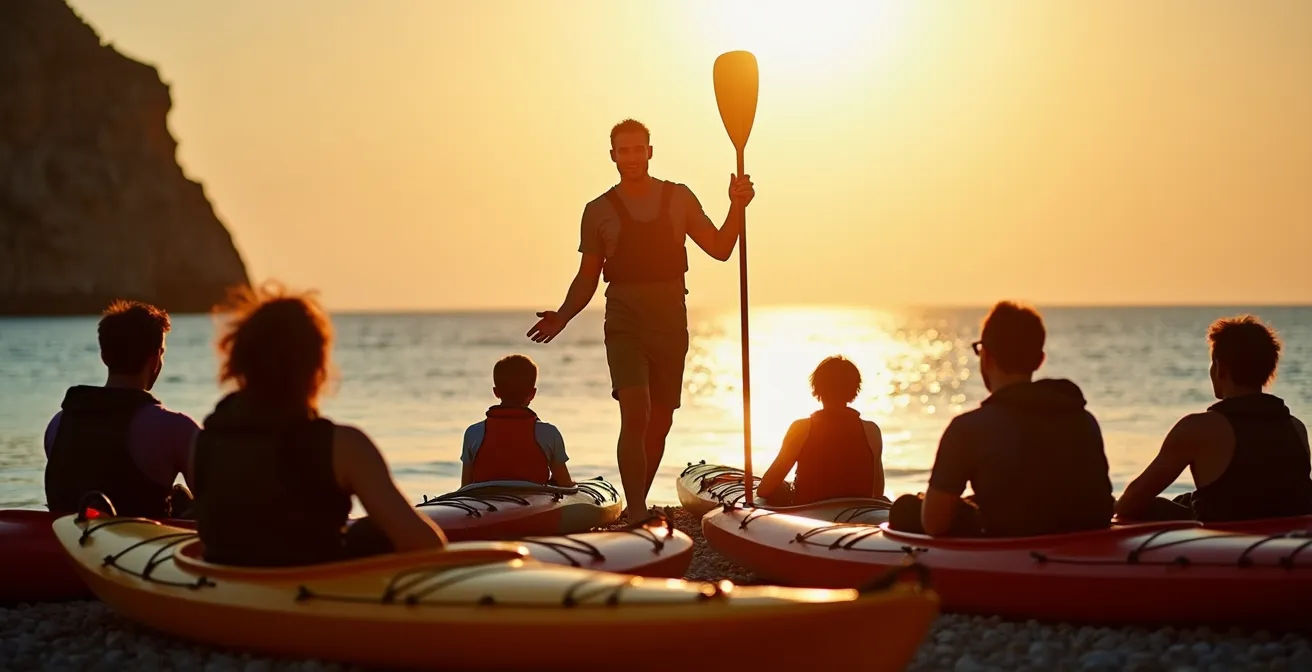
For a first-timer, the choice should lean heavily towards a guided tour, especially a small group tour. It mitigates risk and maximizes insight. You trade a degree of autonomy for a wealth of local knowledge and security. The following table breaks down the options, but the hidden requirement for solo renting—deep local knowledge—is the most important factor to consider.
| Option | Cost Range | Best For | Key Advantages | Hidden Requirements |
|---|---|---|---|---|
| Solo Rental | €40-70/day | Experienced paddlers | Complete freedom, own pace, choose route | Maritime rules knowledge, self-rescue skills, full liability, weather assessment ability |
| Self-Guided Package | €55-85/day | Confident beginners | Pre-trip briefing, waterproof map, safety check-ins, emergency contact | Basic paddling skills, swimming ability, navigation basics |
| Small Group Tour (max 8) | €50-70/half-day | First-timers | Expert knowledge, safety support, wildlife spotting, historical context | Moderate fitness, follow group pace |
| Private Guide | €150-250/half-day | Families or couples | Customized route, flexible timing, personalized instruction | Higher budget, advance booking needed |
Why Touching Stalactites in Caves Causes Irreversible Damage?
Paddling into the cool darkness of a sea cave is a magical experience. The air grows still, the sound of the ocean deepens, and intricate formations—stalactites and stalagmites—come into view. The temptation to reach out and touch one of these glistening calcite structures is almost primal. It is an act that seems harmless, a simple connection with ancient geology. In reality, it is an act of irreversible vandalism.
Stalactites are formed by a painstakingly slow process. Water seeping through the limestone ceiling deposits microscopic layers of calcite. The growth rate is almost imperceptible; geological research indicates stalactites grow at an average of just one cubic centimetre per century. A formation that is 30 centimetres long could be 3,000 years old. When you touch a stalactite, the natural oils and bacteria from your skin coat the calcite surface. This contamination creates a “dead zone.” It permanently alters the surface chemistry, preventing the mineral-rich water from adhering. Growth in that spot stops forever.
A single fingerprint can halt a process that has been continuous for millennia. In the stable, high-humidity environment of a sea cave, this delicate balance is everything. The rule is simple and absolute: look, but do not touch. Your camera is the only tool you should use to “capture” these formations. The thrill of exploring these hidden chambers carries a profound responsibility to leave them exactly as you found them, preserving their slow, silent work for the next century and beyond.
Why Is Posidonia Seagrass Crucial for Oxygenating the Mediterranean?
As you paddle through the clear waters of the Calanques, your attention is naturally drawn to the towering cliffs above. But some of the park’s most important work is happening in the dark, dense meadows on the seafloor below your kayak. This is Posidonia oceanica, a species of seagrass that is not just a plant, but the cornerstone of the entire Mediterranean marine ecosystem.
Often mistaken for seaweed, Posidonia is a flowering plant that forms vast underwater prairies. These meadows are the lungs of the Mediterranean, with a single square metre producing up to 14 litres of oxygen every day—more than an equivalent area of the Amazon rainforest. Though they cover only 3% of the Mediterranean basin, these seagrass beds are vital nurseries, supporting an incredible 25% of all its marine species. They provide food, shelter, and breeding grounds for hundreds of species of fish, crustaceans, and molluscs.
Posidonia’s role extends to protecting the coastline itself. Its dense root systems (rhizomes) form a mat that grips the seabed, preventing coastal erosion by absorbing up to 50% of wave energy. The piles of dead leaves you might see washed up on beaches, known as “banquettes,” are not pollution; they are a natural barrier that protects the beaches from being stripped away by winter storms. Protecting Posidonia is a primary goal of the Calanques National Park. This means never anchoring or dragging your kayak across these dark green patches. By learning to identify Posidonia meadows from the surface, you can actively help protect the hidden engine that keeps the Calanques alive.
Key Takeaways
- Your safety and experience depend on your ability to read the landscape (geology), the weather (Mistral), and the rules (park regulations).
- Physical barriers (UPF clothing, spray skirt) are more effective than sunscreen alone for preventing the unique “kayaker’s sunburn.”
- Respect for the ecosystem is non-negotiable: never touch cave formations and never disturb Posidonia seagrass meadows.
Why Climbing on Fragile Limestone Is Banned in Specific Zones?
From the water, you may see small, colourful figures moving slowly up the immense white walls. The Calanques are a world-famous rock-climbing destination. However, this activity coexists with kayaking under a strict set of rules born from a surprising reality: the climbing bans in certain areas are primarily in place to protect you, the kayaker below.
The limestone of the Calanques, while appearing solid, can be deceptively fragile. A safety analysis conducted by the park revealed a startling fact: the risk of rockfall from a cliff face increases by a staggering 300% when climbers are active above. The vibrations from movement, the placement of gear, and the simple weight of a climber can dislodge loose rocks. These can range from pebbles to chunks the size of a basketball. For a kayaker passing 50 or 100 meters below, even a small falling rock can be lethal.
Consequently, the park has banned climbing in specific zones deemed too unstable or located directly above popular paddling routes. These zones are marked with red signs featuring a climber symbol, mounted on the cliffs and visible from the water. It is your responsibility to spot these signs and identify climbing activity. If you see climbers on a cliff face, even in a legal zone, the safest practice is to give the base of the cliff a wide berth—at least 50 meters. Listen for the warning shout “Rocher!” (Rock!), the universal call from climbers indicating falling debris. If you hear it, paddle away from the cliff immediately. Your awareness of what’s happening above you is as important as your awareness of what’s below.
Ultimately, the best time to kayak the Calanques is when you are prepared to be more than a tourist. It’s when you have armed yourself with the knowledge to move with respect, the foresight to prioritize safety, and the humility to recognize that you are a guest in a fragile and powerful natural sanctuary. By embracing this mindset, you will find the solitude you seek is not on a calendar, but within your approach. For those ready to take this step, planning a trip with this new perspective is the logical next move.