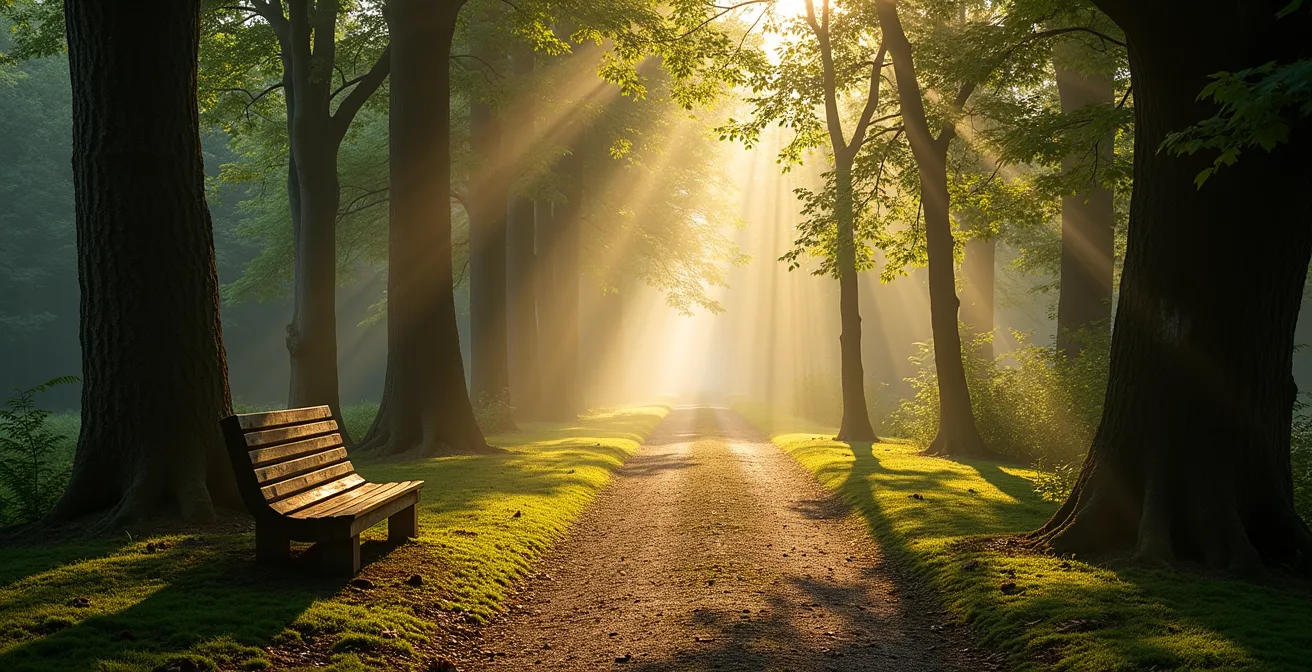
True silence isn’t a place you find on a map; it’s an internal state you cultivate through intentional practice.
- Scientific evidence shows that specific nature-based practices actively reduce stress hormones like cortisol.
- Effective digital detox isn’t about total abstinence but flexible, mindful use of technology that respects your brain’s needs.
Recommendation: Instead of just seeking a quiet location, focus on learning simple rituals and breathing techniques to create your own sanctuary anywhere in nature.
For the urban dweller, the search for silence often begins with a map of France, pointing towards the vast forests of the Vosges or the quiet peaks of the Mercantour. We dream of escaping the incessant hum of the city, believing that solitude is a destination we can drive to. We pack our bags, turn on our “out of office” notifications, and head for the green expanses, expecting tranquility to simply wash over us upon arrival. Yet, how often do we find ourselves in a pristine forest, our minds still buzzing with deadlines, notifications, and the phantom vibrations of a phone we’ve dutifully switched off?
The common advice—”go hiking,” “disconnect,” “listen to the birds”—while well-intentioned, often misses the crucial point. These are passive suggestions for an active problem. The real challenge isn’t the absence of external noise but the presence of internal chatter. This guide proposes a fundamental shift in perspective. What if the key to profound solitude wasn’t about *where* you go, but *how* you arrive, both physically and mentally? What if silence isn’t something you find, but something you create?
This journey moves beyond geography and into the realm of practice. We will explore the science behind natural silence, learn specific techniques for walking meditation, and understand how to build a bridge from our chaotic city lives to a state of inner sanctuary. This is not a travelogue of quiet places, but a manual for cultivating a quiet mind.
This article will guide you through practical, science-backed methods to transform any natural outing into a profound spiritual retreat. Below is a summary of the intentional practices you will learn to master your inner world.
Summary: A Guide to Cultivating Inner Silence in Nature
- Why Natural Silence Is More Than Just the Absence of Noise?
- How to Practice Walking Meditation in a Forest Setting?
- Forest Immersion or Mountain Peak: Which Environment Soothes Anxiety Better?
- The Digital Detox Error That Ruins Your Retreat Experience
- How to Create a Personal Ritual to Transition from City to Sanctuary?
- Why Does Your Brain Need 72 Hours in Nature to Fully Reset?
- How to Sync Your Breath with Your Steps in the Woods?
- How to Practice Shinrin-Yoku Without a Guide for Stress Relief?
Why Natural Silence Is More Than Just the Absence of Noise?
Natural silence is not an empty void; it is a rich, textured soundscape that actively calms our nervous system. Unlike the dead quiet of a soundproof room, the “silence” of a forest is filled with what soundscape ecologists call “biophony” (the sounds of non-human life) and “geophony” (the sounds of wind and water). This complex acoustic environment signals safety to our primal brain, allowing the prefrontal cortex—the part responsible for worry and rumination—to relax its hyper-vigilant state. It’s a shift from processing threats to experiencing presence.
This is not just a poetic idea; it has a measurable physiological basis. The experience of being in a natural environment triggers a cascade of positive biological responses. Your body begins to down-regulate the production of stress hormones, primarily cortisol. A 2019 study confirmed this, showing that a nature experience can produce a 21.3% per hour cortisol reduction, a rate significantly faster than the body’s natural diurnal drop. This hormonal shift is the physical manifestation of your mind letting go.
Therefore, seeking natural silence is not about escaping noise. It is about immersing ourselves in a specific type of sound that is restorative. It’s an active exchange where the environment doesn’t just stop bombarding you with stressful stimuli (like traffic and sirens) but actively provides you with a biological signal to stand down. It’s the difference between merely not being stressed and actively being soothed. The goal is to replace the chaotic noise of the city with the coherent, life-affirming soundscape of the natural world.
This understanding transforms a simple walk in the woods from a recreational activity into a therapeutic practice, where every rustle of leaves and bird call contributes to your mental reset.
How to Practice Walking Meditation in a Forest Setting?
Walking meditation is the art of bringing your full awareness to the simple act of moving through space. In a forest, this practice is amplified, as the uneven ground and rich sensory tapestry demand a gentle, focused attention. The goal is not to “hike” to a destination but to experience each step as its own event. Begin by finding a relatively flat, clear path to minimize distractions. Stand still for a moment, take a few deep breaths, and set an intention to simply be present with your body and the forest.
A powerful method to anchor your awareness is the sensory rotation technique. Start by synchronizing your breath with your steps: inhale for four steps, then exhale for four steps. Once a rhythm is established, bring your awareness first to your sense of sight. Notice the play of light and shadow, the patterns in the bark, the subtle movements of leaves in the breeze, without naming or judging. After a few minutes, gently close your eyes (if you feel safe to do so) and switch your focus entirely to the sounds of the forest. Finally, engage your sense of smell and touch, noticing the scent of damp earth or the feeling of air on your skin.
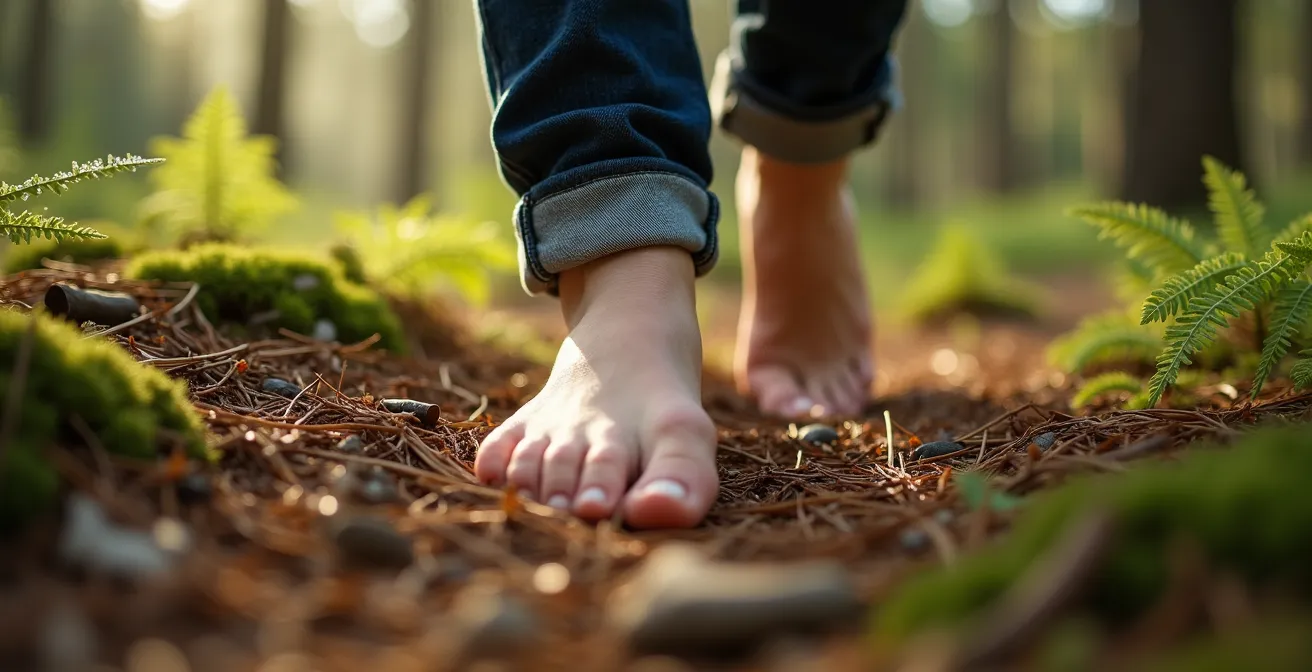
As you walk, notice the sensation of your feet connecting with the earth. Feel the roll of your foot from heel to toe. If your mind wanders, as it inevitably will, gently guide it back to the physical sensation of walking or the rhythm of your breath. There is no failure in walking meditation; there is only the practice of returning, again and again, to the present moment. This is not about achieving a state of “no thought,” but about cultivating a relationship of gentle awareness with your thoughts and your surroundings.
This practice transforms a walk from a means to an end into the experience itself, allowing you to find a moving stillness that quiets the mind far more effectively than simply sitting still.
Forest Immersion or Mountain Peak: Which Environment Soothes Anxiety Better?
The choice between a dense forest and an open mountain peak for anxiety relief is not about which is “better,” but which is better for the *type* of anxiety you are experiencing. Each environment offers a distinct psychological medicine. The forest, with its canopy and enclosed trails, provides a sense of refuge and safety. For those experiencing anxiety rooted in overstimulation and hyper-vigilance, the woods act as a natural container, reducing the sensory field and promoting a feeling of being held and protected. The presence of phytoncides—aromatic compounds released by trees—has also been shown to boost the immune system and lower cortisol.
Conversely, the mountain peak offers perspective and freedom. For anxiety characterized by feeling trapped, overwhelmed, or claustrophobic, the vast, open vista from a summit can be profoundly liberating. It triggers the “awe response,” a powerful emotion that has been shown to shrink our self-preoccupation and connect us to something larger than ourselves. The physical effort to reach the peak, combined with the increased oxygen and expansive view, can dissolve feelings of being stuck in a mental loop. It externalizes an internal struggle and provides a tangible sense of accomplishment and perspective.
The following table, based on psychological and environmental research, summarizes these distinct benefits. As a study in Frontiers in Psychology notes, wilderness provides an optimal setting for self-reflection. The team’s research highlights that a wilderness solo experience away from daily demands and technology allows for profound silence and introspection.
| Environment | Primary Benefit | Best For | Physiological Effect |
|---|---|---|---|
| Dense Forest | Refuge & Safety | Overstimulation anxiety | Phytoncides boost immunity, lower cortisol |
| Mountain Peak | Perspective & Freedom | Feeling trapped/overwhelmed | Increased oxygen, awe response activation |
| Mixed Forest-Mountain | Balance of both | General anxiety | Combined benefits |
The wilderness solo experience provides an optimal environment for the experience and practice of silence, as a mindful state of being. Studies emphasize the significance of the wilderness, far from daily demands, devoid of technological stimuli allowing silence, time and space for self-reflection
– Frontiers in Psychology Research Team, The Wilderness Solo Experience Study
Ultimately, the most healing landscape is the one that answers your specific psychological need. Listen to your intuition: do you need to be held, or do you need to be set free?
The Digital Detox Error That Ruins Your Retreat Experience
The most common mistake in a digital detox is approaching it with rigid, all-or-nothing absolutism. We believe that to truly disconnect, we must completely sever our ties to the digital world, often leading to a “white-knuckle” experience of anxiety and withdrawal that undermines the very peace we seek. The goal is not to prove our willpower by resisting temptation, but to gently retrain our nervous system. Forcing a sudden, total elimination of a deeply ingrained habit can create more stress than it relieves, causing a rebound effect where we binge on technology the moment the retreat is over.
A more effective and sustainable approach is one of flexible and mindful engagement. This counter-intuitive idea is supported by research. Dr. MaryCarol Hunter’s work at the University of Michigan revealed a crucial insight: when participants were given flexibility in their nature experiences—choosing the time, duration, and place—they showed better stress reduction outcomes. A study on urban dwellers found that rigid digital elimination isn’t necessary for benefits, suggesting that personal choice and autonomy are key ingredients for a successful retreat.
Instead of a complete ban, consider a “digital buffer” strategy. This involves a gradual re-introduction to technology post-retreat and even allows for purposeful, limited tech use during it. For example, using a plant identification app for a focused 15-minute session can deepen your connection to nature rather than distract from it. The key is shifting from mindless, reactive scrolling to conscious, tool-based usage. The error is not using your phone; the error is letting your phone use you.
To manage the transition back to daily life without losing the benefits of your retreat, a structured re-entry is crucial. Consider implementing this gradual process:
- Day 1 Post-Retreat: Allow for essential communication only (calls, texts) but avoid all social media and news feeds.
- Day 2 Post-Retreat: Introduce limited email checking at two designated times of the day, outside of which your phone remains out of sight.
- Day 3 Post-Retreat: Begin reintroducing other apps but with strict time limits, using your phone’s built-in wellness features.
By treating technology with mindful intention rather than outright fear, you can create a lasting peace that integrates into your daily life, rather than being a temporary escape you can’t maintain.
How to Create a Personal Ritual to Transition from City to Sanctuary?
The transition from the frenetic energy of the city to the quiet sanctuary of nature is often the most jarring part of a retreat. We carry the city’s pace with us, striding into the forest with the same purpose-driven mindset we apply to our work week. A personal ritual acts as a conscious “rite of passage,” a deliberate act that signals to your mind and body that you are crossing a threshold. It is a way of intentionally shedding the old state to become receptive to the new.
This ritual doesn’t need to be elaborate. Its power lies in its personal meaning and consistency. It could be as simple as finding a specific “gateway” tree at the start of a trail, placing your hand on its bark, and silently stating your intention for the walk. It could involve leaving a small, biodegradable offering like a flower petal, or simply sitting on a particular rock for five minutes of focused breathing before you begin to walk. The key is to create a sensory anchor—an action that involves your physical body and marks a clear beginning.
Case Study: Sensory Anchoring at the New York Botanical Garden
The New York Botanical Garden’s forest bathing program provides a perfect model for this practice. Before entering the forest, participants are guided to find their own space and establish a personal ‘intention.’ This isn’t a goal, but a positive, creative thought that acts as an anchor—a word, a color, or a feeling they wish to cultivate. This simple act of setting an intention bridges the formal practice of forest bathing with the participant’s everyday life, making the experience more meaningful and transferable.
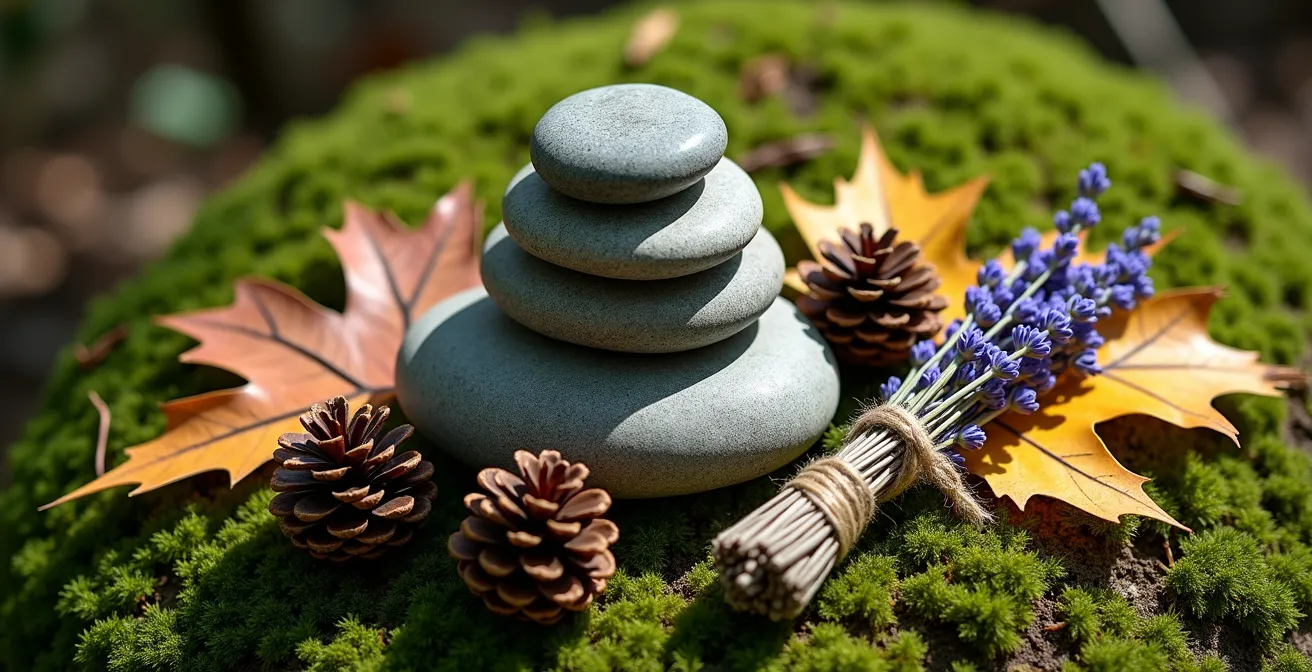
Your transition ritual can also mark the end of your nature immersion. Before getting back in the car, you might perform a small closing act: find a smooth stone to take with you as a tangible reminder, or simply turn and bow to the forest in gratitude. This closing bookend is just as important as the opening one. It helps contain and honor the experience, preventing the peace you’ve cultivated from evaporating the moment you hit the motorway.
This conscious transition is the difference between being a tourist in the wilderness and becoming a participant in its silence.
Why Does Your Brain Need 72 Hours in Nature to Fully Reset?
While a short walk in a park can provide immediate stress relief, a full neurological “reset” requires a more significant immersion. The “three-day effect,” a concept popularized by wilderness guides and now explored by cognitive neuroscientists, suggests that it takes about 72 hours of being in nature, away from technology and urban stressors, for the brain to fundamentally shift its mode of operation. During this period, the over-stimulated prefrontal cortex, responsible for executive functions like planning and decision-making, finally gets a chance to quiet down.
This mental down-regulation allows for a different kind of cognitive activity to emerge. Creativity, problem-solving, and a sense of well-being are often reported to spike after the third day. This isn’t just anecdotal; it’s linked to Attention Restoration Theory (ART), which posits that natural environments are uniquely suited to restoring our “directed attention,” the kind of focus we exhaust in our daily lives. After 72 hours, your brain has had enough time to clear its cognitive clutter, allowing for deeper, more reflective thoughts to surface.
However, you don’t need to wait for a three-day trip to reap significant rewards. The benefits of nature are dose-dependent, and even small “nature pills” can have a powerful effect. As researcher MaryCarol Hunter points out, the “sweet spot” for an efficient cortisol drop is between 20 and 30 minutes of nature exposure. As her University of Michigan research confirms, benefits accrue after this point, but at a reduced rate.
For salivary cortisol, a nature experience produced a 21.3%/hour drop beyond that of the hormone’s 11.7% diurnal drop. The efficiency of a nature pill per time expended was greatest between 20 and 30 min, after which benefits continued to accrue, but at a reduced rate
– MaryCarol Hunter, Urban Nature Experiences Study
Think of it like this: a 20-minute walk is a healthy snack for your brain, while a 72-hour immersion is a full-course, nourishing meal. Both are essential for a healthy mental diet.
How to Sync Your Breath with Your Steps in the Woods?
Synchronizing your breath with your steps is one of the most direct ways to anchor your mind in the present moment and create a state of “environmental entrainment,” where your inner rhythm aligns with the outer world. This practice, often called “walking breath” or “rhythmic breathing,” turns a simple walk into a powerful meditative exercise. It quiets the mental chatter by giving the “monkey mind” a simple, repetitive task to focus on: counting steps and matching them to your inhales and exhales.
The beauty of this technique lies in its adaptability to the terrain. A flat, easy path allows for longer, more relaxed breathing patterns, promoting a parasympathetic (rest-and-digest) response. A steep incline, however, demands a shorter, more powerful breathing pattern to meet the body’s increased need for oxygen. By consciously adjusting your breath to the landscape, you enter into an intimate dialogue with your environment. You are no longer simply a visitor passing through; you are an active participant, responding and adapting in real time.
This practice deepens your awareness not only of the external world but also of your internal state. You become acutely aware of your heart rate, your muscle tension, and your energy levels. It’s a form of embodied mindfulness, where wisdom is accessed not through abstract thought but through physical sensation. By focusing on the simple, vital connection between breath and movement, you create a space of profound inner silence, even while in motion.
Your Action Plan: Terrain-Adaptive Breathing Patterns
- Flat terrain: Begin with 4-4-4-4 Box Breathing. Inhale for a count of 4 steps, hold your breath for 4 steps, exhale for 4 steps, and hold at the bottom for 4 steps.
- Gentle incline: Shift to a 3-3 pattern. Inhale for 3 steps and immediately exhale for 3 steps to maintain a steady rhythm without strain.
- Steep uphill: For maximum oxygen efficiency, adopt a quick 2-2 pattern. Inhale for 2 steps, exhale for 2 steps, focusing on a powerful, full breath.
- Downhill relaxation: As you descend, extend your breath to a 5-5 pattern (inhale 5 steps, exhale 5 steps) to calm your heart rate and relax your body.
- Rest stops: While standing still, practice a 5-7-8 pattern. Inhale through your nose for a 5-count, hold the breath for 7, and exhale slowly through your mouth for an 8-count to maximize relaxation.
Through this synchronization, the forest ceases to be a backdrop for your thoughts and becomes a partner in your journey towards stillness.
Key Takeaways
- True silence is an internal state cultivated through practice, not just an external location.
- Nature provides measurable physiological benefits, such as significant cortisol reduction, which can be optimized with specific techniques.
- Effective disconnection comes from mindful, flexible engagement with technology, not rigid abstinence.
How to Practice Shinrin-Yoku Without a Guide for Stress Relief?
Shinrin-Yoku, or “forest bathing,” is the Japanese practice of immersing oneself in the forest atmosphere. While guided sessions can be beneficial, the true essence of Shinrin-Yoku is a personal, intuitive connection with nature that anyone can cultivate. The key is to shift your mindset from “doing” to “being.” It’s not about mileage or destination; it’s about a slow, aimless wandering designed to engage all five senses. The forest itself is the therapist; your job is simply to show up and be receptive.
To structure a self-guided session, you can follow a simple five-stage framework that provides a gentle container for the experience. This structure helps you transition from the goal-oriented mind of daily life to the sensory-oriented mind of the forest. The culmination, a simple tea ceremony, is a crucial step. Taking a thermos of warm herbal tea to drink at the end of your walk is a way to honor the experience and gently transition back, carrying the forest’s peace with you. It is a moment of reflection and gratitude.
The practice is less about a strict protocol and more about a series of “invitations.” Instead of telling yourself to “relax,” you might invite yourself to notice the different shades of green, to feel the texture of bark, or to listen for the furthest sound you can hear. These gentle prompts guide your attention without force. Remember, consistency is more important than duration. As research consensus indicates, a minimum of 120 minutes per week in nature is needed to see significant mental health benefits, a “dose” that can be broken into smaller, more frequent sessions.
A simple, effective structure for a self-guided session could be:
- The Gateway: Find a point that feels like an entrance to the forest. Pause here for a moment. Take a deep breath and acknowledge that you are crossing a threshold.
- Aimless Wandering: For the next 15-20 minutes, walk very slowly with no destination in mind. Let your body be drawn to whatever catches its attention.
- The Sit Spot: Find a comfortable, safe place to sit for at least 15 minutes. Do nothing but observe the forest unfolding around you, as if you were a part of the landscape.
- Sensory Invitations: From your sit spot, consciously focus on one sense at a time. What patterns do you see? What do you smell? What can you feel on your skin?
- Tea Ceremony: Conclude your practice by pouring a warm drink from a thermos. As you sip it, reflect on your experience and offer a silent moment of gratitude.
By engaging with nature in this gentle, structured way, you can reliably access a state of deep calm and rejuvenation, transforming any nearby woods into a powerful place of healing.