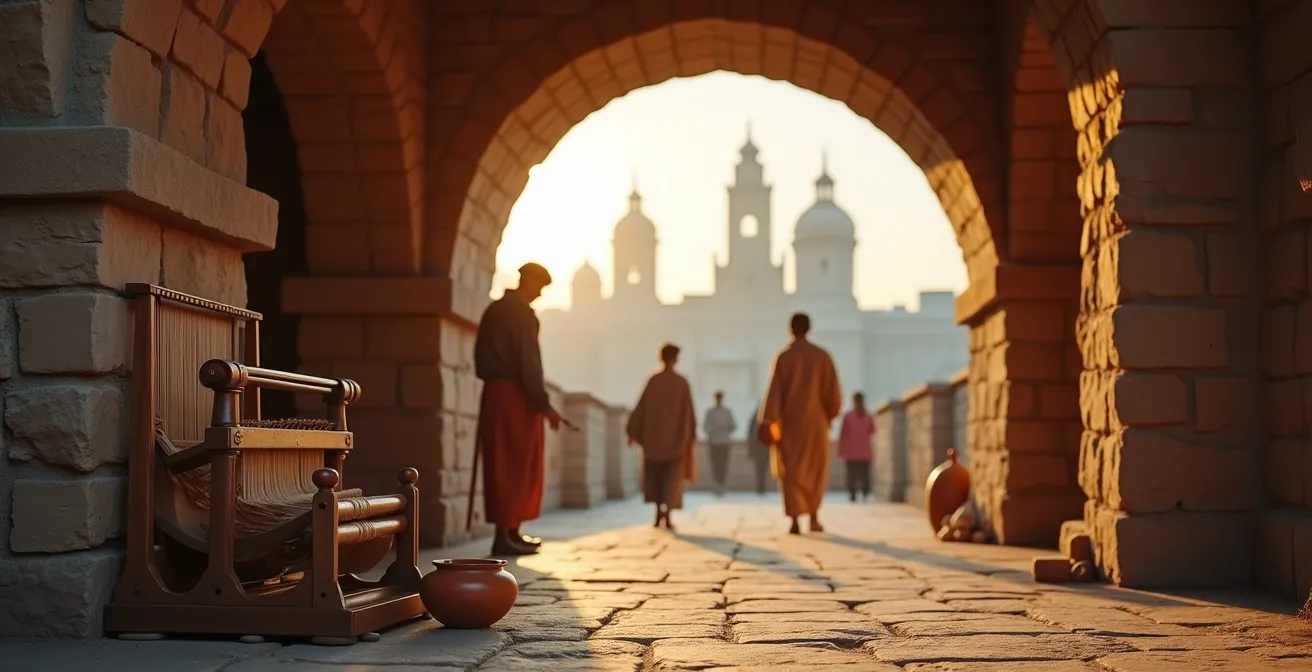
Contrary to the purist’s belief, a tradition that changes is not a tradition that is dying—it’s one that is fighting to live.
- The “corruption” of a ritual with modern materials or new participants is often a deliberate adaptive mechanism to preserve its core meaning in a new ethical or economic landscape.
- Authenticity lies in a tradition’s function (community, identity, meaning), not its static form (materials, rules, performers).
Recommendation: Next time you travel, view a modern adaptation not as a loss of purity, but as a sign of profound cultural resilience you are privileged to witness.
For the purist traveler, the scene can be jarring: a centuries-old ritual performed not with hand-woven textiles but with synthetic fabrics, or a sacred rite once reserved for men now led by a woman. The immediate reaction is often one of disappointment, a sense of loss, a feeling that something “authentic” has been corrupted by the modern world. This perspective views tradition as a fragile museum piece, something to be preserved under glass, unchanged and pure. It operates on the assumption that any deviation from an imagined original form is a step toward extinction.
This article challenges that very notion. What if this perceived corruption is not decay, but a sign of life? What if the use of a cell phone to coordinate a festival, or the substitution of a harmful practice with a symbolic one, is not an act of surrender but a brilliant strategic adaptation? Culture is distinct from tradition; culture is the vast ocean of shared values and practices, while a tradition is a specific current within it. For that current to continue flowing through generations, it cannot remain rigid. It must navigate new topographies of ethics, economics, and social structures.
We will explore the crucial difference between a tradition’s form—the materials, rules, and actions—and its function—the meaning, identity, and community it fosters. By examining real-world examples, from bullfighting arenas to remote sacred lands, we will argue that for a tradition to survive, it must be willing to sacrifice parts of its form to protect its essential function. This is not the death of heritage; it is the very definition of a living one.
This guide deconstructs the mechanisms of cultural evolution. It provides a new framework for understanding why traditions adapt and how travelers can engage with these changing practices in a more respectful and insightful way. We will look at how roles are shifting, how ethical considerations are reshaping ancient rites, and how technology is becoming an unlikely guardian of oral history.
Summary: Unpacking the Evolution of Cultural Heritage
- Why Are Women Now Performing Rites Formerly Reserved for Men?
- Bullfighting or Running: How Are Animal Traditions Adapting to Ethics?
- Synthetic or Natural: Why Do Costumes Now Use Modern Fabrics?
- The Engagement Mistake That Almost Killed the Language
- Podcast or Elder: How Is Oral History Being Saved Today?
- Why Are the Most Iconic French Dishes Originally Peasant Food?
- Why Must You Ask the Elder Before Entering Sacred Land?
- How to Negotiate Prices in Local Markets Without Disrespecting Artisans?
Why Are Women Now Performing Rites Formerly Reserved for Men?
One of the most visible shifts in traditional structures is the changing role of women in religious and cultural ceremonies. For centuries, many rites were exclusively the domain of men, reinforcing patriarchal social orders. However, as societies evolve and gender equality becomes a more central value, these ancient rules are being challenged and rewritten from within. This is not an external imposition, but an internal adaptive mechanism. Communities are recognizing that excluding half their population from core spiritual practices weakens the tradition’s relevance and sustainability. When women take on roles as priests, officiants, or ritual leaders, they are not erasing the past; they are ensuring the tradition has a future.
This trend is mirrored in broader societal shifts in faith and community engagement. For instance, recent data on church attendance shows a fascinating reversal. Where women once formed the majority of congregations, new research reveals a different pattern among younger generations, with 43% of men vs. 36% of women attending church regularly in 2025. In some specific denominations, the shift is even more pronounced. In The Church of Jesus Christ of Latter-day Saints, men now constitute 52% of membership, a reversal from 2014. This demographic fluidity demonstrates that no tradition is immune to social change. The inclusion of women in previously barred rites is a proactive response to these shifting dynamics, a way to maintain the tradition’s vitality and connection with the entire community.
Ultimately, when a woman stands to lead a ceremony once forbidden to her, it signifies that the community has chosen the function of spiritual continuity over the form of male exclusivity. It is a powerful statement that the collective identity and spiritual health of the group are more important than preserving rigid, and increasingly alienating, gender roles from a bygone era.
Bullfighting or Running: How Are Animal Traditions Adapting to Ethics?
Few traditions stir as much controversy as those involving animals, with bullfighting being the quintessential example. For purists, the *corrida* is a complex art form steeped in history, a dramatic ballet of courage and death. For modern ethical sensibilities, it is a brutal spectacle of animal cruelty. This clash of values has forced many communities to a crossroads: let the tradition die, or radically transform it. The resulting adaptations are a masterclass in preserving cultural function while overhauling its form. These are not signs of weakness, but of incredible creativity and cultural resilience.
This shift isn’t universal. Some regions double down on the original form, as seen where government subsidies for bullfighting expanded by 69.75% in just four years in parts of Korea, framing it as vital cultural heritage. However, the more sustainable trend is adaptation. In 2025, Mexico City made a historic move by passing legislation that permits only “violence-free bullfighting.” This decision transformed the events at Plaza México, the world’s largest bullring. Bulls are no longer harmed or killed, shifting the focus entirely to the matador’s skill and showmanship. While opponents raised concerns over job losses, the city chose to align the tradition with modern animal welfare ethics, allowing it to survive in a changed social climate.
This transformation is a textbook case of symbolic substitution. The core function of the event—a public spectacle demonstrating courage, artistry, and a confrontation with primal forces—is maintained. However, the most problematic form—the lethal violence—is replaced. For the traveler, witnessing a bloodless bullfight is not seeing a “lesser” version; it is watching a living culture actively negotiate its place in the 21st century.

The empty arena at sunset symbolizes this profound shift. The space remains, the history is palpable, but the practice itself has been reimagined. It’s a powerful reminder that the spirit of a tradition can endure even when its most controversial elements are shed, ensuring its survival for a new generation that holds different ethical values.
Synthetic or Natural: Why Do Costumes Now Use Modern Fabrics?
A traveler attending a vibrant local festival might notice that a dancer’s intricate costume is made not of rare bird feathers or hand-dyed silk, but of brightly colored nylon and synthetic beads. The initial thought might be one of inauthenticity or a decline in craftsmanship. However, this material shift is rarely a sign of cultural apathy. More often, it is a pragmatic and intelligent adaptive mechanism driven by a combination of ethics, economics, and environmental conservation. Using modern fabrics can be a conscious choice to protect endangered species, reduce costs for community members, or ensure the durability of a costume that sees frequent use.
This idea is perfectly captured by the work of one research team, who noted that cultural identity is not intrinsically tied to the physical materials used in its expression. As they state in their findings on animal welfare reforms:
Traditions persist through meaning and identity rather than unchanged material practices, suggesting that symbolic alternatives can preserve cultural significance while eliminating harm.
– Anthropological Research Team, Animal Welfare and Policy Reforms Study
This principle of symbolic substitution is beautifully illustrated by Portuguese-style bullfighting in California. Faced with strict U.S. animal cruelty laws, these communities replaced the traditional piercing *banderillas* with Velcro-tipped darts that attach to a pad on the bull’s back. The form (piercing the animal) was eliminated, but the function (demonstrating the skill of placing the darts) was perfectly preserved. The spectacle, the color, and the community celebration remain intact. The tradition did not die; it evolved. The synthetic Velcro is not a sign of corruption but of genius adaptation. It is proof that the culture values the living continuation of the festival more than the static preservation of a harmful detail.
The Engagement Mistake That Almost Killed the Language
Of all traditions, language is perhaps the most fundamental. It is not just a tool for communication but the very vessel of a culture’s worldview, history, and unique identity. Yet, it is also one of the most fragile. A tradition’s survival depends on intergenerational transmission, and when that chain is broken, the consequences are dire. The mistake is not in adapting, but in failing to adapt. When a community’s elders speak a language that the youth no longer see as relevant to their modern lives, it creates a chasm that no amount of purist preservation can bridge.
The statistics are stark. Of the approximately 7,099 languages spoken globally, a vast number are at risk of extinction, primarily because they are no longer being taught to children. This happens when the elders, holding onto the “pure” form, fail to find ways to make it engaging and useful for a generation immersed in a globalized, digital world. The tradition doesn’t die because it changes; it dies because it refuses to. It becomes a relic spoken by a few, its rich tapestry of stories and knowledge fading into silence.

The image of an elder and a youth separated by an invisible barrier of technology and time is a poignant metaphor for this crisis. The connection is almost there, but the words dissolve before they can be received. To survive, a language must find its place in the modern world. This might mean developing a writing system, being used on social media, or being integrated into modern music and film. These are not acts of corruption; they are lifelines. A language spoken by rappers on YouTube or used in text messages is a living heritage, while a “pure” language spoken only by a handful of aging scholars is a museum piece on the verge of closure.
Podcast or Elder: How Is Oral History Being Saved Today?
For millennia, the primary vehicle for transmitting history, mythology, and cultural values was the spoken word, passed from elder to youth. To a purist, the only “authentic” way to receive this knowledge is to sit at the feet of a storyteller. But what happens when the youth have moved to cities, or when the elders are disappearing? In this context, technology, often seen as the enemy of tradition, becomes its most powerful ally. The choice is no longer between the elder and the podcast; it is about using the podcast to amplify the elder’s voice.
Digital documentation is a powerful adaptive mechanism. Recording an elder’s stories, digitizing ancient songs, or creating online archives of oral traditions is not a replacement for the real thing but an insurance policy against total loss. It allows cultural knowledge to transcend geographical and generational divides. A young person living a thousand miles away can now connect with their heritage through a smartphone. This is not a dilution of tradition but a brilliant expansion of its reach. As one anthropological review notes, this is a natural process: “Cultural practices evolve adaptively in response to changing social values and ethical understandings.” Technology provides a new pathway for that evolution.
Case Study: Digital and Educational Revival of the Viola da Terra
A prime example of this synergy is the preservation of the Viola da Terra in the Azores. This traditional stringed instrument was at risk of fading into obscurity. The solution was a two-pronged approach. First, the instrument’s music and history were digitally documented, creating an accessible archive. Second, and crucially, this was combined with education. The Viola da Terra was integrated into school music programs, and an annual day was designated to celebrate it. By pairing digital preservation with active community engagement, the tradition was not just saved—it was revitalized. It now has a secure place in both the cloud and the classroom, ensuring its survival for generations to come.
Why Are the Most Iconic French Dishes Originally Peasant Food?
Travelers flock to France for its haute cuisine, imagining a lineage of aristocratic chefs creating delicate masterpieces. Yet, many of France’s most iconic and beloved dishes—cassoulet, coq au vin, bouillabaisse—have humble origins. They are peasant food, born from the necessity of using cheap, readily available ingredients. These dishes did not emerge fully formed; they evolved. They are the product of generations of adaptation, slowly refined from rustic sustenance into culinary art. This culinary history is a perfect allegory for all traditions: what we revere today as “classic” and “authentic” is often the result of a long, pragmatic process of change.
The journey from peasant pot to Michelin-starred plate shows that traditions are not static. Their survival and elevation depend on their ability to adapt to new tastes, ingredients, and techniques. The idea that there is a single, “pure” version of bouillabaisse is a myth; every coastal town in Provence has its own variation. This diversity is not a sign of corruption but of a vibrant, living culinary heritage. As Mexico City Mayor Clara Brugada stated regarding the evolution of another cultural practice, “Culture evolves, and we have the responsibility to transform it.” This applies as much to the kitchen as it does to the bullring.
The following table illustrates how different regions have formally adapted a single, controversial tradition, proving that evolution is a global pattern, not an isolated event.
| Country/Region | Traditional Practice | Modern Adaptation | Year |
|---|---|---|---|
| Mexico City | Traditional bullfighting with killing | Bloodless bullfighting | 2025 |
| Catalonia | Spanish-style bullfighting | Prohibited on welfare grounds | 2010 |
| California, USA | Portuguese bullfighting | Velcro-tipped darts only | Ongoing |
This evidence reinforces the central argument: traditions, whether culinary or ceremonial, survive by changing. Their modern form is not a betrayal of their past, but a testament to their enduring relevance.
Why Must You Ask the Elder Before Entering Sacred Land?
When traveling, one might encounter a path leading to a stunning waterfall or an ancient grove, only to be stopped by a sign or a local guide explaining that one must first ask permission from a village elder to enter. For a traveler focused on a destination, this can feel like an arbitrary rule or a bureaucratic hurdle. Why can’t one simply walk in? This requirement is a profound lesson in the difference between form and function. The act of asking permission is not about paperwork; it’s about respect. It is a ritual that acknowledges the land is not just a place, but a character in a cultural story with its own history and spiritual significance.
The function of this tradition is to maintain a sacred relationship between the community and its environment. It reinforces the idea that humans are not owners of the land but its custodians. By asking permission, the visitor is asked to pause and shift their mindset from that of a consumer (here to take a photo) to that of a guest (here to appreciate and respect). It forces an awareness that the land is a living entity, not a passive backdrop for a vacation. This protocol protects the land from overuse and desecration, but more importantly, it preserves the community’s worldview and its spiritual integrity.

The weathered stone at the threshold of a sacred space is a physical manifestation of this boundary. It is not just a rock; it is a marker between the profane and the sacred. To cross it without acknowledgment is to disrespect the very meaning of the place. The specific form of the ritual—who you ask, what you say—may vary, but its function is universal: to honor a deep connection that predates your visit. For the traveler, understanding and participating in this ritual is the truest form of authentic engagement, far more meaningful than simply capturing a photo.
Key takeaways
- Cultural change is not a sign of decay but a vital adaptive mechanism for survival in a modern world.
- Authenticity resides in a tradition’s core function (meaning, identity, community), not its static, unchanging form (materials, rules).
- Viewing adaptations like synthetic fabrics or bloodless rituals as signs of cultural resilience, not corruption, offers a more profound travel experience.
How to Negotiate Prices in Local Markets Without Disrespecting Artisans?
The bustling local market is a quintessential travel experience. It’s also where the traveler’s worldview most directly collides with local economic reality. Many guidebooks present haggling as a fun game, a mandatory part of the “authentic” experience. This framing often overlooks a crucial reality: for the artisan, this is not a game. It is their livelihood. Approaching negotiation with a mindset of pure extraction—getting the lowest price possible—disrespects the skill, time, and cultural story embedded in the craft. A more enlightened approach reframes the interaction from a battle over price to a fair exchange of value.
The key is to understand the function of the market beyond a simple transaction. It is a place of social connection, a showroom for cultural heritage, and a source of community pride. When you engage with an artisan, you are interacting with this entire ecosystem. Instead of starting with a lowball offer, start with genuine curiosity. Ask about the materials, the technique, the meaning of the patterns. This simple act of showing respect for the work completely changes the dynamic. It shifts the focus from cost to value.
When the time comes to discuss price, it should be done with an understanding of this value. Aggressive haggling over a few dollars may feel like a victory to the tourist but can be insulting to a person who has spent days creating an item. This doesn’t mean you can never negotiate, but it should be done gently and respectfully. The goal is not to “win,” but to arrive at a price that feels fair to both parties. This approach supports sustainable tourism, where visitors contribute to the preservation of local crafts rather than exploiting them.
Your Action Plan: Engaging Respectfully with Local Artisans
- Points of Contact: Identify where and how you’ll interact. A formal cooperative shop has different price expectations than an open-air market stall.
- Collect Information: Observe and listen first. Take time to understand the artisan’s story and the context of their craft before ever mentioning price.
- Check for Coherence: Does your desire for a ‘cheap souvenir’ align with the artisan’s need for a sustainable livelihood? Reframe the interaction from ‘bargaining’ to ‘fair exchange’.
- Assess Value & Emotion: Recognize the unique skill, time, and cultural story embedded in the object, which goes far beyond its raw material cost.
- Plan your Engagement: Instead of opening with an aggressive offer, ask open-ended questions about the work. If you must negotiate, propose a price that respectfully acknowledges their expertise.