In summary:
- Contrary to popular belief, buying food directly from farmers is often cheaper than buying “organic” or even conventional produce at the supermarket.
- Use specific digital tools and clever tactics like inquiring about one-off CSA shares to find unpublished local food sources.
- Avoid “fake local” marketing ploys in big stores by learning to spot the difference between genuine origin and deceptive packaging.
- Shift your mindset from recipe-based cooking to “component cooking” to build flexible, waste-free meals from what’s fresh and available.
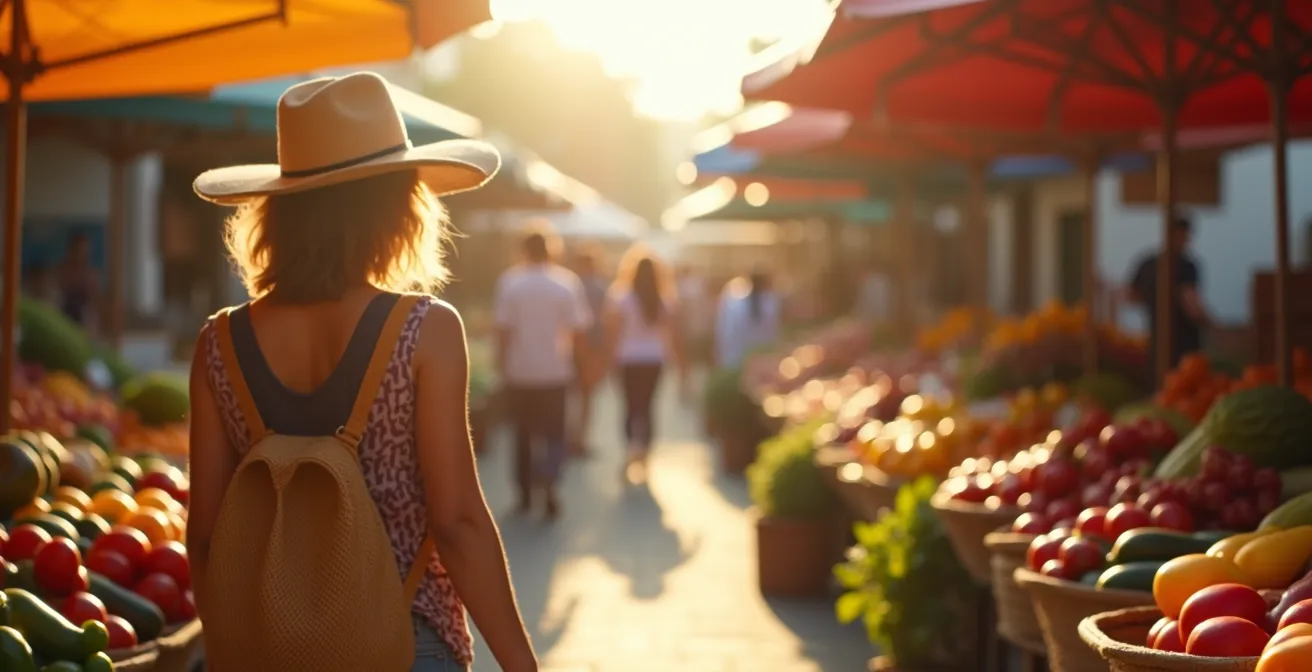
You’re on vacation, exploring a new place, and you want to taste the real flavor of the region. You crave sun-ripened tomatoes, fresh-picked herbs, and artisanal cheese made just down the road. But then, reality hits. A glance at your travel budget and the “organic” section of the local supermarket makes you flinch. The common assumption is that eating fresh, local, and healthy is a luxury reserved for those with deep pockets. So, you might compromise, heading back to the familiar aisles of a large grocery chain, feeling like you’re missing out on an authentic experience.
Many travelers believe the only options are expensive farm-to-table restaurants or equally pricey specialty food stores. They dutifully visit a farmers’ market, but without a strategy, they can end up paying premium prices for a few photogenic items. But what if the entire premise that local costs more is flawed? What if the secret to eating 100% local without blowing your budget isn’t about spending more, but about becoming a smarter food detective?
This guide flips the script. The true key to affordable local eating is not found in the organic aisle; it’s found by completely bypassing the conventional supply chain. We’ll show you why buying directly from the source is economically superior, equip you with the digital tools to find hidden farm-gate sales, and teach you the strategies to spot supermarket scams. Prepare to transform your vacation meals from a budgetary concern into a delicious, affordable adventure that genuinely supports the local community.
This article provides a complete roadmap for the budget-conscious food lover. We will break down the economics, provide actionable tools and techniques, and empower you to cook with creativity and confidence, no matter where your travels take you. Let’s dive into the strategies that will change the way you eat on vacation forever.
Summary: How to Eat 100% Local on Vacation Without Blowing Your Budget?
- Why Is Direct-from-Farmer Often Cheaper Than Supermarket Organic?
- Which 3 Apps Are Essential for Finding Farm Sales on the Road?
- How to Buy a One-Off Basket from a CSA While on Holiday?
- The “Local Product” Scam That Supermarkets Use to Trick You
- How to Reverse-Engineer Your Menu Based on What the Farmer Has Today?
- Why Does spending 100€ at a Local Artisan Worth 300€ for the Community?
- When to Visit Alsace to Eat Genuine Sauerkraut with Fresh Cabbage?
- How to Design a Zero-Waste Menu for a Large Family Reunion?
Why Is Direct-from-Farmer Often Cheaper Than Supermarket Organic?
The perception that “local” or “organic” equals “expensive” comes from our experience in supermarkets. But this premium price isn’t set by the farmer; it’s built by a long chain of intermediaries. When you buy an apple from a large retailer, you’re not just paying for the apple. You’re paying for the processor, the packaging company, the long-haul transport, the distributor’s warehouse, and the supermarket’s marketing budget. Each step adds a markup, inflating the final cost.
In fact, research shows that the farmer’s share of the retail price is shockingly small. For some products sold through major chains, the grower might receive as little as 1% of the final selling price in profit. However, when that same grower sells directly to consumers or through non-profit hubs, their profit margin can increase threefold or more, even while the final price for the consumer is lower. This is the power of bypassing the chain. The money you spend goes to the person who grew the food, not to a series of middlemen.
Furthermore, the price gap is closing in surprising ways. While organic produce has historically been more expensive, recent USDA research shows that conventional produce prices have increased at a higher rate than those for organic items, narrowing the difference. When you buy direct, you often find prices that are competitive with, or even beat, conventional supermarket prices, all while getting superior freshness and quality. You may also find “ugly produce”—fruits and vegetables that are perfectly delicious but don’t meet cosmetic standards for retail—at a steep discount.
Which 3 Apps Are Essential for Finding Farm Sales on the Road?
Becoming a savvy food detective in a new location requires the right tools. In the digital age, your smartphone is your best asset for uncovering farm-gate sales, pop-up markets, and direct-to-consumer producers that don’t appear on typical tourist maps. While a generic map search might show you a few well-known farmers’ markets, these three types of resources will give you a significant edge.

As you can see, technology is the bridge to authentic local experiences. Here are the essential tools for your digital toolkit:
- Government-Run Directories: These are often the most comprehensive and unbiased databases. For instance, the USDA’s National Farmers Market Directory in the United States is a powerful tool allowing you to search by location, products, and payment types. Many countries and regions have similar government-sponsored websites that provide direct links and details for verified local producers. They are a reliable, ad-free starting point.
- Community-Sourced Aggregators: Websites like LocalFarmMarkets.org operate on a more grassroots level, often featuring smaller farm stands and markets that might be missed by official directories. These platforms frequently include user reviews and more detailed information about the types of products available, including whether a farm is organic.
- Social Media Community Groups: This is the secret weapon. Search on platforms like Facebook for groups with names like “[Town Name] Foodies,” “Local Growers of [Region],” or “Support [County] Farms.” In these groups, you’ll find real-time posts from small producers announcing what’s fresh that day, offering bulk deals, or selling surplus produce directly from their property. It’s the most direct line to the freshest food available.
How to Buy a One-Off Basket from a CSA While on Holiday?
Community Supported Agriculture (CSA) programs are a cornerstone of the local food movement. The model is simple: consumers pay a farm upfront for a “share” of the season’s harvest, which they receive in a weekly box. While this sounds like a long-term commitment, a savvy traveler can tap into this system for short-term stays. Many farmers are more flexible than their websites might suggest, offering unadvertised ways to participate.
For example, some innovative farms like Zenger Farm in Portland have pioneered flexible models, allowing members to choose which weeks they want to pick up produce. This is perfect for a multi-week vacation. But even for shorter trips, there are clever workarounds. The key is to be proactive and reach out directly. Here are the most effective strategies:
- Inquire About “Vacation” or “Guest” Shares: Contact farms in your destination area before you travel. Explain you’re visiting for a week or two and ask if they sell one-off “trial” boxes or have a “vacation share” option. Many are happy to accommodate, as it introduces their program to potential new customers.
- Offer to “Adopt” a Share: Join local CSA or community Facebook groups for your destination. Post a message offering to purchase a vacationing member’s share for the week they are away. You get a box of fresh, local produce at a fair price, and the member avoids having their share go to waste.
- Check for Flexible Pick-Up Policies: Some CSAs have policies for missed boxes. They might hold them for an extra day or have alternative pick-up locations. This flexibility can sometimes be leveraged for a one-time purchase if you coordinate with the farm manager.
By thinking outside the traditional subscription model, you can access the incredible value and variety of a CSA basket, even if you’re only in town for a few days. It’s a prime example of how a little resourcefulness yields delicious rewards.
The “Local Product” Scam That Supermarkets Use to Trick You
As consumer demand for local food grows, large supermarkets have responded with clever marketing that can be deeply misleading. You’ve likely seen it: rustic-looking packaging, signs with folksy farm names, and labels proclaiming “Product of Our Region” or “Local Favorite.” This is what we call “fake local.” It’s designed to evoke the feeling of a farmers’ market while the product itself may have traveled hundreds of miles and passed through the same industrial supply chain as any other item.
The core of the scam lies in vague terminology. A “region” can be an entire country, and a “farm brand” can be a fictional name created by a massive food corporation. The economic reality behind this is stark. According to USDA Economic Research, a substantial portion of consumer food prices is attributed to marketing services added by companies after the product leaves the farm. This “fake local” branding is one such service you pay a premium for, with little of that money ever reaching an actual farmer.
To avoid being tricked, you need to become a label detective. A genuinely local product will have specific, verifiable information. The difference between real and fake is often clear once you know what to look for.
| Indicator | Genuine Local | Fake Local |
|---|---|---|
| Origin Label | Specific farm name and location (e.g., ‘Smith Farm, Townville’) | Vague terms like ‘Product of our region’ |
| Seasonality | Matches local growing seasons | ‘Local’ strawberries available in winter |
| Packaging | Minimal, often reusable | Rustic design with fine print revealing distant origin |
| Price Distribution | The farmer receives a higher and more realistic return (e.g. 3% or more in profit). | The grower’s profit is minimal, often around 1% of the selling price. |
| Supply Chain | Direct or minimal intermediaries | Multiple distributors and processors involved |
By using this framework, you can confidently distinguish between authentic products that support local growers and the marketing illusions created by large retail chains.
How to Reverse-Engineer Your Menu Based on What the Farmer Has Today?
The most common mistake travelers make when cooking on vacation is arriving at the farmers’ market with a rigid recipe in mind. This approach inevitably leads to frustration when a key ingredient isn’t available, or to overspending on out-of-season items. The savvy local eater does the opposite: they reverse-engineer the menu. This means letting the market’s offerings dictate your meals, not the other way around. It’s a shift from recipe-based thinking to component-based creativity.
Instead of looking for specific ingredients for a lasagna, think in terms of flexible building blocks: Vegetable + Protein + Starch. The market has beautiful zucchini and fresh goat cheese? That becomes the core of your meal, perhaps a simple pasta dish or a frittata. This method is not only more budget-friendly but also pushes you to be more creative and truly cook with the seasons. A great way to start is by mastering a few universal recipes that can adapt to almost any ingredient, such as a quiche, a composed salad, a roasted vegetable tray, or a blended soup.
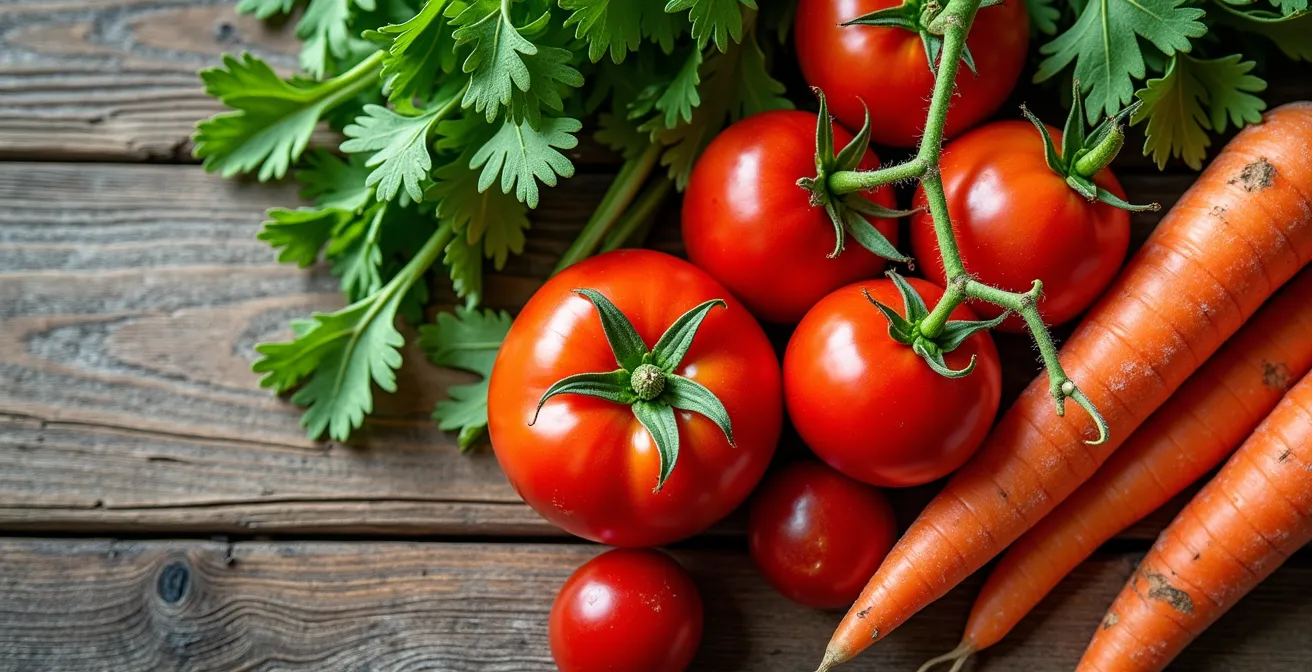
To make this even easier, pack a small “Local Eater’s Travel Kit” with essentials like good olive oil, vinegar, salt, pepper, and one or two of your favorite versatile spices. This frees you from having to buy full-sized condiments for a short stay. And don’t be shy—ask the vendors for advice! They can tell you the best way to store and prepare their products. Sometimes, the easiest local meal is one you don’t have to cook at all; many markets have vendors selling delicious ready-to-eat meals like empanadas or fresh salads.
Your 5-Step Menu Reverse-Engineering Plan
- Survey First, Buy Second: Walk the entire market before purchasing anything. Note what looks freshest, most abundant, and reasonably priced. This is your ingredient palette.
- Identify Your “Hero” Ingredient: Choose one or two standout vegetables or fruits that will be the star of your meal. Let this choice guide the rest of your purchases.
- Build with Components: Based on your hero ingredient, gather complementary components. Think about texture and flavor: something crunchy, something creamy, a fresh herb for brightness.
- Select a Universal Recipe Framework: Decide which of your go-to flexible meals (frittata, salad, pasta, roast) best suits the components you’ve gathered.
- Fill the Gaps Last: Only after you have your core local ingredients should you head to a store for any necessary staples like pasta, eggs, or bread, if they weren’t at the market.
Why Does spending 100€ at a Local Artisan Worth 300€ for the Community?
Choosing to buy directly from a local farmer or artisan goes far beyond just getting fresher food; it triggers a powerful economic phenomenon known as the “local multiplier effect.” This isn’t just a feel-good concept; it’s a measurable economic impact. The title’s claim that 100€ can be worth 300€ isn’t hyperbole—it reflects studies showing that money spent locally circulates within the community, generating additional economic activity. A multiplier of 3 is a common finding in such research.
Here’s how it works: when you spend €100 at a large chain supermarket, a significant portion of that money is immediately siphoned out of the local economy to corporate headquarters in another city or country. In contrast, when you spend that same €100 at a local farmer’s stand, the farmer is more likely to re-spend it locally. They might use it to pay their local employees, buy supplies from a local hardware store, or get their tractor repaired by a local mechanic. That mechanic then uses their earnings to buy groceries from another local business, and so on. The original €100 is re-spent multiple times, amplifying its benefit to the community.
The numbers are compelling. Independent research shows that 52.9 percent of each purchase at local independent businesses is recirculated locally, compared to less than 13.6 percent of purchases at chain stores. This means that for every dollar you spend locally, nearly four times more money stays and works within the community. Your decision to buy a jar of jam from the person who made it doesn’t just get you a better product—it helps fund local jobs, supports other small businesses, and contributes to the unique character and economic resilience of the place you are visiting.
When to Visit Alsace to Eat Genuine Sauerkraut with Fresh Cabbage?
Every region has its iconic dish, and for travelers, tasting it in its place of origin is a peak experience. However, the authenticity of that experience often depends on one crucial factor: timing. Many regional specialties are deeply tied to a harvest season. Visiting Alsace in the spring and eating sauerkraut is a very different experience from eating it in the late autumn, when it’s made with freshly harvested cabbage. The former is likely a preserved, tourist-oriented version; the latter is the genuine article, bursting with flavor.
This principle of “gastronomic timing” applies everywhere. Trying to find fresh morel mushrooms in the wrong month or eating a “fresh” tomato dish in a northern climate in February means you are likely eating a pale imitation of the real thing, often made from ingredients shipped from far away. To have a truly authentic and budget-friendly culinary vacation, align your travel dates with the peak harvest season of the foods you want to try. During peak season, produce is not only at its most flavorful but also at its most abundant and affordable.
Becoming a strategic food traveler requires a little planning before you book your trip. Here’s how to time your visit for peak deliciousness:
- Research Harvest Calendars: Before deciding on travel dates, do a quick search for “[Destination] harvest calendar” or “seasonal food guide.” This will tell you which fruits and vegetables are at their peak each month.
- Contact Tourism Offices: Local or regional tourism boards are excellent resources. Email them and ask specifically, “We want to experience the authentic [regional dish]. When is the best time of year to visit for that?”
- Follow Local Foodie Groups: Join social media groups for your destination months in advance. You’ll see locals posting excitedly about the first strawberries of the season or the arrival of the new olive oil, giving you real-time intelligence.
- Ask the Right Question: Once you’re there, instead of asking a local “Where can I find this dish?” ask “When do you eat this dish?” Their answer will reveal the true season of authenticity.
Key Takeaways
- Bypassing the supply chain by buying direct from farmers is the single most effective way to eat high-quality local food for less money than at a supermarket.
- Leverage technology like government food directories and community social media groups to locate farm-gate sales and other direct-to-consumer opportunities.
- The money you spend at local businesses has a magnified impact on the community, with studies showing it recirculates at a rate nearly four times higher than money spent at chain stores.
How to Design a Zero-Waste Menu for a Large Family Reunion?
Cooking for a large group on vacation, like for a family reunion, can seem daunting, especially when trying to stay on budget and minimize waste. However, by applying the principles of local sourcing and menu flexibility on a larger scale, you can create memorable, affordable, and sustainable feasts. The key is to move away from rigid, single-dish meals and embrace formats that are inherently flexible and produce less waste.
One of the most effective strategies is the “Build-Your-Own” buffet. Instead of making one large, specific dish, you prepare its components separately. For example, a taco bar with various fillings, a salad bar with a dozen different toppings, or a baked potato bar allows everyone to take only what they want. This simple change can reduce food waste from over-serving by up to 40%. It also caters to picky eaters and diverse dietary needs without extra effort.
Another advanced technique is adopting a “root-to-leaf” philosophy. This involves using the entire vegetable. The green tops of carrots or radishes can be blended into a delicious pesto, and vegetable peels and offcuts can be simmered to create a flavorful broth for a future soup. This maximizes the value of every purchase. Finally, have a clear departure day strategy. A “clean-out-the-fridge” quiche, frittata, or savory cake is a perfect way to use up all the remaining bits of cheese, vegetables, and herbs in one delicious, travel-friendly meal.
Now that you’re equipped with these savvy strategies, the next step is to put them into practice on your next trip. Start by researching the local harvest calendar for your destination and begin your journey as a food detective.