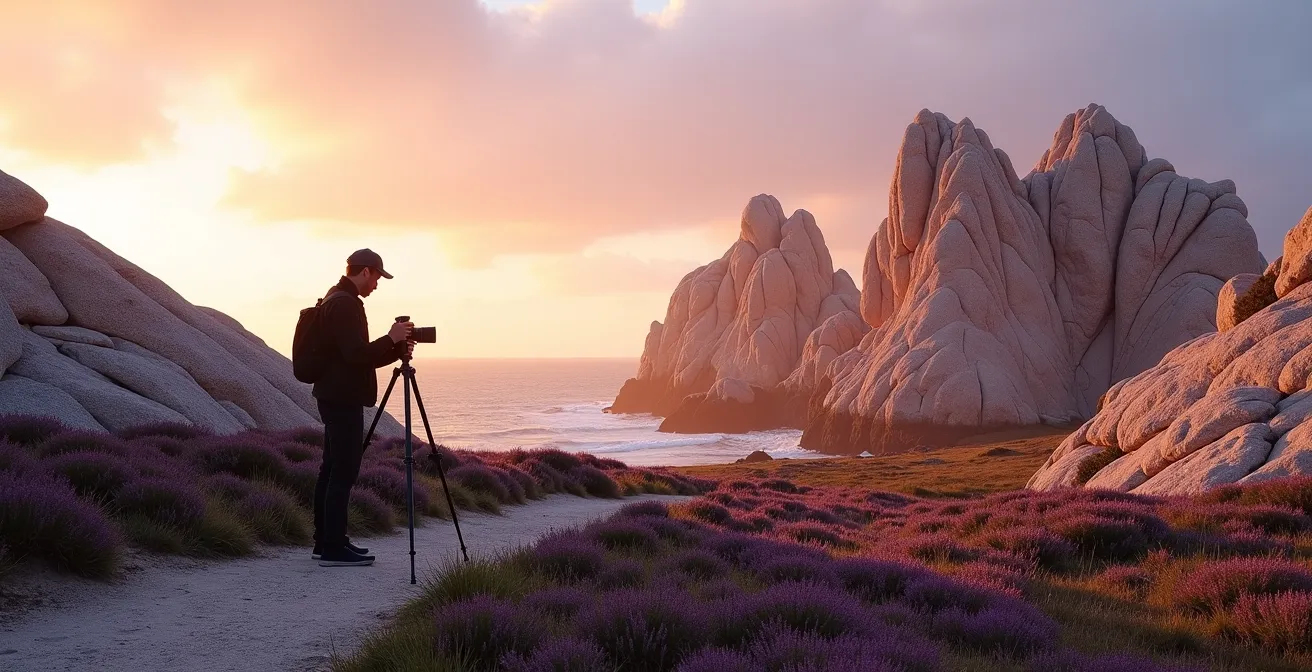
The most breathtaking photographs of the Pink Granite Coast come not from having the best gear, but from a deep understanding of its profound fragility.
- The coast’s unique pink hue is the result of a 300-million-year-old geological process, making it an ancient, non-renewable masterpiece.
- Human activity, from straying off marked paths to seemingly harmless gardening choices, poses a direct and significant threat to its delicate ecosystem.
Recommendation: Shift your mindset from “taking a shot” to “earning it” by learning the coast’s ecological rhythms and adopting a strict Leave No Trace photographic practice.
The Pink Granite Coast of Brittany exerts a magnetic pull on photographers and nature lovers alike. Its otherworldly boulders, sculpted by millennia, glow with an internal fire at sunrise and sunset, promising the shot of a lifetime. The common impulse is to chase this light, to find that perfect, untrodden vantage point, armed with tripods and filters. This pursuit, however, often overlooks a critical truth: the very ground beneath our feet is a fragile, living tapestry woven from protected heathland and ancient rock.
While standard advice focuses on golden hour and tide charts, it misses the heart of the matter. The real challenge, and the deepest reward, is not just to capture the beauty of the coast but to do so as a guardian, not a conqueror. What if the key to an extraordinary photograph wasn’t a new lens, but a new perspective? A perspective rooted in “geological empathy”—an appreciation for the immense timescale that created these landscapes and the speed at which they can be damaged.
This guide moves beyond the basics. We will explore the very fabric of this landscape, understanding why its granite is so rare and why its cliffs are so vulnerable. By connecting the act of seeing with the science of preservation, you will learn not only how to take a better photograph but how to become a part of the coast’s conservation story, ensuring its magic endures for generations of artists to come.
To help you navigate this path of responsible discovery, we’ve structured this guide to build your understanding from the ground up. From the atomic composition of the rock to the grand dance of the tides, each section will equip you with the knowledge to see—and photograph—the Pink Granite Coast with new eyes.
Summary: A Guide to Photographing Brittany’s Coast with Respect and Awe
- Why Brittany’s Granite Is Pink and Rare on a Global Scale?
- How to Hike the GR34 Custom Officers’ Path Without Contributing to Erosion?
- Ploumanac’h or Crozon: Which Peninsula Offers the Wildest Experience?
- The Gardening Error That Threatens Brittany’s Native Coastal Flora
- When to Visit the Coast to Witness the Highest Tides of the Year?
- Why Do Cliff Edges Collapse Even Without Heavy Rain?
- Why Are the Calanques White and Vertical: A Geological Explanation?
- How to Hike the Brittany Coast Path Without Worsening Erosion?
Why Brittany’s Granite Is Pink and Rare on a Global Scale?
The “pink” in the Pink Granite Coast is not just a poetic description; it’s a geological signature. This vibrant hue comes from a specific mineral cocktail that is uncommon on a planetary scale. Understanding this composition is the first step toward appreciating the true preciousness of the landscape you’re about to photograph. The stone isn’t merely a backdrop; it’s the 300-million-year-old protagonist of the story.
The distinct rosy color is primarily due to a high concentration of potassium feldspar. A geological analysis reveals that the pink granite contains approximately 50% potassium feldspar, which imparts the warm tones, alongside 30% quartz (the translucent, glassy crystals) and 20% biotite (the dark mica flakes). This specific balance, formed from magma that cooled slowly deep within the Earth’s crust, is the coast’s unique fingerprint.
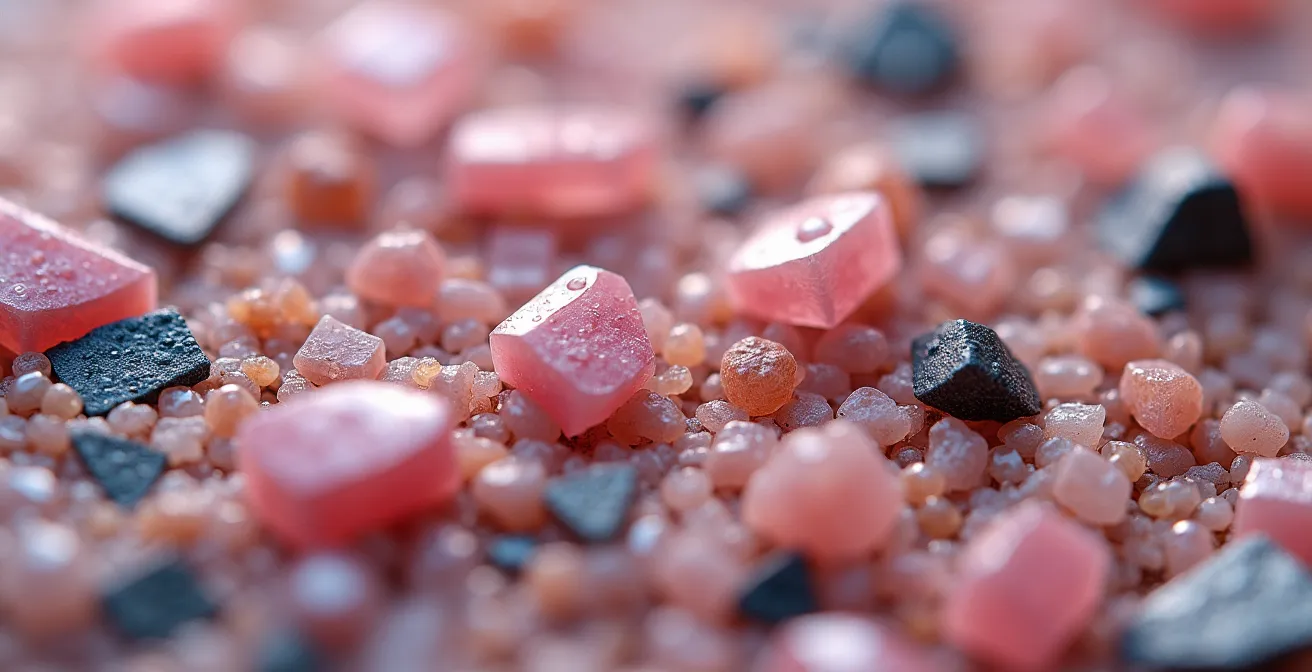
As the macro view above reveals, the rock is a mosaic of interlocking crystals. While other pink granite deposits exist globally—notably in Brazil, Spain, and the USA—the specific texture and sculptural erosion patterns seen at Ploumanac’h are a product of this precise mineralogy combined with millennia of wind and water. When you frame your shot, you are capturing the endpoint of an immense geological journey, a process that makes these formations as unique and irreplaceable as a work of art.
How to Hike the GR34 Custom Officers’ Path Without Contributing to Erosion?
The GR34, or the Custom Officers’ Path, is your gateway to the splendors of the coast. It is designed to offer breathtaking views while channeling human traffic to minimize impact. However, even on a designated trail, erosion is a constant threat. Every footstep has a consequence, and the key to responsible hiking is to make that consequence as negligible as possible. The goal is simple: leave no trace that you were ever there.
The primary rule is absolute: stay on the marked path. The heathland bordering the trail is a fragile ecosystem with thin soil and specialized plants. When hikers cut corners or create “social trails” to get a slightly better photo angle, they trample this vegetation. This compacts the soil, prevents water absorption, and kills the plant roots that hold the earth together. Once the vegetation is gone, wind and rain have a direct line to the soil, accelerating erosion and widening the scar on the landscape. This isn’t a theoretical risk; it’s a visible process all along the coast.
To be an effective guardian of the trail, adopt these essential practices:
- Check tide times: Plan your hike to avoid being trapped by rising tides, which might force you onto fragile higher ground.
- Use rubber tips on poles: If you use hiking poles, their metal tips can scratch and chip the granite. Rubber tips significantly reduce this damage.
- Pack everything out: This includes organic waste like fruit peels. Leave the landscape exactly as you found it.
- Observe wildlife from a distance: Disturbing nesting birds or other coastal animals causes stress and can disrupt their life cycles.
- Report damage: If you see significant erosion, a landslide, or damage to the path, report it to the Conservatoire du littoral so it can be addressed.
Your camera can be a tool for preservation. Use your telephoto lens to get closer shots without leaving the path, and use your creativity to find compelling compositions from the designated route. The best photographers prove that a stunning image doesn’t require sacrificing the environment.
Ploumanac’h or Crozon: Which Peninsula Offers the Wildest Experience?
For a photographer in Brittany, the choice often comes down to two iconic locations: the world-famous Pink Granite Coast centered around Ploumanac’h, and the rugged, sprawling Crozon Peninsula to the south. While both offer magnificent coastal scenery, they provide vastly different experiences in terms of wildness, crowds, and photographic style. Choosing consciously between them allows you to align your trip with your personal vision and tolerance for crowds.
Ploumanac’h is known for its intimate, sculptural scenes. The rounded, warm-toned boulders feel almost alive, creating a natural playground of abstract forms. It’s accessible, with well-maintained paths, but this accessibility comes at the cost of high crowd density, especially in summer. Crozon, by contrast, is a realm of epic, raw drama. Its sharp schist and sandstone cliffs plunge vertically into the turquoise sea, offering vast, windswept panoramas. The trails can be more challenging and the locations more remote, which naturally translates to a wilder, more solitary experience.
This comparative table helps clarify the choice for photographers seeking a specific atmosphere.
| Criteria | Ploumanac’h | Crozon |
|---|---|---|
| Rock Formation Type | Rounded pink granite boulders | Sharp schist and sandstone cliffs |
| Crowd Density | High (especially summer) | Moderate to low |
| Photography Style | Intimate, warm, sculptural scenes | Epic, raw, dramatic coastal landscapes |
| Trail Difficulty | Easy to moderate | Moderate to challenging |
| Accessibility | Well-developed infrastructure | More remote locations |
A Photographer’s Perspective on Ploumanac’h
The famous lighthouse of Ploumanac’h, the Phare de Men Ruz, is a photographic magnet, appearing in thousands of images online. While this popularity can lead to crowded viewpoints, the true appeal for a dedicated photographer lies beyond the obvious. The coastline is lined with huge granite rocks, some over 10 meters high, offering an almost infinite number of unique compositions for those willing to explore patiently and find their own vision away from the crowds.
Ultimately, the decision is a personal one. If you seek the iconic pink glow and don’t mind sharing the view, Ploumanac’h is unparalleled. If your soul craves solitude and raw, dramatic landscapes, the untamed spirit of the Crozon Peninsula will be your reward.
The Gardening Error That Threatens Brittany’s Native Coastal Flora
One of the most insidious threats to the Pink Granite Coast’s ecosystem doesn’t come from a hiker’s boot, but from the local garden. A seemingly innocent horticultural choice—planting attractive but invasive ornamental species—has led to an ecological crisis. These “garden escapees” spread into the wild, outcompeting and smothering the native heathland that is essential to the coast’s stability and character.
The most notorious culprit is the Hottentot-fig (*Carpobrotus edulis*), an attractive, fast-growing succulent from South Africa. Planted for its bright flowers and ground-covering ability, it has proven to be a devastatingly effective invader. Its thick, fleshy leaves form dense mats that choke out native flora like sea thrift, heather, and gorse. This not only destroys the natural habitat but also alters soil chemistry and destabilizes the fragile coastal dunes and cliffs. The scale of the problem is alarming; reports show that invasive plants have spread across the 40-kilometer stretch of this precious coastline.
As a visitor and photographer, you play a role in preventing this spread. By being aware of the issue, you can avoid accidentally transporting seeds on your gear and appreciate the beauty of the true native flora. For residents and gardeners in coastal areas, the responsibility is even greater.
Your Action Plan for Protecting Coastal Flora
- Choose wisely: Never plant ornamental Hottentot-fig (*Carpobrotus edulis*) or other known invasive species near coastal areas.
- Eradicate completely: If removing existing invasive plants, ensure all root fragments are dug up and disposed of properly to prevent regrowth.
- Go native: For gardens, choose native Brittany coastal plants like sea thrift (Armeria maritima), heather (Calluna vulgaris), and gorse (Ulex europaeus) which support local ecosystems.
- Clean your gear: Meticulously clean hiking boots, tripods, and camera bags before and after coastal walks to prevent the spread of seeds between locations.
- Report sightings: If you spot what you believe to be an invasive plant species spreading in the wild, report it to local environmental authorities or the Conservatoire du littoral.
Protecting the visual integrity of the landscape means protecting its botanical integrity. A field of purple heather is not just more beautiful than a mat of Hottentot-fig—it’s the sign of a healthy, resilient ecosystem.
When to Visit the Coast to Witness the Highest Tides of the Year?
The Pink Granite Coast is a landscape in constant motion, sculpted by the dramatic tides of the English Channel—some of the most powerful in Europe. For a photographer, the tides are not a minor detail; they are a primary creative tool. They dictate access, reveal hidden landscapes, and completely transform the character of a scene. Planning your visit around the tidal calendar is as important as watching the weather forecast.
The most visually stunning moments often occur at extreme low tide. This is when the sea retreats to reveal vast expanses of seabed, exposing seaweed-draped boulders and secret tidal pools that are otherwise submerged. These moments turn the coast into an alien, almost surreal landscape, offering unique compositions and leading lines that simply don’t exist at high tide. To witness this, you need to consult a tide chart and plan your visit for the days of the month with the largest tidal coefficients, which correspond to the new and full moons.
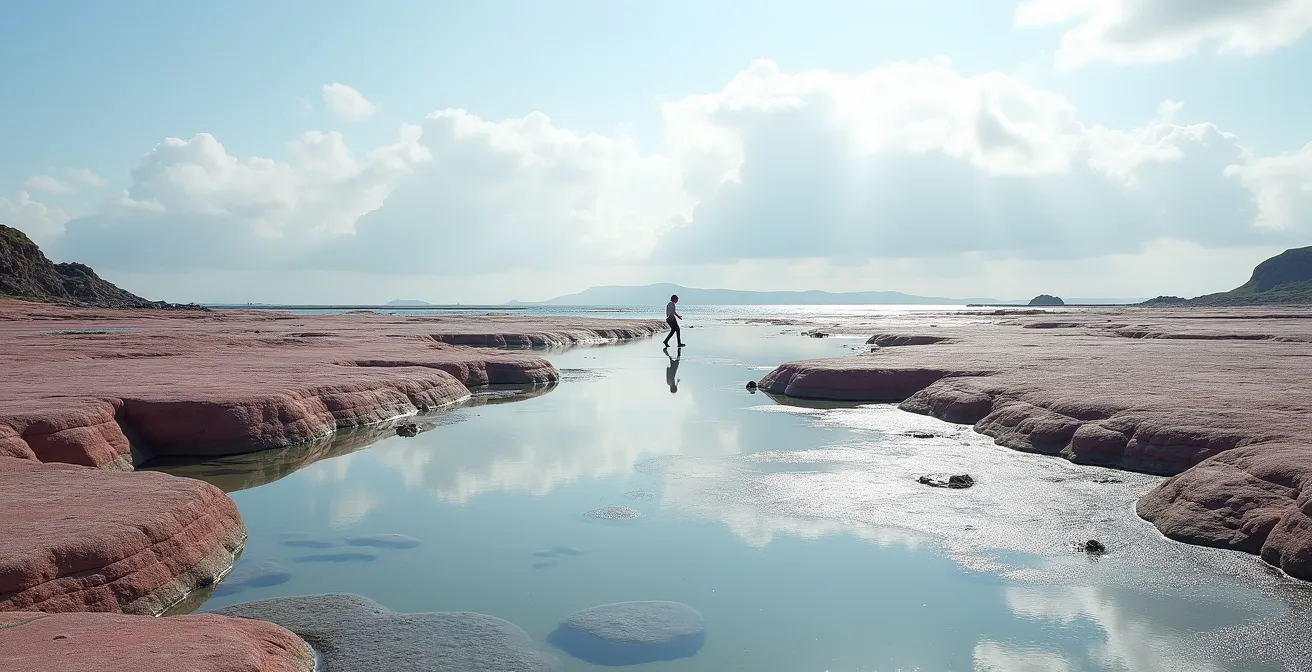
Conversely, the highest tides, known as “spring tides,” offer a different kind of drama. Waves crash with incredible force against the granite sentinels, sending spray high into the air. This is a chance to capture the raw power of the ocean, but it requires extreme caution and a safe vantage point well away from the water’s edge. The highest tides of the year typically occur during the spring and autumn equinoxes (around March and September), when gravitational forces are at their peak.
A Photographer’s Tidal Planning Strategy
To capture her viral image of Ploumanac’h, French photographer Élodie Martin demonstrated the power of meticulous planning. She studied tide charts for weeks, identifying the window of the lowest tide that coincided with the best morning light. Arriving on location at 5:30 a.m., she was able to access parts of the shore that are usually underwater, allowing her to capture the granite formations in their full, majestic splendor. Her final shot, taken at ISO 100, f/8, and 1/125s, was only possible because she mastered the coast’s tidal rhythm.
Whether you seek the quiet revelations of low tide or the explosive drama of high tide, respecting their power is paramount. The tide is the pulse of Brittany; learning to photograph in sync with it is the mark of a true coastal artist.
Why Do Cliff Edges Collapse Even Without Heavy Rain?
The dramatic cliffs of Brittany may seem eternal and unyielding, but they are in a constant, slow-motion state of collapse. While major rockfalls are often associated with heavy rain, many cliff edges crumble due to more subtle, internal processes. Understanding these “invisible” forces is crucial for your safety and for appreciating the inherent fragility of the very ground you stand on.
The granite itself has been exposed to the elements for an immense period. Some geological studies show granite has been exposed to 300 million years of erosion, a process that has weakened its internal structure through freezing, thawing, salt crystallization, and chemical weathering. This creates micro-fractures within the rock. Water seeps into these cracks and acts like a slow, powerful hydraulic wedge, gradually pushing sections of the cliff apart from within. This happens year-round, not just during storms.
This internal pressure means a cliff can be critically unstable even if it looks solid. The weight of a person standing too close to an edge can be the final straw that triggers a collapse. The most dangerous areas are often overhanging sections, where the rock below has already eroded away, leaving a precarious ledge with no visible support. For this reason, respecting safety barriers and keeping a significant distance from any cliff edge is not optional—it’s a matter of life and death.
Train your eye to spot the warning signs of an unstable area. This active observation is a key part of responsible coastal exploration:
- Tension cracks: Look for fractures in the ground running parallel to the cliff edge, indicating the land is pulling away.
- Fresh debris: A recent accumulation of rocks and soil at the base of a cliff is a clear sign of active erosion above.
- Water seepage: Noticeable water weeping from the cliff face, even on a dry day, signals internal water pressure that is weakening the rock.
- Vegetation gaps: An abrupt stop in vegetation near the edge can indicate that the ground has recently shifted or is too unstable to support life.
- Overhangs: Be extremely wary of any section of the path or cliff that juts out over the sea with no visible support beneath it.
Your best photograph is one you can return home to share. Never risk your life for a shot. The power of the coast demands our utmost respect and caution.
Why Are the Calanques White and Vertical: A Geological Explanation?
To truly grasp the uniqueness of Brittany’s Pink Granite Coast, it helps to compare it to another of France’s celebrated coastlines: the Calanques of Provence. While both are stunningly beautiful, they are geological polar opposites. The Calanques are a world of brilliant white limestone that forms sharp, vertical cliffs, a stark contrast to the rounded, warm-hued granite of Brittany. This difference is not just aesthetic; it stems from entirely different origins and erosion patterns.
The Calanques’ limestone is a sedimentary rock, formed around 120 million years ago from the compressed skeletons and shells of marine creatures in a shallow tropical sea. Its primary component, calcium carbonate, is bright white and reflects light harshly. Granite, on the other hand, is an igneous rock, born from molten magma that cooled deep underground 300 million years ago. Its feldspar and quartz crystals absorb light, giving it that characteristic soft glow, especially at dawn and dusk.
This fundamental difference in rock type dictates how they erode and, consequently, the landscapes they form. The bedding planes and vertical fractures in limestone lead to the formation of steep, fjord-like inlets and sharp cliffs. Granite, being a more homogenous and massive rock, weathers through a process called spheroidal weathering, where its corners and edges erode faster, resulting in the soft, rounded, and often bizarrely shaped boulders seen at Ploumanac’h.
The difference between the ~300 million year old pink granite at Ploumanac’h isn’t merely ornamental. The pink granite gets its rosy hue from potassium feldspar, while the greyer granite has more creamy-colored plagioclase feldspar.
– Blue Marble Earth Geology Blog, Geological Analysis of Brittany Coast
This geological contrast offers a powerful lesson for photographers.
| Feature | Brittany Pink Granite | Calanques Limestone |
|---|---|---|
| Rock Type | Igneous (cooled magma) | Sedimentary (marine deposits) |
| Age | 300 million years | 120 million years |
| Formation | Slow cooling of magma batholith | Accumulated marine skeletons/shells |
| Erosion Pattern | Rounded, sculpted forms | Sharp, vertical cliffs |
| Color Source | Potassium feldspar minerals | Calcium carbonate (white) |
| Light Behavior | Absorbs light, glows at dawn/dusk | Reflects light harshly |
By understanding that the Pink Granite Coast is not just another pretty shoreline but a distinct geological phenomenon, our appreciation deepens. We are not just photographing rocks; we are documenting the legacy of ancient magma, sculpted into a form found almost nowhere else on Earth.
Key Takeaways
- Respect the Path: Staying strictly on marked trails is the single most important action to prevent erosion and protect fragile heathland.
- Understand the Tides: Use tide charts as a creative and safety tool. Extreme low tide reveals hidden landscapes, while high tides require extreme caution.
- Think Like a Geologist: Appreciate that the pink granite is a 300-million-year-old, non-renewable feature. This mindset shifts your interaction from consumption to conservation.
How to Hike the Brittany Coast Path Without Worsening Erosion?
We’ve explored the geology, the flora, and the forces that shape the Pink Granite Coast. Now, let’s bring it all together into a core philosophy for photographers and hikers: a commitment to moving through this landscape so lightly that we leave it unchanged, or even better than we found it. Worsening erosion is not an inevitable consequence of visiting; it is the result of a lack of awareness and a mindset focused on “getting” rather than “experiencing”.
The “Leave No Trace” ethos is the foundation. It’s a simple concept with profound implications. It means that every decision you make, from where you place your tripod to what you do with a snack wrapper, is made with the environment’s well-being as the top priority. It’s about shifting from a consumer of views to a steward of the land. This requires patience and a willingness to sometimes forego a shot if it compromises the integrity of the ecosystem.
This philosophy directly counters the fast-paced, competitive nature that can sometimes creep into landscape photography. The pressure to capture an “epic” shot can lead to risky behavior and environmental damage. The true art lies in slowing down, observing, and connecting with the place on a deeper level.
The “Leave No Trace” Photography Workshop
Photography workshops focused on “Leave No Trace” principles have proven highly effective in refreshing what many photographers know but can forget in the heat of the moment. Participants learn to stop hurrying, to select their subjects more carefully, and to think for far longer before clicking the shutter. The main lesson is a powerful one: photography is not a race. It is far better to wait for the right, safe, and respectful conditions than to damage the environment for a fleeting image. The best pictures are born from patience and respect, not haste.
Embracing this mindset transforms your experience. The focus shifts from the final image to the entire process: the quiet observation, the understanding of the natural forces at play, and the satisfaction of knowing your art did no harm. This is the ultimate goal: to let the beauty of the Pink Granite Coast inspire a deeper commitment to its preservation.
By adopting this protective mindset, your photographs become more than just beautiful images; they become a testament to a respectful and sustainable relationship with one of the world’s natural treasures. Start today to practice photography as an act of guardianship.
Frequently Asked Questions about How to Photograph the Pink Granite Coast Without Trampling Protected Heathland?
Can I use a drone for photography along the coast?
Drone usage may be restricted in certain areas, especially near nature reserves or private properties. These regulations are in place to protect nesting birds and ensure the tranquility of the site. Always check and comply with the latest local regulations before flying your drone.
What camera equipment is best for coastal photography without damaging trails?
The best equipment is that which allows you to be creative from the path. A versatile zoom lens (e.g., 24-105mm) can cover both wide landscapes and tighter details without you needing to move. A telephoto lens is excellent for capturing wildlife or distant rock formations from a safe, respectful distance. A tripod is useful for low light, but be mindful of its placement, ensuring its legs are on durable surfaces like rock or the designated path, never on fragile vegetation.
When should I visit to minimize both crowds and environmental impact?
The shoulder seasons (April-June and September-October) offer a great balance of pleasant weather and fewer people. Regardless of the season, visiting early in the morning or late in the afternoon is always best. You’ll not only avoid the peak crowds but also be rewarded with the magical “golden hour” light on the pink rocks. Choosing to visit on a weekday rather than a weekend will also guarantee a more peaceful and less impactful experience.