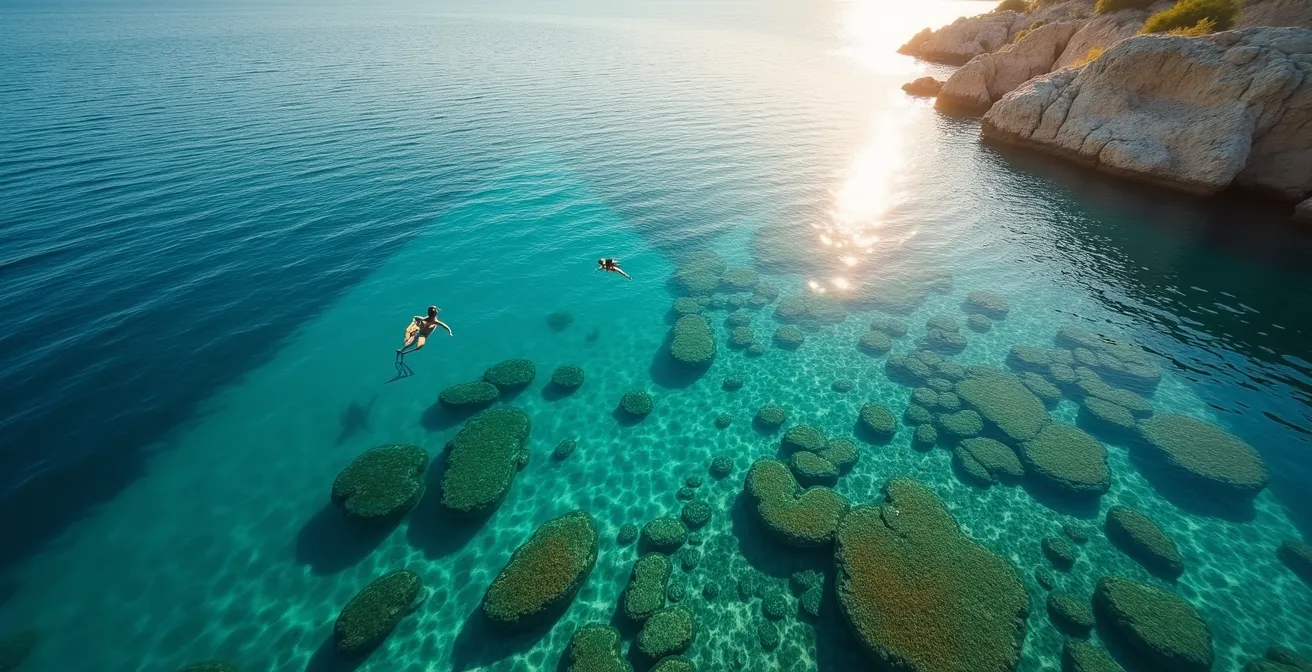
Protecting the Mediterranean is not about avoiding the obvious, but about understanding the invisible damage we cause without realizing it.
- The “reef-safe” label on sunscreen is often meaningless; only specific mineral ingredients are truly safe.
- Anchoring is destructive, but even designated mooring buoys can cause harm if misused.
- Feeding fish bread doesn’t help them; it disrupts their metabolism and the entire food web.
Recommendation: Shift from a passive “do no harm” mindset to an active, conscious technique, where every action—from how you paddle to when you swim—is a deliberate choice to preserve the ecosystem’s delicate balance.
The allure of the Mediterranean is undeniable. The sun-drenched coast of Southern France, with its crystal-clear coves and vibrant marine life, invites us to immerse ourselves in its beauty. As swimmers and snorkelers, we feel a deep connection to this underwater world, and we carry a genuine desire to protect it. We diligently follow the common advice: we don’t touch the wildlife, we pack out our trash, and we believe we are leaving no trace. But what if the greatest threats we pose are invisible? What if our well-intentioned actions are inadvertently harming the very heart of the Mediterranean?
This guide is not a simple checklist of “don’ts.” It’s an invitation to go deeper, to understand the fragile mechanics of this unique ecosystem. We often hear about coral reefs, but the true lungs of the Mediterranean are the vast, swaying meadows of Posidonia seagrass. These underwater prairies are not just scenery; they are complex, life-giving habitats and critical carbon sinks. The reality is that our choice of sunscreen, the way our boat is moored, or even the bread we toss to the fish can cause profound, lasting damage to these vital systems.
The key to true conservation lies in shifting from a mindset of passive avoidance to one of active, conscious technique. It’s about understanding the “why” behind each guideline and recognizing that being a guardian of the sea is a practice, not a label. Throughout this article, we will explore the hidden impacts of our presence and uncover the specific methods that allow us to observe the underwater world not just without disturbing it, but by actively safeguarding its biochemical and physical integrity.
This article provides a detailed roadmap for the conscious snorkeler. We will examine the crucial role of Posidonia, learn to identify genuinely safe sunscreens, and master low-impact techniques for boating and wildlife observation, ensuring our presence enhances, rather than diminishes, the magic of the Mediterranean.
Summary: A Practical Guide to Snorkeling Without Harming Mediterranean Ecosystems
- Why Is Posidonia Seagrass Crucial for Oxygenating the Mediterranean?
- How to Identify Truly Reef-Safe Sunscreen Before Entering the Water?
- Anchoring or Mooring Buoys: Which Method Saves the Seabed?
- The Bread-Feeding Mistake That Kills Fish Populations
- When to Swim in Reserves to See Maximum Fish Activity?
- Canyoning or Rafting: Which Disturbs Aquatic Life Less in Narrow Gorges?
- Why Poor Paddling Technique Causes Shoulder Injury by Day 2?
- When to Kayak the Calanques to Avoid the Summer Flotilla?
Why Is Posidonia Seagrass Crucial for Oxygenating the Mediterranean?
When we snorkel over those vast, green underwater fields, it’s easy to mistake them for simple seaweed. But Posidonia oceanica is not an alga; it’s a flowering plant, a complex organism that forms the foundation of the entire coastal ecosystem. These meadows are often called the “lungs of the Mediterranean,” and for good reason. Through photosynthesis, they produce enormous quantities of oxygen, oxygenating the water and making life possible for countless other species. More than just a habitat, Posidonia is a powerful force in the fight against climate change.
The dense network of its leaves and roots, known as a “matte,” is incredibly effective at trapping sediment and capturing carbon from the atmosphere. Research shows that these humble seagrass meadows are carbon sequestration powerhouses; some studies indicate Posidonia oceanica sequesters between 7.7 to 84.4 grams of carbon per square meter each year. This makes them one of the most efficient carbon sinks on the planet, far more effective than terrestrial forests on a per-area basis.
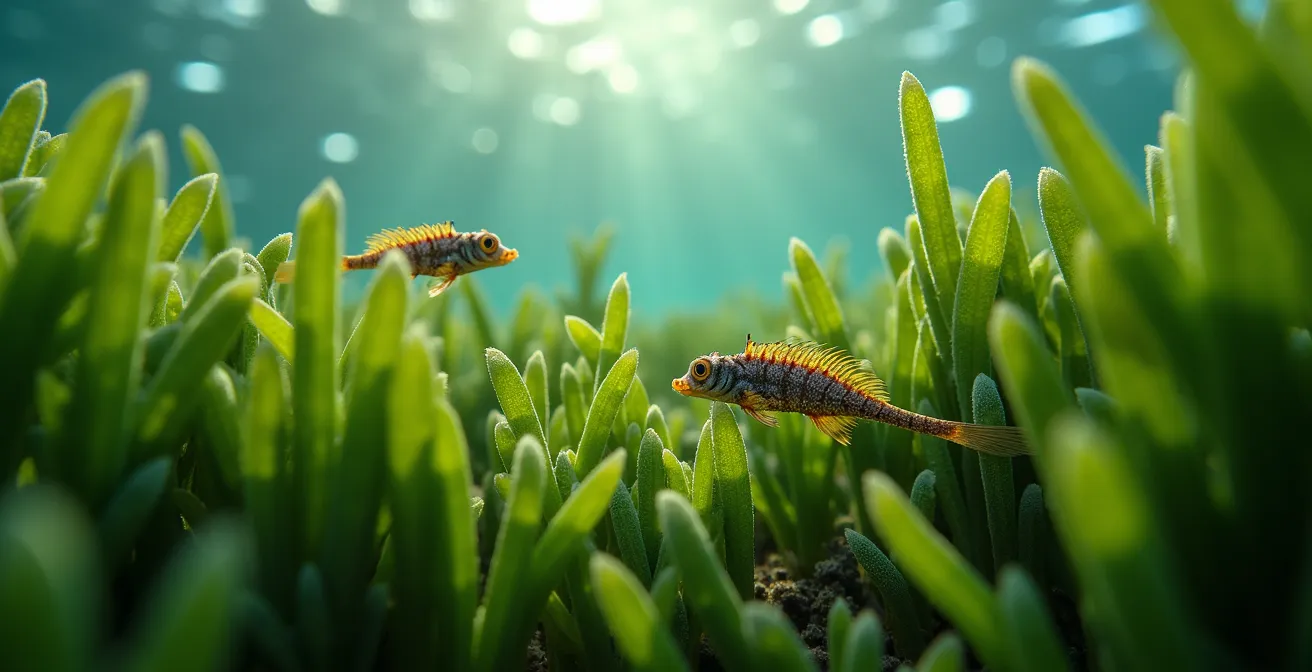
This image perfectly illustrates the meadow’s role as a nursery and a sanctuary. The intricate structure provides shelter for juvenile fish, seahorses, and a myriad of invertebrates, protecting them from predators. A single hectare of Posidonia can support thousands of species, making its preservation a matter of biodiversity. When these meadows are damaged, it’s not just a plant that disappears; it’s an entire web of life and a critical climate regulator that is destroyed. Understanding this is the first step toward becoming a true guardian of the sea.
Case Study: Corsica’s Massive Carbon Storage
To grasp the scale of Posidonia’s impact, a comprehensive seismic survey of Corsica’s eastern continental shelf revealed an astonishing capacity. The study found that the local Posidonia meadows store approximately 15.6 million tons of organic carbon. This demonstrates that protecting these seagrass beds is a globally significant climate action, not just a local conservation effort.
How to Identify Truly Reef-Safe Sunscreen Before Entering the Water?
One of the most direct and invisible ways we impact marine ecosystems is through the chemicals we wear on our skin. Many snorkelers choose sunscreens labeled “reef-safe” with the best intentions, but this term is unregulated and often used as a “greenwashing” tactic. A product might remove one or two harmful chemicals, like oxybenzone, but still contain others that are toxic to marine life. The only way to be certain is to ignore the front label and become an ingredient detective.
True marine-safe sunscreens are mineral-based and contain only two possible active ingredients: non-nano Zinc Oxide and/or non-nano Titanium Dioxide. These ingredients form a physical barrier on the skin that reflects UV rays, rather than being absorbed. The “non-nano” part is critical; it means the particles are larger than 100 nanometers and too large to be ingested by coral and other small marine organisms. If a product doesn’t explicitly state it is “non-nano” or “micro-sized,” it’s best to assume it contains nanoparticles and avoid it.
This comparative table, based on guidance from organizations like the Surfrider Foundation, clarifies the fundamental differences and why your choice matters. The data shows that chemical sunscreens don’t just pose a threat to marine life; their active ingredients are also absorbed by the human body.
| Aspect | Chemical Sunscreens | Mineral Sunscreens (Non-nano) |
|---|---|---|
| Active Ingredients | Oxybenzone, Octinoxate, Octocrylene | Zinc Oxide, Titanium Dioxide |
| Coral Impact | Cause coral bleaching, under FDA reevaluation for human safety | Safe when non-nano particles used |
| Human Detection | Over 90% of people tested had oxybenzone in urine (CDC study) | Not absorbed through skin |
| Regulation Status | Terms ‘reef friendly’ and ‘reef safe’ are not regulated | Same lack of regulation applies |
Ultimately, the most eco-friendly approach is to reduce sunscreen use altogether. Wearing UV-protective clothing like rash guards, hats, and sunglasses provides a reliable and chemical-free barrier, reserving sunscreen for exposed areas like the face, neck, and hands. This not only guarantees zero chemical pollution but also offers more consistent protection throughout the day.
Anchoring or Mooring Buoys: Which Method Saves the Seabed?
The physical damage caused by boats is one of the most visible threats to Posidonia meadows. The common understanding is that anchoring is destructive, while using designated mooring buoys is the responsible alternative. While this is generally true, the reality is more nuanced. Dropping an anchor into a seagrass bed is catastrophic. The anchor itself rips out plants and their root systems, but the real damage comes from the “scouring” effect of the anchor chain. As the boat swings with the wind and currents, the chain drags across the seabed, carving out circles of destruction and leaving scars that can take decades, or even centuries, to heal.
For this reason, mooring buoys are presented as the solution. In theory, they allow boats to secure themselves without any contact with the seabed. However, their effectiveness depends entirely on their design and proper use. An “ecological mooring” uses a system that keeps all parts of the mooring line floating, preventing any chain from dragging. Unfortunately, not all mooring fields are designed this way, and misuse can still lead to significant damage.
Case Study: The Ineffective Moorings of La Maddalena
A startling study in La Maddalena Archipelago National Park, Italy, provided a crucial lesson. Researchers found that 12 years after establishing mooring fields and anchoring restrictions, the measures were largely ineffective at protecting the seagrass. Anchor scars had actually increased, and the mooring systems themselves were causing damage to surrounding areas due to improper use and poor design. This highlights that simply providing infrastructure is not enough; conscious technique is paramount.
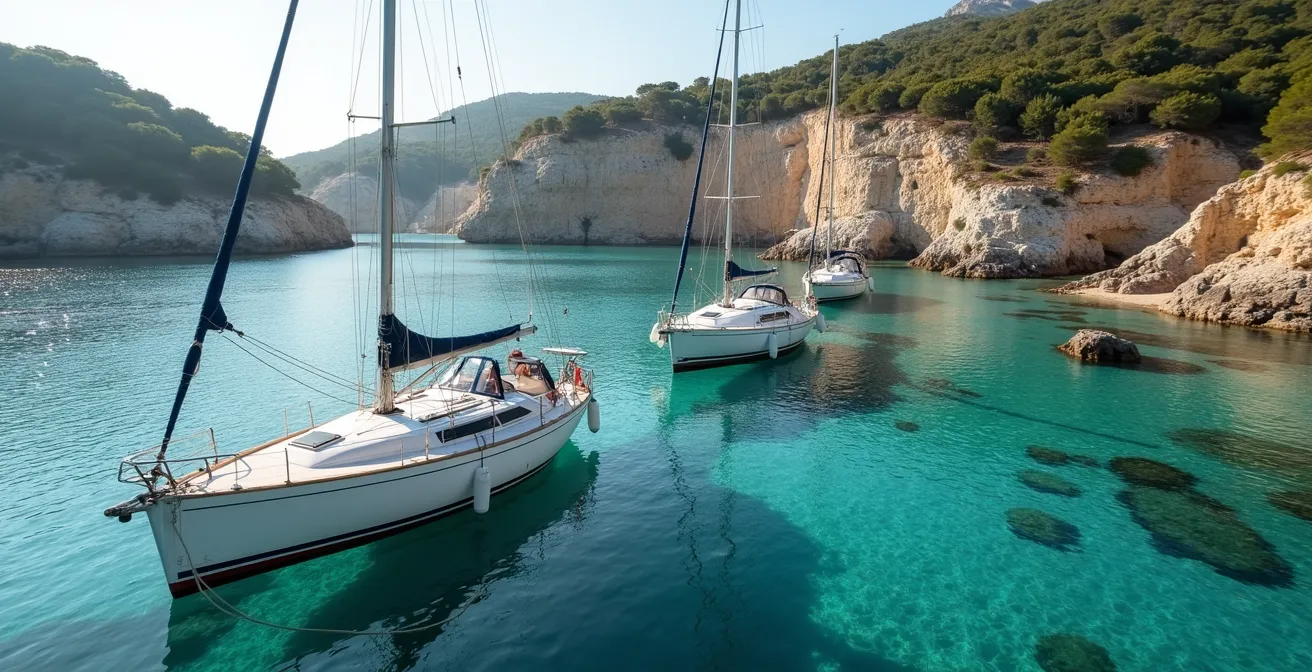
As a snorkeler, even if you are not the captain, you have a role to play. Encourage your skipper to anchor only in sandy patches, clearly identifiable by their light color from the surface. If using a mooring buoy, observe how the boat is behaving. Is it positioned directly over the buoy, or is it drifting too far, potentially causing the line to drag? Advocating for conscious mooring is just as important as avoiding anchoring in the first place.
The Bread-Feeding Mistake That Kills Fish Populations
Tossing a piece of bread into the water and watching a swarm of colorful fish appear is a magical moment for many tourists. It feels like an act of connection, a friendly offering to the local wildlife. Tragically, this common practice is one of the most harmful things you can do. Fish in the Mediterranean have evolved over millennia with a specific diet of algae, small crustaceans, and other marine organisms. Their digestive systems are not equipped to process processed foods like bread, which is high in carbohydrates and gluten.
Feeding bread to fish is akin to feeding a wild herbivore a diet of candy. It can lead to severe health problems, including liver damage, and disrupts their natural feeding behaviors. Fish become dependent on handouts, abandoning their ecological roles, such as grazing on algae that would otherwise overgrow and smother sensitive habitats. This creates a profound nutritional imbalance in the ecosystem. Furthermore, it habituates fish to humans, altering their natural caution and making them more vulnerable to predation or fishing.
The desire to get a closer look at marine life is understandable. The good news is that you can have incredible, intimate encounters without causing harm. The key is to become a quiet, patient observer. Instead of luring fish with food, try these natural observation techniques:
- Float quietly and motionless on the surface. Fish will often become curious and approach you on their own terms.
- Look for natural feeding behaviors. Watch for parrotfish scraping algae off rocks or wrasses searching for tiny invertebrates.
- Identify “cleaning stations,” where larger fish queue up to have parasites removed by smaller fish and shrimp. This is a fascinating natural spectacle.
- Time your snorkel for early morning or late afternoon, when many species are most active and engaged in hunting or transitioning for the night.
By observing these natural behaviors, you gain a much deeper and more authentic appreciation for the underwater world. You are no longer just a spectator but a respectful visitor witnessing the intricate workings of a wild ecosystem.
When to Swim in Reserves to See Maximum Fish Activity?
Visiting a marine protected area (MPA) like Port-Cros or the Calanques National Park is a privilege. In these reserves, years of protection have allowed marine life to flourish, offering a glimpse of what the Mediterranean should look like. To make the most of this experience—both for your own enjoyment and to minimize your impact—timing is everything. Fish and other marine creatures follow distinct daily and seasonal patterns, and aligning your snorkel with these rhythms can lead to breathtaking encounters.
Generally, the best times to see high levels of activity are during the transitional periods of dawn and dusk. In the early morning, as the light first penetrates the water, nocturnal species are retreating to their shelters while diurnal (daytime) species are just beginning to forage. This is often when predators like amberjack or dentex are most active, creating a dynamic and exciting environment. Similarly, the “golden hour” before sunset triggers another flurry of activity as species prepare for the night.
Case Study: Dawn and Dusk in Port-Cros National Park
Observations in Port-Cros, one of the Mediterranean’s most pristine reserves, confirm these patterns. Snorkelers and divers report that iconic species like dusky groupers, schools of barracuda, and brown meagre are most active and visible during the low-light hours of dawn and dusk. The preserved seabed and lack of disturbance in the park allow these natural behaviors to be observed in their purest form.
Beyond the time of day, the season is also crucial. The summer months of July and August bring the warmest water but also the largest crowds. For a more serene and arguably better experience, consider snorkeling in June or September. The water temperature is still very comfortable, there are far fewer people, and marine life is often less stressed and more visible.
| Time of Day | Light Conditions | Best For Observing | Water Conditions |
|---|---|---|---|
| Dawn (6-8am) | Low angle light | Predator activity, hunting behaviors | Calmest waters |
| Midday (11am-2pm) | Sunlight reaches deep, lighting up bright colors | Herbivores grazing, clearest visibility | Potential for wind |
| Dusk (5-7pm) | Golden hour light | Crepuscular species, feeding transitions | Calming conditions |
| June & September | Extended daylight | Comfortable water, fewer tourists | Ideal temperature |
Canyoning or Rafting: Which Disturbs Aquatic Life Less in Narrow Gorges?
For those exploring the inland rivers and gorges of Southern France, like the Verdon, the choice between canyoning and rafting also has ecological implications. Both activities offer incredible ways to experience the landscape, but they interact with the aquatic environment differently. Canyoning, which involves walking, swimming, and rappelling down a river course, often leads to more direct and repeated contact with the streambed. This can disturb sensitive invertebrate populations, fish spawning grounds, and delicate aquatic plants, especially in shallow areas.
Rafting, by keeping participants inside a boat, generally confines the physical impact to the paddle and the raft itself. In narrow gorges, however, the passage of a large raft can create significant water displacement and wake, potentially disturbing bank-side vegetation and stirring up sediment. There is no simple answer as to which is “better,” as the impact depends heavily on the specific location, water levels, and, most importantly, the behavior of the participants and guides.
The most significant threat in both activities is often invisible: the transfer of invasive species. Moving between different rivers or lakes without properly cleaning your gear can transport microscopic organisms, algae, or plant fragments that can wreak havoc on a new ecosystem. This principle of biosecurity is a core tenet of responsible water sports. Before moving from one waterway to another, every piece of equipment—wetsuits, boots, ropes, and even the raft itself—must be thoroughly checked, cleaned, and dried.
Your Biosecurity Checklist: Preventing the Spread of Invasive Species
- Check: Visually inspect all gear, seams, and crevices for any visible plant matter, mud, or algae before leaving a site.
- Clean: Thoroughly wash all equipment with fresh, clean water. Pay special attention to boots and any absorbent materials.
- Dry: Completely dry all your gear in the sun for at least 48 hours before entering a new waterway. Drying is one of the most effective ways to kill invasive organisms.
- Disinfect: If moving between particularly sensitive or distinct ecosystems, consider using a gear-safe disinfectant solution, especially for wetsuits and footwear.
- Report: If you spot any unusual or non-native species, take a photo if possible and report it to local park authorities or conservation groups.
Whether you choose canyoning or rafting, adopting these biosecurity practices is the most impactful action you can take to protect the fragile aquatic life of the region’s beautiful gorges.
Why Poor Paddling Technique Causes Shoulder Injury by Day 2?
Kayaking is a beautifully silent way to explore coastlines like the Calanques, allowing access to hidden coves without a motor. However, the way you paddle has consequences for both your body and the environment. From a biomechanical standpoint, many beginners rely solely on their arms and shoulders to power the kayak. This “arm paddling” is inefficient and places immense strain on the small muscles of the shoulder joint, leading to fatigue, tendonitis, and the classic “day two” soreness and injury. The correct technique involves engaging the much larger and stronger muscles of your core. A good paddle stroke is a rotational movement of the torso, where your arms and shoulders primarily act as a frame to transfer power from your core to the paddle.
This ergonomic technique not only prevents injury but also directly benefits the environment. A paddler using their core muscles creates a smoother, more efficient stroke. The paddle enters and exits the water cleanly, with minimal splashing and noise. This silent glide is far less disruptive to wildlife, both above and below the surface. A noisy, splashing paddler sends pressure waves and sounds through the water that can startle fish and disturb nesting seabirds.
Furthermore, an efficient stroke helps prevent another form of invisible damage: boat-induced wake. While a kayak’s wake is minimal compared to a motorboat’s, research has shown that even small, repeated water turbulence can resuspend fine sediment from the seabed. In shallow areas over Posidonia meadows, this can cloud the water, reducing the light available for photosynthesis and stressing the plants. A smooth, powerful core-driven stroke creates a cleaner wake and a more stable kayak, minimizing this subtle but cumulative impact.
- Engage your core and rotate your torso for every stroke.
- Aim for a steady rhythm that creates a silent, smooth glide.
- Keep the paddle blade fully submerged to minimize splashing.
- Wear polarized sunglasses to easily spot and avoid shallow seagrass areas.
Mastering this technique transforms kayaking from a simple activity into a mindful practice. You move through the water with grace and power, protecting your own body while becoming a silent, respectful presence in the marine world.
Key Takeaways
- True conservation is about understanding invisible impacts, not just following basic rules.
- Your choices regarding sunscreen, anchoring, and feeding wildlife have direct, often severe, consequences for the Mediterranean ecosystem.
- Adopting conscious techniques—from how you paddle to when you swim—is the most effective way to be a guardian of the sea.
When to Kayak the Calanques to Avoid the Summer Flotilla?
The Calanques National Park is a jewel of the French coast, but its popularity is also its greatest vulnerability. In July and August, the narrow coves can become choked with a “flotilla” of motorboats, yachts, and kayaks, creating noise, pollution, and immense pressure on the fragile ecosystem. Trying to snorkel or kayak in these conditions is not only stressful but also contributes to the problem of over-tourism. To truly experience the wild, serene beauty of the Calanques, strategic timing is your most powerful tool.
Avoiding the peak summer rush is the first and most important step. If possible, plan your visit for the shoulder seasons: late May, June, September, or even early October. The weather is still magnificent, the water is pleasant, and the crowds are a fraction of their summer size. You’ll find quiet coves where the only sound is the lapping of water against the limestone cliffs. An even more effective strategy is to paddle at the edges of the day. A sunrise kayaking trip into a calanque like En-Vau or Port-Pin is an almost spiritual experience. You have the place to yourself, the light is magical, and wildlife is more active.
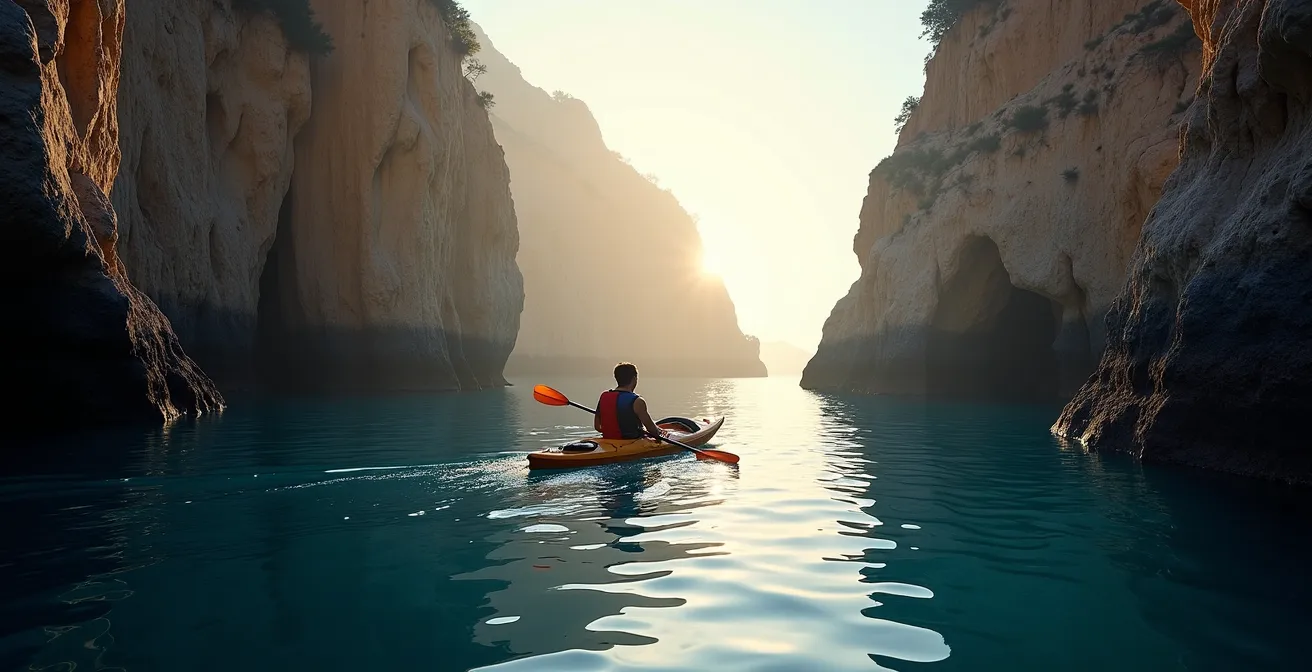
If you must visit during the high season, consider exploring the less-famous but equally beautiful areas just outside the park’s busiest zones. The coastline around La Ciotat or the protected waters of the Frioul archipelago offer fantastic kayaking with far fewer people. This not only improves your experience but also helps alleviate the intense pressure on the most iconic sites. Recent studies on anchoring pressure in France have shown that adaptive management and tightened regulations can effectively reduce these pressures. As visitors, our choices to disperse and avoid peak times are a crucial part of this solution.
| Location | Proximity to Calanques | Best Features | Crowd Level |
|---|---|---|---|
| La Ciotat Coast | 15 km east | Rocky coves, clear waters, the “Bec de l’Aigle” rock formation | Low-Moderate |
| Frioul Archipelago | Offshore from Marseille | Protected waters, historical sites, coves like Calanque de Saint-Estève | Low |
| Anse du Petit Mugel | Eastern edge of La Ciotat | Rocky drop-offs, yellow gorgonians, rich marine life | Moderate |
| Port-Cros Waters | 100 km east | Strictly regulated National Park, pristine seabed, exceptional biodiversity | Low (regulated) |
By choosing when and where you paddle, you move from being part of the crowd to a conscious explorer, seeking solitude and ensuring the Calanques remain a sanctuary for generations to come.
Your journey as a conscious snorkeler begins not when you enter the water, but with the choices you make long before. By understanding the hidden mechanics of the Mediterranean, you transform a simple holiday activity into a meaningful act of guardianship. Embrace these techniques, share this knowledge, and become a true protector of the sea you love.