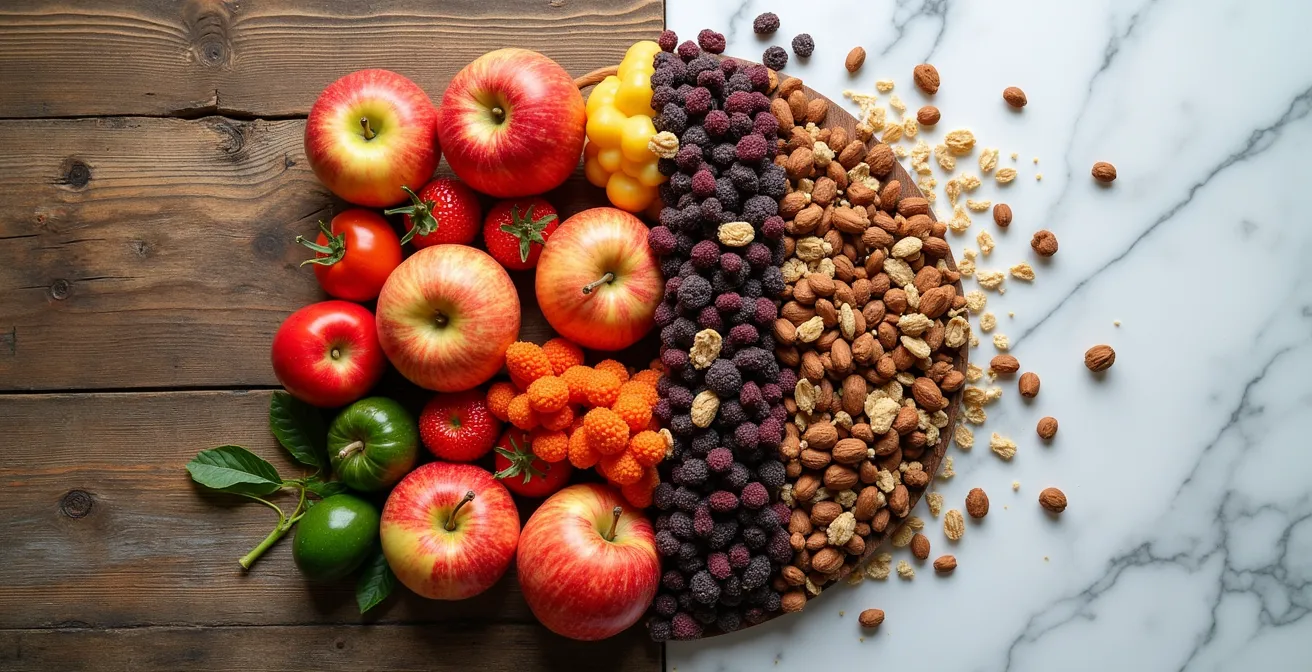
The “health halo” around exotic superfoods masks a staggering environmental cost that goes far beyond simple food miles.
- Air-freighted produce, common for perishable superfoods, emits up to 50 times more CO2 than sea transport.
- The “virtual water” needed to grow trendy foods like avocados and quinoa in arid regions creates severe water scarcity for local populations.
Recommendation: Shift your focus from “exotic vs. local” to “conscious vs. unconscious” consumption by prioritizing seasonal, sea-freighted, or truly local foods to align your health goals with planetary well-being.
For the health-conscious consumer, the grocery store aisle is a map of global wellness. Goji berries from the Himalayas, quinoa from the Andes, avocados from Mexico—these “superfoods” promise a potent dose of nutrients and a connection to something pure and powerful. We fill our baskets with these exotic treasures, believing we are making the optimal choice for our bodies. But what if this quest for peak nutrition is inadvertently fueling an environmental crisis? The conversation often begins and ends with “food miles,” a simple calculation of distance that barely scratches the surface of a much larger, more complex issue.
The common wisdom is to “eat local,” but this advice is often presented without the crucial context. The real story isn’t just about distance; it’s about a hidden web of inefficient transport, massive water consumption, and significant nutrient loss. The true environmental cost of that imported superfood smoothie is far greater than the sum of its miles. It’s a cost measured in depleted aquifers in Peru, in the carbon-intensive cold chains required to keep berries fresh, and in the nutritional value that degrades with every passing day in transit.
This article will dismantle the myth that “exotic” equals “better.” We will move beyond the simplistic food miles debate to uncover the systemic impacts of our global appetite. By exploring the hierarchy of transport pollution, the concept of virtual water, and the surprising nutritional advantages of local produce, you will gain a new framework for making food choices. It’s time to understand how to align your dietary goals with genuine sustainability, ensuring that what’s good for your health is also good for the planet.
This guide will equip you with the knowledge to navigate the supermarket, your kitchen, and even your travel destinations with a new, more critical eye. Let’s explore the data and strategies that empower truly conscious consumption.
Summary: The Real Footprint of Our Food Choices
- How to Identify Air-Freighted Fruits on Supermarket Shelves?
- Local Apple or Imported Goji Berry: Which Has More Bioavailable Nutrients?
- The Purchasing Habit That Drives Water Scarcity in Exporting Nations
- How to Cook Fusion Cuisine Without Appropriating Cultural Heritage?
- How to Find a Thai Restaurant That Doesn’t Adapt Spice Levels for Tourists?
- Carbon Offsetting or Direct Reduction: Which Truly Helps the Planet?
- Why Is the Train 80 Times Less Polluting Than the Plane in France?
- How to Eat 100% Local on Vacation Without Blowing Your Budget?
How to Identify Air-Freighted Fruits on Supermarket Shelves?
The single most damaging factor in the food transport chain is air freight. While transport as a whole is a fraction of a food’s total emissions, this one mode is a massive outlier. According to research from Our World in Data, air transport emits around 50 times more CO2 per tonne-kilometer than sea transport. Berries, asparagus, green beans, and other highly perishable “fresh” produce from distant countries are the most common culprits. Avoiding these is one of the most impactful dietary choices you can make for the climate.
But how can you spot these high-carbon items in the store? It requires a bit of detective work, as they are rarely labeled “fly-in.” You need to look for clues related to seasonality, origin, and appearance. A punnet of perfect-looking raspberries in the dead of a northern winter, flown in from South America, carries a much heavier carbon burden than a shipload of bananas, which are hardier and travel by sea. Learning to read these signals empowers you to sidestep the most polluting products and make genuinely low-carbon choices.
Your Action Plan: Identify Air-Freighted Produce
- Check seasonality: If produce is out of season for both your location and its distant country of origin (e.g., berries in winter), it’s almost certainly air-freighted.
- Look at PLU codes: Check for codes starting with 3 or 4 on highly perishable items like asparagus, berries, and green beans from far-away countries. While not a direct indicator of air freight, it confirms conventional growing methods on items that often require fast transport.
- Examine uniformity and aroma: Air-freighted fruits often show unnatural consistency and have minimal fragrance because they are picked before they are ripe. A lack of natural smell is a red flag.
- Assess texture and feel: A waxy texture or an overly firm feel can be signs of artificial ripening agents used after long-distance air transport to make the product look appealing.
- Ask the manager: Ask the produce manager directly, “Does this come by air or sea freight?” It is a legitimate question for any carbon-conscious consumer.
Local Apple or Imported Goji Berry: Which Has More Bioavailable Nutrients?
The allure of exotic superfoods is often tied to their perceived superior nutrient density. We imagine a goji berry, packed with antioxidants, must be “healthier” than a common local apple. However, this assumption ignores a critical factor: nutrient degradation. The moment a fruit or vegetable is harvested, its vitamin and nutrient content begins to decline. This process is accelerated by time, light, and temperature changes—all hallmarks of long-distance transport.
An apple picked from a local orchard yesterday and sold at a farmers’ market today retains a huge percentage of its vitamins. In contrast, an exotic fruit harvested weeks ago, flown across the globe in a temperature-controlled container, and then stored in a warehouse has lost a significant portion of its nutritional value by the time it reaches your kitchen. The very systems designed to transport these goods, such as refrigeration, contribute to emissions. Data shows that temperature-controlled transportation releases more than three times the amount of CO2 equivalent than ambient transport. So, you may be paying a premium for a product that is not only worse for the environment but also less nutritious than its local, seasonal alternative.

As the illustration starkly shows, the fresh, crisp cellular structure of a local fruit holds onto its vitality. The longer the journey, the more the nutritional benefit withers. The most potent superfood is often the one that has traveled the shortest distance from farm to table. The focus on bioavailability—what your body can actually absorb—tilts the scales heavily in favor of fresh, local produce over their well-traveled counterparts.
The Purchasing Habit That Drives Water Scarcity in Exporting Nations
The carbon footprint of our food is a major concern, but there’s another, equally devastating impact hidden in our grocery bags: virtual water. This is the total volume of freshwater used to produce a commodity, and it’s a critical concept when we import foods from water-stressed regions. While agriculture is a thirsty industry everywhere— accounting for 70% of the world’s annual water consumption—our demand for year-round trendy produce like avocados, asparagus, and quinoa places immense pressure on the ecosystems where they are grown.
When you buy asparagus from Peru or almonds from California, you are effectively importing the water from those regions—water that local communities and ecosystems desperately need. This creates a paradox where health-conscious consumers in one part of the world are unknowingly contributing to drought and the depletion of ancient aquifers in another. The problem is that the price tag on these items never reflects their true water cost, externalizing the environmental damage to the producing nations.
This table illustrates the stark difference in water consumption for certain globally traded products, highlighting the immense “virtual water” footprint we are outsourcing.
| Product | Local Water Use (L/kg) | Imported Water Use (L/kg) | Additional Impact |
|---|---|---|---|
| Asparagus (Peru) | 500 | 2,150 | Depletes Ica Valley aquifers |
| Quinoa (Bolivia) | N/A | 3,000 | Affects traditional farming |
| Cut flowers (Kenya) | N/A | 4,000 | Lake Naivasha water conflicts |
The data is clear: our purchasing habits for these specific items have a direct and damaging effect on water security abroad. Choosing local, seasonal alternatives is not just about reducing food miles; it’s a powerful act of water conservation on a global scale.
How to Cook Fusion Cuisine Without Appropriating Cultural Heritage?
As our understanding of global food systems deepens, so must our respect for the cultures they come from. The joy of cooking is often found in experimenting with new flavors and techniques, leading to the rise of “fusion” cuisine. However, there’s a fine line between appreciative culinary dialogue and outright cultural appropriation. Simply taking an element from another culture without understanding its context or giving credit can erase its origins and devalue its significance.
True ethical fusion cooking isn’t about thoughtlessly mashing up ingredients. It’s a practice rooted in respect, research, and recognition. It involves learning about the history of a dish, the significance of its ingredients, and the traditional methods of its preparation. It also means actively supporting the communities from which you are drawing inspiration. This approach enriches your own cooking while honoring the heritage of others, turning your kitchen into a space of respectful cultural exchange rather than appropriation.
To navigate this complex territory, an ethical framework is essential. The following steps provide a guide for creating fusion dishes that celebrate, rather than co-opt, cultural heritage. This approach allows for creative expression while maintaining a deep sense of integrity and respect.
The 3 C’s: An Ethical Framework for Fusion Cooking
- Context: Before adapting a dish, take the time to research its historical and cultural significance. Understand its role in festivals, daily life, or religious practices.
- Credit: Always name the culture of origin and explicitly acknowledge your sources of inspiration. If you substitute a key imported ingredient with a local one, be transparent about the modification and why you made it.
- Contribution: Actively support the culture you are inspired by. This can mean buying ingredients from businesses owned by people from that culture, purchasing Fair Trade certified spices, or donating to organizations that support those communities.
How to Find a Thai Restaurant That Doesn’t Adapt Spice Levels for Tourists?
Just as we seek authenticity in our own cooking, finding it when dining out is a key part of a conscious consumer’s journey. Many ethnic restaurants, in an effort to appeal to a broader palate, will “dumb down” their dishes—reducing spice, substituting traditional ingredients, and generally moving away from their culinary roots. This often happens with Thai cuisine, where the complex balance of spicy, sour, sweet, and salty can be muted for Western tastes. Finding a restaurant that stays true to its heritage is a sign that it likely values authentic sourcing and traditional methods.
An authentic restaurant often has a deeper connection to its community and suppliers. It is more likely to source specialty ingredients from local Asian markets rather than generic food service distributors, which indirectly supports a more diverse and resilient local food economy. The indicators of authenticity are often subtle, but learning to spot them can lead you to a more genuine—and often more delicious—dining experience. It’s about looking beyond the menu and observing the restaurant’s environment, clientele, and relationship with its food.

Visible signs like an on-site herb garden, a clientele composed largely of people from the local Thai community, or the willingness to offer a “Thai spicy” option are all strong clues. These details suggest a commitment to authenticity that goes beyond just the food on the plate.
Indicators of Authentic Sourcing in Ethnic Restaurants
- Look for restaurants with their own herb gardens or those that mention specific local Asian market suppliers on their menu or website.
- Check if the clientele is primarily from the local ethnic community, especially during off-peak hours.
- Ask for your dish “Thai spicy” or inquire if there is a separate, more traditional menu available. A restaurant’s positive response is a good sign.
- Notice if fresh, vibrant ingredients like lemongrass, kaffir lime leaves, and Thai basil are visibly used and have a strong aroma.
- Observe whether the restaurant sources from local Asian markets rather than relying on generic, large-scale suppliers.
Carbon Offsetting or Direct Reduction: Which Truly Helps the Planet?
In the quest to mitigate our environmental impact, two paths emerge: direct reduction and carbon offsetting. Offsetting—paying for a project that reduces emissions elsewhere to “cancel out” your own—can feel like an easy solution. However, its effectiveness is widely debated. The more robust and scientifically sound approach is always direct reduction: changing the behaviors and systems that cause emissions in the first place. When it comes to food, this means tackling the real sources of its carbon footprint.
Many people assume that “eating local” is the ultimate act of direct reduction. However, the data reveals a more complex reality. Transport is, on average, a small part of a food’s total carbon footprint; production is usually the largest. In a groundbreaking analysis, research by Hannah Ritchie demonstrates that a completely nationalized food system, where a country only eats food produced within its borders, would reduce food emissions by a mere 1.7%. This is because the type of food you eat is often far more significant than its origin. The exception, as we’ve seen, is air-freighted food, which has a disproportionately high impact.
This points to a clear hierarchy of action. The most effective direct reduction strategy is not obsessing over the origin of your vegetables, but rather focusing on the highest-emission food groups. As expert Hannah Ritchie explains, this is where true impact lies.
What’s much more effective in reducing emissions is eating less meat, especially beef, and lamb, and improving crop yields and productivity to reduce land use and deforestation.
– Hannah Ritchie, Our World in Data analysis
Therefore, the most powerful choice is reducing consumption of high-impact foods like red meat and dairy. After that, the next best thing is to consciously avoid air-freighted products. These acts of direct reduction are far more meaningful than any offset credit you can buy.
Why Is the Train 80 Times Less Polluting Than the Plane in France?
The headline figure—that a train journey in France can be 80 times less polluting than the equivalent flight—often shocks people, but the science behind it is straightforward and applies universally. It all comes down to the fundamental physics of transport. The enormous difference in emissions between transport modes is not unique to passenger travel; it is the same principle that governs the environmental impact of our food supply chain. Understanding this transport hierarchy is key to making informed decisions, whether you’re booking a ticket or buying groceries.
Planes require a massive amount of energy to defy gravity, burning jet fuel directly in the upper atmosphere where its climate impact is magnified. Trains, by contrast, run on increasingly decarbonized electricity grids and benefit from the simple efficiency of rolling on steel wheels. The same logic applies to food. Air-freighting a box of berries is inherently energy-intensive, while moving a massive container of grain by ship is one of the most carbon-efficient ways to transport goods on the planet. The mode of transport is paramount.
The following table, while focused on food, perfectly illustrates the principle of this transport emissions hierarchy. The relative impact between air and sea is of a similar magnitude to the difference between planes and trains.
| Transport Mode | CO2 per tonne-km (food) | Relative Impact | Common Foods |
|---|---|---|---|
| Air freight | 500g CO2/tkm | 50x ship emissions | Berries, asparagus, green beans |
| Truck | 60-150g CO2/tkm | 10-20x ship emissions | Regional distribution |
| Ship | 10-40g CO2/tkm | Baseline (lowest) | Grains, bananas, dried goods |
This data confirms that choosing the train over the plane is a powerful act of direct carbon reduction. It’s the same logic as choosing sea-freighted bananas over air-freighted berries. It’s about picking the most efficient system for the job, a principle that holds true for both people and produce.
Key Takeaways
- The biggest food-related carbon saving comes from avoiding air-freighted goods, not just from eating local.
- Long-distance transport significantly degrades the nutritional value of “fresh” produce, making local alternatives often healthier.
- Your food choices have a “virtual water” footprint that can contribute to water scarcity in exporting countries.
How to Eat 100% Local on Vacation Without Blowing Your Budget?
Applying the principles of conscious consumption while traveling can seem daunting. Tourist-trap restaurants often serve generic, imported ingredients at inflated prices. However, eating 100% local on vacation is not only possible but can also be a more affordable and authentic experience. It requires shifting your mindset from being a passive tourist to an active culinary explorer. The key is to tap into the same food systems that locals use every day.
This means embracing local markets, street food stalls, and the daily specials at neighborhood eateries. These venues are where you’ll find the freshest, most seasonal ingredients at the best prices. According to data from the Global Footprint Network, transportation accounts for about 11% of the carbon emissions from food, so by eating locally sourced meals, you’re directly reducing your vacation’s environmental footprint. More importantly, you’re gaining a deeper, more flavorful connection to the place you are visiting.
Mastering a few simple strategies can transform your travel diet. From assembling a gourmet picnic with market finds to learning how to order the freshest dish, eating local on a budget is a skill. As sustainable travel expert Lesley Chen advises, a simple question can make all the difference.
Be sure to ask your waiter, ‘What’s the best dish this time of year?’ This way, you’ll gain insight into what’s actually seasonal and ensure you receive naturally grown, locally sourced, and yes, delicious ingredients. It’s a specialty for a reason.
– Lesley Chen, Connect4Climate sustainable travel guide
Embracing this approach not only saves money and reduces your impact but also unlocks the true taste of a destination. It turns every meal into an act of discovery.
Budget-Friendly Local Eating Strategies for Travelers
- Master the Market-to-Mouth Picnic: Assemble gourmet meals from local market finds like fresh bread, regional cheeses, seasonal fruits, and cured meats for a fraction of a restaurant’s price.
- Choose the ‘Plat du Jour’: The “dish of the day” in many countries is almost always based on the freshest ingredients the chef found at the market that morning.
- Explore Street Food: Seek out street food vendors, who often specialize in a single, perfected dish made with ingredients from local suppliers.
- Shop Markets in the Morning: Visit local food markets early in the day for the best prices, freshest selection, and most vibrant atmosphere.
- Discover Traditional Staples: Ask locals about traditional, low-cost grains and legumes—the region’s original, time-tested “superfoods.”
By shifting your perspective from a simple “local versus global” debate to a more nuanced understanding of transport, water use, and authenticity, you can make choices that truly align your health goals with the well-being of the planet. The most powerful decision is a conscious one. Start today by evaluating the hidden story behind the food in your cart and on your plate.