
The beauty of your favorite natural escape isn’t a permanent feature; it’s a fragile system actively maintained by a hidden workforce of insects performing critical, often invisible, services.
- The presence of a single predator like a wolf can indirectly trigger a cascade that boosts insect populations, revitalizing entire forests.
- Insect diversity acts as a “biological insurance” against catastrophes like forest fires by controlling pests and improving soil health.
Recommendation: To protect these landscapes, we must shift our focus from just saving iconic species to preserving the complex, insect-driven processes that support them.
Imagine your favorite vacation spot: a sun-drenched Mediterranean cove, a misty old-growth forest, or a meadow buzzing with life. We see these landscapes as robust, permanent fixtures, sources of peace and beauty. We might worry about obvious threats like pollution or development, but the most profound danger is often invisible, silent, and smaller than a thumbnail. The common understanding is that insects are important for pollinating our food, a fact that is true but dangerously incomplete. This view misses the intricate, hidden web of services that insects provide, the very services that build and maintain the landscapes we cherish.
The truth is far more complex and urgent. The stability of that forest, the clarity of that water, and the resilience of that meadow depend on a cascade of interactions initiated by creatures we barely notice. What if the real key to protecting these places isn’t just about planting more flowers for bees, but about understanding how feeding a fox can inadvertently starve a forest, or how a single hiker’s footprint can erase a vital link in the food chain? This is not an exaggeration; it is the fundamental principle of ecosystem engineering, where tiny organisms perform monumental tasks.
This article moves beyond the platitude of pollination to reveal the secret work of insects. We will explore the surprising connections that hold our world together, from the role of predators in boosting butterfly numbers to the way insects create rain in a dry forest. By understanding these hidden services, we can begin to see why the disappearance of a single insect species is not a small loss, but a crack in the very foundation of our planet’s most beautiful places.
To grasp the full extent of this interconnectedness, this guide will walk you through specific, often surprising, examples of how insect life underpins the health of the ecosystems you love to visit. The following sections reveal the secret roles these creatures play in everything from fire prevention to oxygen production.
Summary: The Secret Work of Insects Holding Ecosystems Together
- Why Are Wolves Essential for the Health of French Forests?
- How to Transform a Rental Property Garden into a Biodiversity Haven?
- Monoculture Forests or Mixed Woodlands: Which Resists Fire Better?
- The Feeding Error That Sentences Wild Foxes to Death
- When to Observe Bird Migrations Without Disturbing Their Rest Stops?
- Why Is Posidonia Seagrass Crucial for Oxygenating the Mediterranean?
- Why Does the Forest “Drip” Even When It Is Not Raining?
- Why Is Access to Nature Reserves Often More Restricted Than National Parks?
Why Are Wolves Essential for the Health of French Forests?
It sounds counterintuitive: how can a large predator at the top of the food chain possibly benefit the smallest creatures at the bottom? The answer lies in a powerful ecological concept known as a trophic cascade. When wolves, as apex predators, are reintroduced into an ecosystem like a forest, their impact ripples down through every level. Their presence changes the behavior of large herbivores, such as deer, which begin to avoid open areas like riverbanks and valleys to steer clear of predation. This simple behavioral shift has monumental consequences for insects.
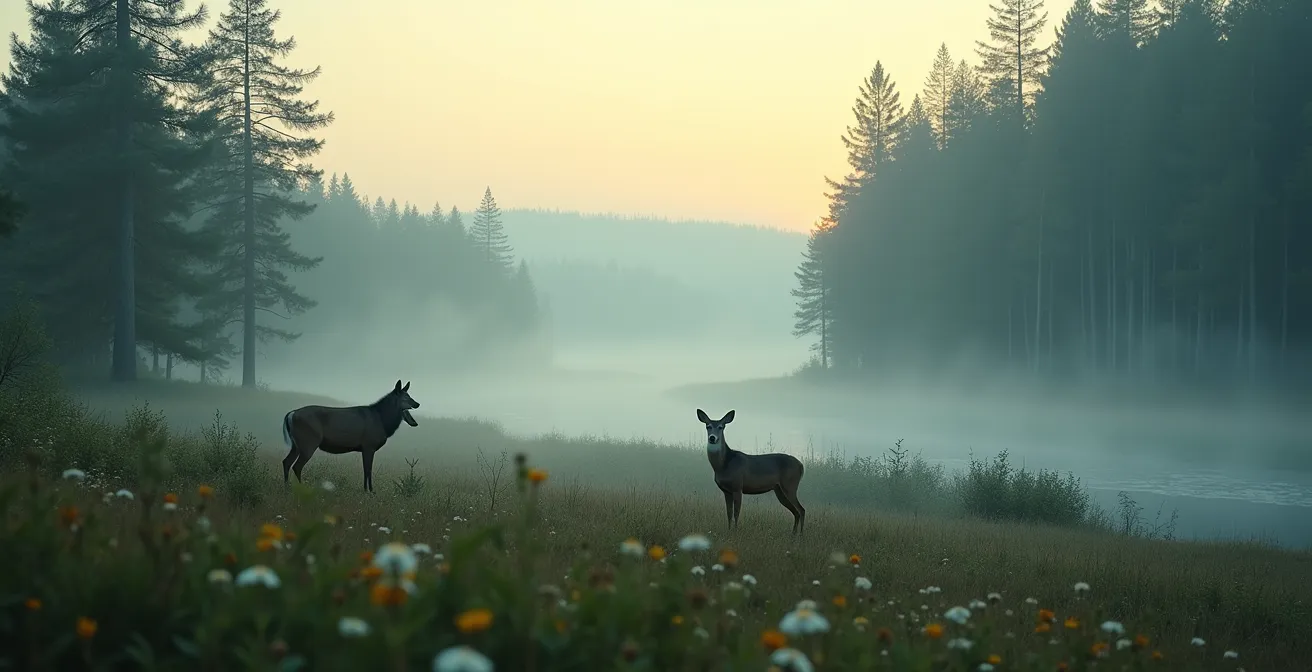
As deer graze less intensively along rivers, the vegetation—willows, aspens, and wildflowers—begins to flourish. This renewed growth creates a thriving habitat for a vast array of insects. Pollinators find more flowers, caterpillars have more leaves to eat, and the restored riverbank vegetation provides shelter and breeding grounds. The ecosystem, freed from overgrazing, explodes with life. This isn’t just a theory; reintroducing wolves has been shown to result in a massive 24.0–52.0 g C·m−2·yr−1 increase in net ecosystem productivity, a scientific measure of an ecosystem’s health and vitality. The wolf, by controlling the deer, becomes an unlikely guardian of insect biodiversity.
How to Transform a Rental Property Garden into a Biodiversity Haven?
The principles that govern vast forests can be applied on a much smaller scale, even in the temporary garden of a vacation rental. Many people believe a “healthy” garden is a tidy one, with manicured lawns and exotic flowers. However, this aesthetic often creates a food desert for local insects. The real key to creating a biodiversity haven is to embrace a little bit of “mess” and prioritize native plants, which act as keystone species for local insect populations.
Instead of a uniform lawn, allowing even a small patch to grow wild can have a dramatic impact. Research shows that letting a patch of lawn grow wild can dramatically boost butterfly populations by up to 93% and provide habitat for hundreds of other insect species. Native plants are particularly crucial because local insects have evolved alongside them for millennia. An oak tree, for instance, can be a host plant for over 500 species of moths and butterflies, whereas a non-native ornamental tree might support none. These insects are not pests; they are the foundation of the local food web, providing essential food for birds and other wildlife.
Your action plan: Creating an insect sanctuary in any garden
- Plant keystone natives: Prioritize species like oaks, willows, and native wildflowers that support hundreds of local insect species.
- Leave the “mess”: Create corners with dead wood, leaf litter, and bare soil patches to provide shelter and nesting sites for ground-nesting bees and beetles.
- Provide a safe water source: Use shallow dishes filled with pebbles or marbles, allowing insects to drink without drowning.
- Think beyond nectar: Plant specific native host plants for caterpillars, as they are the primary food source for most songbird chicks.
- Offer nesting sites: Cut the tops off some hollow plant stems (like old sunflowers) to create ready-made homes for cavity-nesting native bees.
Monoculture Forests or Mixed Woodlands: Which Resists Fire Better?
From a distance, a dense, uniform pine forest might look lush and healthy. In reality, these monoculture plantations, often grown for timber, are incredibly vulnerable to catastrophic events like wildfire. A diverse, mixed woodland, rich in different tree and plant species, possesses a form of biological insurance that makes it far more resilient. This insurance is largely underwritten by insect diversity.
In a monoculture, if a single pest species—like a specific type of bark beetle—arrives, it can sweep through the forest like a plague because every tree is a potential host. The stressed and dying trees become a massive accumulation of dry fuel, ready to ignite. In a mixed woodland, the story is different. The variety of trees means that a pest specific to one species cannot wipe out the entire forest. Furthermore, a healthy insect population includes predators and parasites that naturally control pest outbreaks. Wood-boring beetles, for example, play a vital role by thinning out weaker trees, reducing fuel load, and opening up the canopy to let light reach the forest floor, promoting a healthier, less flammable understory.
This table highlights the stark differences in resilience, driven largely by the hidden services of insects.
| Factor | Mixed Woodlands | Monoculture Forests |
|---|---|---|
| Insect Diversity | High diversity acts as ‘biological insurance’ with natural pest control | Single pest species can overwhelm stressed trees |
| Fuel Load | Endemic bark beetles naturally thin weak trees | Massive dead wood accumulation from pest outbreaks |
| Soil Structure | Porous, absorbent soil from diverse insect bioturbation | Compacted soil with poor moisture retention |
| Post-Fire Recovery | Wood-boring beetles quickly start decomposition | Slower decomposition and regeneration |
The Feeding Error That Sentences Wild Foxes to Death
Seeing a wild fox near a campsite or trail can be a thrilling experience, and the temptation to leave out food is strong. It feels like a kind gesture, but it is often a death sentence—not just for the fox, but for the ecosystem it helps manage. This seemingly harmless act disrupts the fox’s role as a natural and vital controller of insect populations, a function many people are completely unaware of. As wildlife ecology research points out:
A healthy fox’s diet consists largely of rodents, but also significant quantities of beetles, crickets, and grasshoppers.
– Wildlife ecology research, Wildlife behavior and ecosystem balance studies
When we offer processed human food, we trigger a devastating chain of events. The fox’s digestive system isn’t adapted for it, leading to poor health and a greater dependence on this easy but unnatural food source. It stops hunting effectively, abandoning its crucial role as an ecosystem engineer. The populations of rodents and large insects it would normally control can explode, leading to imbalances that damage plant life and disrupt the food web.
Case Study: The Impact of Human Food on a Fox’s Ecosystem Role
When foxes consume processed human food, their gut microbiome changes dramatically, making them more susceptible to parasites and diseases. This weakened state impairs their hunting ability, creating a vicious cycle where they become more dependent on human food sources while losing their role as natural insect controllers in the ecosystem. The result is a sick animal and a sicker environment.
When to Observe Bird Migrations Without Disturbing Their Rest Stops?
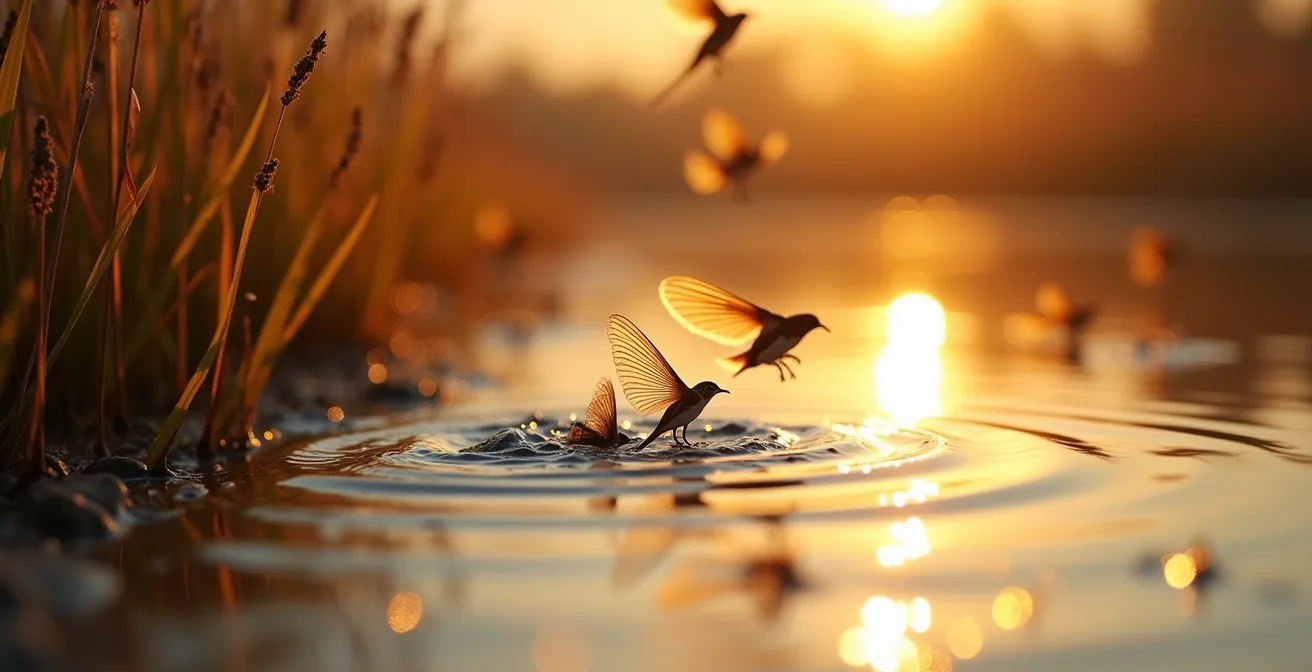
The spectacle of bird migration is one of nature’s great dramas. But for these birds, it’s a grueling marathon that depends on finding high-energy food at precisely the right time. That food is, overwhelmingly, insects. It’s a connection that is absolute; as research shows that nearly all (96%) of songbirds feed insects to their young. During migration, adults are just as dependent on this fuel source. Migratory birds time their long journeys to coincide with massive insect emergences along their routes—mayflies hatching from a lake, for example—creating critical refueling windows.
The value of these insect buffets lies in their caloric density. A single juicy caterpillar or a fat beetle provides far more energy than dozens of smaller flies. This is why birds are so specific about their rest stops, targeting areas where these high-value insects are abundant. However, human activity is increasingly disrupting these vital windows. Light pollution is a major culprit; artificial lights at night can trap and kill billions of nocturnal insects, effectively turning off the all-night buffet that many migrating birds rely on to travel safely through the darkness. Observing migrations, therefore, requires awareness. It means keeping a respectful distance from feeding areas and, more broadly, advocating for measures like “lights out” programs in cities during peak migration seasons.
Why Is Posidonia Seagrass Crucial for Oxygenating the Mediterranean?
The crystal-clear turquoise waters of the Mediterranean, a hallmark of a perfect beach vacation, are not an accident. They are the result of a healthy ecosystem, and at its heart are the vast underwater meadows of Posidonia oceanica, or Neptune Grass. This incredible plant is a lung for the sea, producing vast amounts of oxygen. But for Posidonia to thrive, it needs sunlight, which requires clear water. This clarity is maintained by a legion of tiny, often-overlooked invertebrates, many of which are the larval stages of insects or their close relatives.
These filter-feeding organisms constantly clean the water, removing suspended particles and keeping it transparent. However, the very tourism that draws people to these beautiful coasts puts immense pressure on these delicate systems. Coastal development, pollution, and physical disturbances all harm invertebrate populations. The impact is severe; research in the Maldives found an 8-fold decline in invertebrate biomass on islands with heavy tourism. While this study was not in the Mediterranean, the principle is universal. When these tiny ecosystem engineers disappear, the water becomes cloudier. Sunlight can no longer reach the Posidonia, which begins to die off. The result is a less oxygenated, murkier, and fundamentally less healthy sea—a direct threat to the very beauty that defines a Mediterranean vacation.
Why Does the Forest “Drip” Even When It Is Not Raining?
Walking through a forest on a dry day, you might feel a mysterious, light “rain” dripping from the canopy. This isn’t condensation; it’s a phenomenon known as honeydew, and it’s another one of the vital hidden services provided by insects. Tiny plant-sucking insects like aphids and spittlebugs consume vast quantities of sap from leaves and stems. This sap is rich in sugar but poor in nitrogen, so the insects must process a huge volume to get the nutrients they need. They excrete the excess as a sugary liquid: honeydew.
This constant drip is far from being a simple waste product. It is a cornerstone of the forest’s nutrient cycle. The honeydew serves as a crucial food source for other insects, including ants, wasps, and flies. It also coats leaves and branches, promoting the growth of sooty mold, which in turn becomes another unique habitat and food source. Most importantly, this “insect rain” acts as a slow-release fertilizer. As it drips onto the forest floor, the nitrogen-rich compounds are absorbed into the soil, nourishing the very trees the insects are feeding on. This creates a complex, self-sustaining loop of nutrients.
This table breaks down the different sources of this fascinating forest phenomenon and their functions.
| Source | Composition | Ecological Function |
|---|---|---|
| Aphid honeydew | Sugar-rich liquid excretion | Food for ants, wasps; promotes sooty mold ecosystem |
| Spittlebug secretions | Foam and liquid waste | Moisture retention; nutrient recycling |
| Decomposer activity | Nitrogen compounds | Soil fertilization; supports plant growth |
Key takeaways
- Ecosystem health depends on complex interactions, where predators like wolves can indirectly boost insect populations by controlling herbivores.
- Insect diversity is a form of “biological insurance,” making ecosystems more resilient to threats like pests and fire.
- Simple human actions, like feeding wildlife or creating light pollution, can have devastating and unforeseen consequences on the food web.
Why Is Access to Nature Reserves Often More Restricted Than National Parks?
For many nature enthusiasts, a sign that reads “Area Closed” or “Stay on Trail” can feel frustrating. Why are nature reserves, which are supposed to protect wildlife, often more restrictive than larger national parks that see millions of visitors? The answer lies in the extreme fragility of the specialized species these reserves are designed to protect. While a national park may be established to preserve a grand landscape, a nature reserve is often created to save a single, highly vulnerable species or a unique, delicate habitat—a habitat whose very existence might depend on one specific insect.
The threat is not abstract; it’s alarmingly real. A comprehensive assessment found that over one-fifth (22.6%) of native North American pollinators face an elevated risk of extinction. Reserves are the last line of defense for many of these species. The restrictions are in place because even the smallest disturbance can be catastrophic. As conservation biologists explain, the impact of a single person can be immense:
A hiker’s footprint can crush the only patch of a specific plant that a rare butterfly’s caterpillar can eat, or compact the soil where a specialist ground-nesting bee makes its home.
– Conservation biologists, Nature reserve management studies
These rules are not about limiting enjoyment; they are about preventing irreversible extinction. They are an urgent recognition that the survival of an entire species can literally be crushed underfoot. A national park can often absorb the impact of a hiker, but a nature reserve protecting a specialist insect cannot. Understanding this is the final, crucial step in becoming a true ally for conservation.
Protecting the beautiful places we love requires a profound shift in perspective. It demands that we look past the grand vistas and see the intricate, fragile machinery of tiny lives that build and sustain them. The next time you visit a wild place, the most meaningful action you can take is to walk lightly, observe closely, and remember the invisible workforce all around you.
Frequently Asked Questions about Insect Conservation and Ecosystems
Why do migrating birds need specific rest stops?
Birds time their stops to coincide with insect emergences like midges from lakes or cicadas, creating critical refueling windows. These stops are not random; they are precisely targeted to intersect with these predictable, high-energy food sources that are essential for completing their long journeys.
How does light pollution affect bird migration feeding?
Artificial lights at night attract and kill countless nocturnal insects. This acts like a giant bug zapper for the landscape, effectively removing the all-night food source that many migratory birds, especially those that travel after dark, depend on to refuel.
What is ‘caloric density’ in bird migration?
Different insects provide varying energy values. A single juicy caterpillar or a fat beetle offers far more calories and fat than a small fly. This is why birds are often seen foraging in specific patches—they are actively seeking out the most energy-dense food to fuel their marathon flights efficiently.