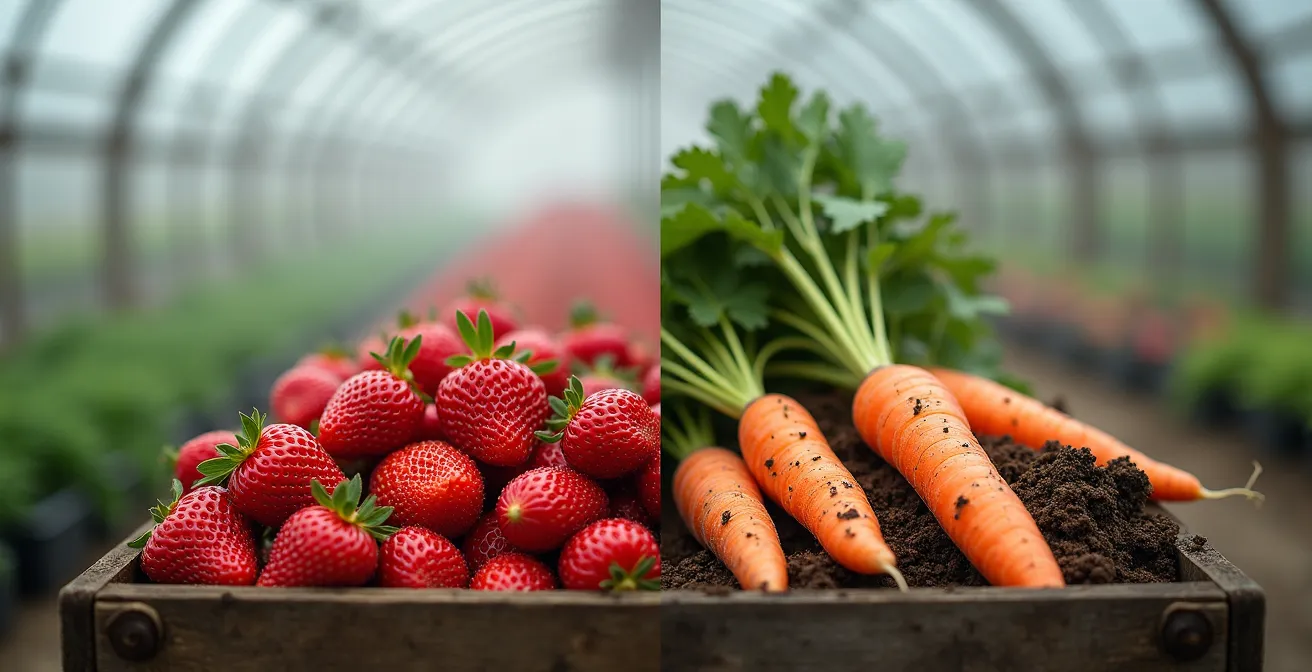
Buying out-of-season produce isn’t a harmless treat; it’s a direct subscription to a high-energy, high-carbon system designed to deceive your senses.
- A single hothouse tomato can demand ten times more energy than its sun-grown equivalent, a hidden cost not reflected on the price tag.
- Supermarkets perpetuate this illusion of eternal summer, leading to massive food waste from purely cosmetic standards.
Recommendation: The most impactful change you can make is to learn the true seasons of your food and consciously reject the illusion of perpetual abundance.
That perfectly shaped, ruby-red strawberry sitting on a supermarket shelf in the dead of winter seems like a small, harmless miracle. It’s a taste of summer, a burst of brightness in the cold. We are told to eat more fruits and vegetables, and there they are, available 24/7, 365 days a year. But this convenience is a carefully constructed illusion, a facade that hides a staggering environmental cost. We’ve been trained to think about “food miles,” but what if the distance the food travels is only a tiny part of the story? What if the real climate villain isn’t the truck, but the greenhouse?
The truth is, the very existence of that winter strawberry represents a declaration of war against nature’s cycles, a war fought with massive inputs of fossil fuel energy. This isn’t about shaming a simple craving; it’s about exposing the hidden “Energy Arbitrage” that our modern food system runs on. The real key to reducing your food’s carbon footprint isn’t just about buying local—it’s about stopping the practice of forcing nature’s hand. This article will dismantle the supermarket’s illusion, piece by piece, and give you the tools to see the true cost of your food, reclaim your connection to the seasons, and drastically shrink your carbon budget, one meal at a time.
In the sections that follow, we will dissect the enormous energy demands of out-of-season produce, teach you how to taste the difference between real and forced flavor, and provide actionable strategies for aligning your plate with the planet. This is your guide to eating intelligently in a world of artificial abundance.
Summary: Decoding the True Cost of Our Food Choices
- Why Does a Hothouse Tomato Use 10 Times More Energy Than an Outdoor One?
- How to Taste the Difference Between Forced and Natural Produce?
- How to Can Tomatoes in August to Last Until Next May?
- The Supermarket Illusion That Makes You Believe Summer Never Ends
- Root Vegetables or Leafy Greens: Which Should Dominate Your Winter Plate?
- When to Buy Bell Peppers to Get the Lowest Price of the Year?
- When to Observe Bird Migrations Without Disturbing Their Rest Stops?
- How to Identify Peak Ripeness in Market Vegetables Like a Chef?
Why Does a Hothouse Tomato Use 10 Times More Energy Than an Outdoor One?
The central lie of out-of-season produce is that it is equivalent to its seasonal counterpart. The reality is a matter of pure physics and energy. To grow a sun-loving plant like a tomato in a cold, dark climate during winter requires a massive energy subsidy. This is the concept of Energy Arbitrage: using vast amounts of fossil fuels to artificially replicate conditions that nature would provide for free a few months later. We must pay to heat the structure, power artificial lighting, and run complex hydroponic systems. These energy inputs are not trivial; they are astronomical.
The numbers are stark and revealing. Research from Our World in Data has shown that growing tomatoes in a heated Swedish greenhouse requires 10 times more energy than growing them in an open field in sunny Southern Europe, even when accounting for transportation. This single fact shatters the simplistic “local is always best” mantra. A “local” tomato grown with fossil fuels is a carbon bomb compared to a seasonal tomato shipped efficiently. The problem isn’t geography; it’s the energy-intensive defiance of seasonality.
This immense energy consumption translates directly into CO2 emissions. That winter tomato is not just a food item; it’s a physical manifestation of burned natural gas, coal, or oil. By choosing it, consumers are unknowingly voting for this high-energy system. The first step toward a saner carbon budget is to recognize that the energy embodied in your food is as important, if not more so, than the miles it traveled to reach you. We must learn to see the hidden energy cost behind the price tag.
How to Taste the Difference Between Forced and Natural Produce?
The high-energy inputs required to grow produce out of season don’t just impact your carbon budget; they fundamentally alter the food itself. A plant grown under artificial lights and in a sterile medium is a pale imitation of one ripened by the sun in nutrient-rich soil. This isn’t food snobbery; it’s a biological fact that leads to a profound Sensory Disconnect for the consumer. Your taste buds are the most honest tool you have for detecting this difference.
A naturally ripened fruit or vegetable develops a complex profile of sugars, acids, and volatile aromatic compounds. This complexity is what we perceive as deep, satisfying flavor. In scientific terms, this can be partially measured by its sugar content. According to Ohio State University research, °Brix values primarily represent the sugar content in a fruit, which is a direct result of photosynthesis fueled by natural sunlight. A winter greenhouse tomato might look the part, but it often has a watery, mealy texture and a one-dimensional, acidic flavor because it never had the chance to develop this full spectrum of compounds. It is, in essence, an empty shell.

Re-calibrating your palate is a powerful act. It involves consciously seeking out and tasting produce at its seasonal peak. When you taste a truly ripe August tomato or a crisp autumn apple, you create a sensory benchmark. Compared to this, the blandness of the out-of-season impostor becomes glaringly obvious. By learning to trust your own senses over supermarket aesthetics, you begin to dismantle the illusion and naturally gravitate toward foods with more flavor, more nutrients, and a much lower carbon footprint.
Your Action Plan: A Sensory Audit for Seasonal Produce
- Measure Brix levels: When possible, check the data. A study on fruit maturity shows that seasonal fruits typically range 12-20°Bx while greenhouse often stays below 10°Bx. This is the sugar difference you can taste.
- Check texture: Listen for the satisfying snap of a seasonal vegetable. This indicates proper turgor pressure from healthy, well-hydrated cells, a quality often lacking in forced produce.
- Evaluate aroma complexity: Take a moment to smell the produce before you buy it. Sun-ripened fruits develop a rich perfume from volatile organic compounds that is often absent in their hothouse cousins.
- Assess sugar-acid balance: True flavor comes from a dynamic interplay between sweetness and acidity. Naturally ripened produce achieves this balance, while forced versions are often just watery or tart.
- Compare shelf life: Counterintuitively, high-Brix, nutrient-dense produce often has a longer shelf life in your kitchen because its cellular structure is more robust.
How to Can Tomatoes in August to Last Until Next May?
Rejecting the carbon-intensive winter tomato does not mean you must live without the taste of tomatoes for six months. It means embracing a smarter, older strategy: Time-Shifting Nutrition. The most logical and low-carbon way to enjoy summer produce in winter is to buy it in abundance at its peak and preserve it yourself. This is not a quaint hobby; it’s a powerful climate action.
The principle is simple: you capture the sun’s energy, which is stored as flavor and nutrients in a peak-season tomato, and lock it away for a time when that energy is scarce. Canning, freezing, drying, and fermenting are all low-tech, low-energy methods of doing this. When you buy a crate of sun-ripened tomatoes in August, their carbon footprint is minimal. Climate action research shows that the footprint of 0.4kg CO2e for local outdoor July tomatoes is a tiny fraction of the emissions from their winter greenhouse counterparts. By preserving them, you carry that low-carbon advantage forward through the year.
This approach transforms your relationship with food from one of passive consumption to active participation. It requires a small investment of time during the peak season but pays dividends all winter. Opening a jar of your own canned tomatoes in January is a completely different experience from buying a plastic-wrapped, hothouse-grown specimen. The jar contains not just tomatoes, but the stored sunshine of August, a rich, complex flavor, and the satisfaction of knowing you have outsmarted the high-carbon food system. It’s a tangible way to ensure your meals have seasonal integrity, no matter what the calendar says.
The Supermarket Illusion That Makes You Believe Summer Never Ends
The modern supermarket is a marvel of logistics and marketing, but it’s also the primary architect of The Carbon Lie. It’s a carefully curated stage set designed to create an illusion of perpetual, perfect abundance. Every day is a high summer day in the produce aisle. This illusion is maintained through two key strategies: global, energy-intensive supply chains and a ruthless obsession with cosmetic perfection, both of which have devastating environmental consequences.
The perfect, blemish-free pyramids of identical fruits and vegetables are not a reflection of nature; they are a reflection of a system that prioritizes aesthetics over all else. This has led to a catastrophic amount of waste before the produce even reaches the shelf. It is a shocking fact that, in the U.S., grocery stores reject more than 20 billion pounds of produce annually simply due to cosmetic imperfections. A slightly misshapen pepper or a carrot with two legs is deemed unfit for the illusion, and so it is discarded, along with all the water, soil, and energy that went into growing it.
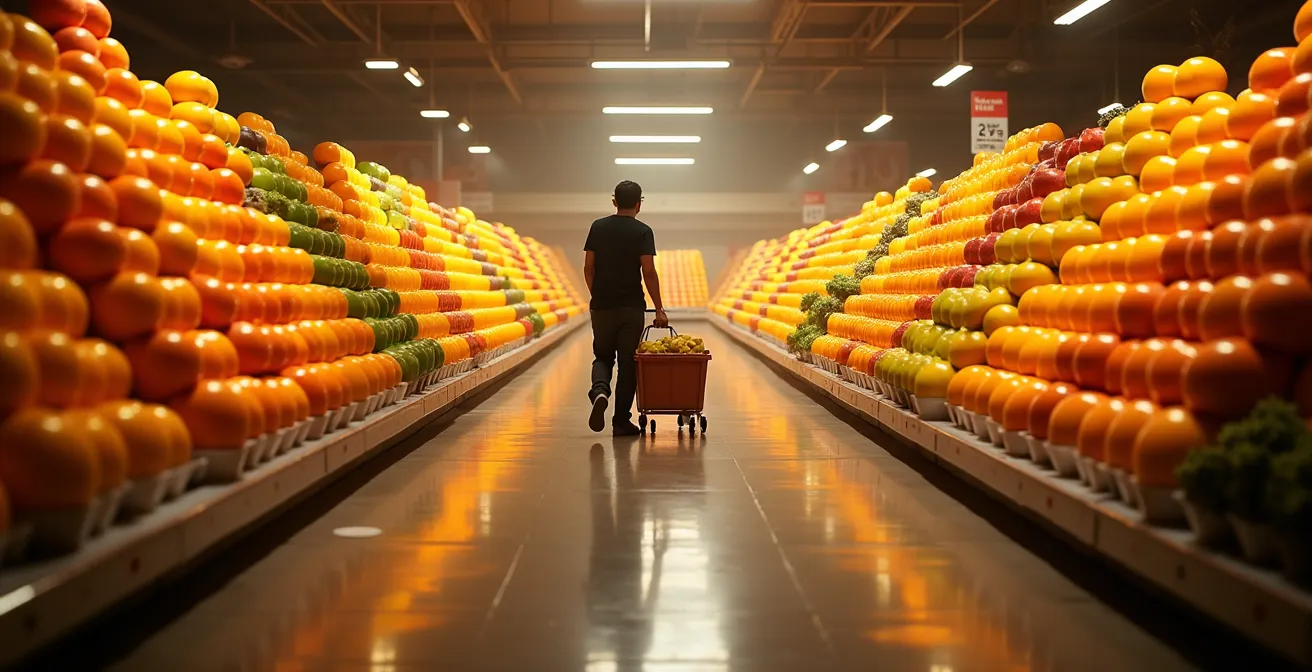
This system disconnects us from the reality of food production. We forget that real food has variations, blemishes, and, most importantly, seasons. The supermarket’s endless summer normalizes the presence of strawberries in January, making it seem like a right rather than an energy-intensive privilege. To break free, we must actively look past the perfect displays, perhaps by seeking out farmers’ markets or “ugly” produce delivery services. We must retrain our brains to find beauty in the imperfect and to accept that true abundance isn’t having everything all the time, but appreciating everything in its right time.
Root Vegetables or Leafy Greens: Which Should Dominate Your Winter Plate?
Navigating the produce aisle in winter requires a strategic shift. While the supermarket offers a dazzling array of choices, many are carbon-intensive phantoms. The key is to embrace the foods that have true seasonal integrity during the colder months. These are primarily the hardy, nutrient-dense foods that nature designed to withstand or thrive in the cold: root vegetables, winter squashes, and certain brassicas.
Root vegetables like carrots, parsnips, beets, and potatoes are brilliant storage crops. They are harvested in the fall and can be kept in cool, low-energy conditions for months without any loss of quality. Their dense, starchy structure is literally stored solar energy from the previous summer. Leafy greens are a more complex story. While some, like kale and collards, can be very hardy and even improve in flavor after a frost, many of the delicate lettuces and herbs you see have likely been grown in a heated greenhouse. A winter plate dominated by roasted root vegetables, hearty stews, and robust greens like kale is a plate that is aligned with the season’s natural, low-energy offerings.
This discussion also brings nuance to the “local” debate. An important study highlighted that the energy source can be more critical than the season itself. As researchers from a study in the Journal of Cleaner Production noted:
The reduction from eating only Swedish products was not due primarily to characteristics commonly associated with seasonal production but to the use of renewable fuel instead of fossil energy
– Researchers, Journal of Cleaner Production study on seasonal eating
This is a vital point. A locally grown leafy green from a greenhouse powered by renewable energy has a vastly different footprint than one from a greenhouse burning natural gas. As a consumer, this is harder to track, which is why defaulting to natural winter crops—the roots and squashes—is often the safest and most reliable strategy for minimizing your carbon impact.
When to Buy Bell Peppers to Get the Lowest Price of the Year?
Price is a powerful, if sometimes misleading, signal of seasonality. While global supply chains can flatten price fluctuations, the fundamental laws of agriculture and economics still hold true: when a crop is at its peak harvest in its ideal growing region, supply is highest, and prices tend to be lowest. For a heat-loving crop like bell peppers, this provides a clear guide for the carbon-conscious consumer.
In most of the Northern Hemisphere, bell peppers are a quintessential summer vegetable. Their peak season for field-grown crops typically runs from late July through September. During this window, markets are flooded with peppers from local and regional farms. This is the moment of maximum abundance and, consequently, the lowest prices of the year. This is the time to buy them in bulk—for fresh eating, for roasting and freezing, for incorporating into sauces. The low price is a direct market signal of seasonal integrity.
Conversely, when you see a bell pepper for sale in March, it has a hidden story. It was either grown in a high-energy greenhouse much closer to you, or it was field-grown in the Southern Hemisphere (or a perpetually warm climate like Mexico) and then shipped a great distance. In either case, a significant energy and carbon cost is embedded in its existence. The higher price often reflects these additional costs. By learning to recognize these price signals, you can use your purchasing power strategically, aligning your budget with your carbon budget and enjoying the best quality for the lowest cost.
When to Observe Bird Migrations Without Disturbing Their Rest Stops?
The concept of aligning with natural cycles extends far beyond the produce aisle. The intricate web of our ecosystem is deeply connected to our agricultural practices. Bird migration, one of nature’s most spectacular seasonal events, is profoundly influenced by the way we farm our land. Understanding this connection broadens our perspective on what “eating with the seasons” truly means—it’s not just about us, but about the entire environment we inhabit.
Migratory birds depend on a network of “rest stops” during their long journeys—wetlands, fields, and forests where they can refuel and rest. Many of these habitats are directly or indirectly created by agriculture. For example, leftover grains in harvested fields or the temporary wetlands created by flooding rice paddies provide critical food sources. When our farming practices are in sync with the needs of wildlife, we create a virtuous cycle. Farmers who practice nature-friendly agriculture, such as leaving field stubble over winter or maintaining wetlands, become crucial partners in conservation.
The connection for the consumer is this: supporting farms that practice regenerative, ecosystem-friendly agriculture is another way to vote for a system that respects natural cycles. These farms are often the same ones that prioritize seasonal, open-field crops over energy-intensive monocultures. As a case in point, in the Northeast China Plain, leftover seeds in harvested fields provide essential food for migrating birds arriving before spring has fully sprung. This demonstrates how a simple change in post-harvest practice can have a massive positive impact. Our food choices ripple outward, affecting not just the carbon in the atmosphere, but the very survival of the creatures that share our planet.
Key takeaways
- The true villain is energy, not distance. A “local” hothouse tomato can have 10x the carbon footprint of a seasonal one shipped efficiently.
- Trust your senses. Natural, seasonal produce has a complexity of flavor and texture that its forced, out-of-season counterpart can never replicate.
- Preserve the peak. Capture the low-carbon abundance of summer by canning or freezing produce to enjoy all winter long, beating the high-energy system.
How to Identify Peak Ripeness in Market Vegetables Like a Chef?
The final step in reclaiming your seasonal carbon budget is to become your own expert. The power to dismantle the supermarket illusion lies in your own knowledge and senses. A chef doesn’t rely on a calendar or a price tag to know what’s good; they rely on a multi-sensory evaluation of the produce itself. You can cultivate the same skill by paying attention to a few key indicators of peak ripeness and quality.
First, use your eyes for more than just color. Look for vibrant, taut skin. A bell pepper should be firm and heavy for its size, not wrinkly or soft. A cucumber should have a slight sheen, not a dull, waxy coating. Second, engage your sense of touch. Feel the weight of a melon; it should feel substantial. Gently press the skin of a peach near the stem; it should have a slight give. Third, and most importantly, use your nose. A ripe cantaloupe, a perfect peach, or a fresh bunch of basil will have an unmistakable, fragrant aroma. If it smells like nothing, it will likely taste like nothing.
Developing this sensory expertise empowers you to see past the marketing and connect with the food’s true state. It allows you to identify the produce that is not only at its peak in flavor and nutrition but also most likely to be in season and thus have a lower environmental impact. You become an active, discerning participant in the food system, making choices based on real quality, not artificial perfection.
Start today. The next time you’re in the produce aisle, don’t just look at the price tag or the country of origin—pick up the fruit, feel its weight, smell it, and ask yourself what season it truly belongs to. Your carbon budget, and your taste buds, will thank you.
Frequently asked questions on Why Eating Strawberries in Winter Destroys Your Carbon Budget?
What exactly is a Brix measurement?
A Brix value, expressed as degrees Brix (°Bx), is simply how many grams of sucrose are present per 100 grams of liquid solution, serving as a baseline reference for fruit ripeness.
Is a higher Brix number always better?
Not necessarily – sometimes high sugar fruit lacks acidity, giving it a flabby one-note flavor. Often, a lower Brix reading paired with good acidity level is the perfect pairing.
How do farmers use Brix measurements?
In the produce industry, Brix is used to determine if items like melons have enough sugar to harvest, helping growers know when it’s time to harvest fields for market.