Many assume the strict rules of nature reserves are just an extreme form of the conservation found in national parks. The reality is far more precise. Reserve management is a science of ecological fragility, where restrictions are not barriers but essential protocols—like biosecurity checks—designed to prevent catastrophic cascading effects from a single, seemingly minor human error. It’s a shift from managing crowds to managing microscopic risks.
For the dedicated nature enthusiast, the difference between a national park and a nature reserve can feel like an invisible wall. While parks often welcome visitors with open arms, many reserves present a landscape of restrictions, permits, and sometimes, outright closure. The common assumption is a simple trade-off: parks are for recreation, and reserves are for conservation. This view, however, barely scratches the surface of a much deeper, more complex ecological reality.
The distinction isn’t merely about protecting “more” wildlife; it’s about safeguarding entire, intricately connected systems whose stability is so fragile that even the most well-intentioned human presence can cause irreversible damage. This isn’t a philosophy of exclusion but a necessary strategy rooted in a profound understanding of ecological fragility. The management of a nature reserve operates on a different calculus, one that weighs the microscopic risk of introducing a foreign spore against the potential collapse of an entire ecosystem. It’s a world where the guiding principle is not just to minimize impact, but to eliminate it entirely.
This guide moves beyond the simple “parks vs. reserves” debate. We will explore the science-driven framework that governs these protected sanctuaries. We will deconstruct the reasons behind total closures, the meticulous process for gaining research access, the debate between guided and free entry, and why seemingly small actions, like forgetting to clean your shoes, pose an existential threat. Ultimately, you will understand why these restrictions are not arbitrary barriers, but the essential, invisible fortress protecting our planet’s most pristine environments.
To complement the concepts in this guide, the following video offers a visual immersion into the kind of pristine environments these protective measures aim to preserve.
To navigate this complex topic, this article breaks down the core principles and practical implications of nature reserve access. The following sections will guide you through the precise science and robust policies that define these unique protected areas.
Summary: Unpacking the Science Behind Nature Reserve Restrictions
- Why Are Some Reserves Completely Closed to the Public?
- How to Apply for Access to Restricted Areas for Photography or Research?
- Guided Only or Free Access: Which Policy Protects Wildlife Better?
- The Shoe Cleaning Mistake That Introduces Invasive Plants to Reserves
- When to Visit Bird Reserves to Witness Nesting Without Disturbing?
- When to Observe Bird Migrations Without Disturbing Their Rest Stops?
- Why Are Permit Lotteries the Fairest Way to Limit Crowds?
- Why Does the Disappearance of a Single Insect Species Threaten Your Vacation Spot?
Why Are Some Reserves Completely Closed to the Public?
The concept of a “Keep Out” sign on a piece of wild land seems counterintuitive to the ethos of public enjoyment. However, for a designated nature reserve, complete closure is the ultimate expression of its core mission. Unlike national parks, which balance conservation with recreation, these reserves have what conservationists call a “purity of purpose.” Their sole objective is the absolute preservation of an ecosystem in its most undisturbed state, serving as a living laboratory and a baseline for planetary health.
This strict stance is a direct response to the immense pressure human activity places on natural habitats. Even in protected zones, degradation is a constant threat. For example, research published in Nature Communications reveals that 1.14 million km² of habitat was altered within 73% of protected areas globally between 2003 and 2019. In the face of such widespread, creeping change, some areas require total isolation to survive. These reserves often protect “type specimens” of ecosystems—the most intact, representative examples of a particular habitat left on Earth.
Nature reserves have a purity of purpose that other lands lack, and that purity is protected by a legislated ‘Keep Out’ sign.
– David Barnes, FMC Executive Member and NZ Conservation Authority representative
New Zealand’s system exemplifies this. Its nature reserves operate under stringent legislation where access is forbidden without a specific, scientifically-vetted permit. These areas are not set aside for future enjoyment; they are set aside from human influence altogether. The Nardoo Scientific Reserve, for instance, was established to protect a rare tussock grassland ecosystem, with access strictly limited to controlled research. This isn’t about hiding nature away; it’s about acknowledging that for some of the world’s most fragile places, the most valuable form of human interaction is none at all.
How to Apply for Access to Restricted Areas for Photography or Research?
Gaining entry to a restricted nature reserve is not a matter of tourism; it is a formal process akin to applying for a research grant. The gatekeepers of these sanctuaries are not concerned with your passion for nature, but with your methodology for interacting with it. The burden of proof is on the applicant to demonstrate that their presence will have zero negative impact and, ideally, will contribute to the conservation goals of the reserve.

Applications are scrutinized through a lens of scientific and ecological rigor. Whether for photography or academic research, you must present a detailed plan that addresses biosecurity, wildlife disturbance, and data sharing. This often involves specifying equipment sterilization protocols, outlining behavioral codes to mitigate animal stress, and agreeing to provide all observational data to the reserve’s management. In the United States, for instance, according to U.S. Fish and Wildlife Service records, multiple permits are issued annually under strict habitat conservation plans, highlighting the formal, structured nature of this process.
The distinction between scientific and commercial purposes is critical. A researcher documenting a rare lichen may face different criteria than a professional photographer on a commercial assignment. The potential for the activity to benefit the reserve’s knowledge base is a significant factor. Flying a drone, for example, would require not only a robust scientific justification but also proof of proper aviation authorizations. It’s a clear message: access is a privilege granted only to those who can prove they are assets, not risks, to the ecosystem’s integrity.
Action Plan: Key Requirements for a Reserve Access Application
- Demonstrate zero environmental impact methodology, including equipment sterilization protocols.
- Provide detailed behavioral protocols around wildlife and stress mitigation strategies.
- Include a data contribution clause, agreeing to share all observations with reserve management.
- Specify whether the purpose is scientific documentation or commercial, as evaluation criteria differ significantly.
- Submit proof of adequate insurance and licensing for any equipment, like drones, requiring aviation authority authorization.
Guided Only or Free Access: Which Policy Protects Wildlife Better?
The debate between requiring guided tours and allowing free, unrestricted access lies at the heart of the human impact calculus. While free access embodies a spirit of trust and personal responsibility, a “guided-only” policy acts as a powerful management tool. It’s not about mistrusting the public, but about controlling the cumulative and often invisible impacts that even the most conscientious visitors can have.
A guide serves as more than just an interpreter of the landscape; they are a behavioral buffer. They enforce minimum distances from wildlife, ensure visitors stay on designated paths, and educate on the subtle signs of ecological stress. This approach directly manages what is known as the psychological carrying capacity—the ability of an area to provide a high-quality experience without suffering degradation. While a comprehensive ecological study found that in some contexts, 75% of visitor observations resulted in no identifiable environmental effects, the risk of the remaining 25% causing significant harm is what drives policy in highly fragile zones. The guided model minimizes this risk variable.
Furthermore, guided tours can be a self-funding conservation mechanism. The fees generated often directly support the reserve’s maintenance, patrols, and research, reducing the burden on public funds. In contrast, free access areas require a substantial budget for trail maintenance, signage, and enforcement to mitigate the higher potential for impact. The choice between these policies depends entirely on the specific fragility of the ecosystem in question, as this comparison illustrates.
This table, based on conservation management principles, breaks down the trade-offs of different access policies.
| Access Type | Environmental Impact | Management Cost | Conservation Effectiveness |
|---|---|---|---|
| Guided Only | Minimal – guides act as behavioral buffers | Self-funding through tour fees | High – manages psychological carrying capacity |
| Free Access | Higher – cumulative small impacts | Requires extensive patrol and maintenance budget | Variable – depends on visitor compliance |
| Permit System | Controlled – limited numbers | Moderate – administrative overhead | Effective for sensitive areas |
The Shoe Cleaning Mistake That Introduces Invasive Plants to Reserves
The request to scrub your hiking boots at a cleaning station may seem like a minor, almost quaint, precaution. In reality, it is one of the most critical biosecurity protocols in modern conservation. The mud caked in the tread of a shoe is a Trojan horse, capable of carrying microscopic seeds, spores, and pathogens from one ecosystem to another with devastating consequences. This is not a theoretical risk; it is a proven vector for ecological destruction.
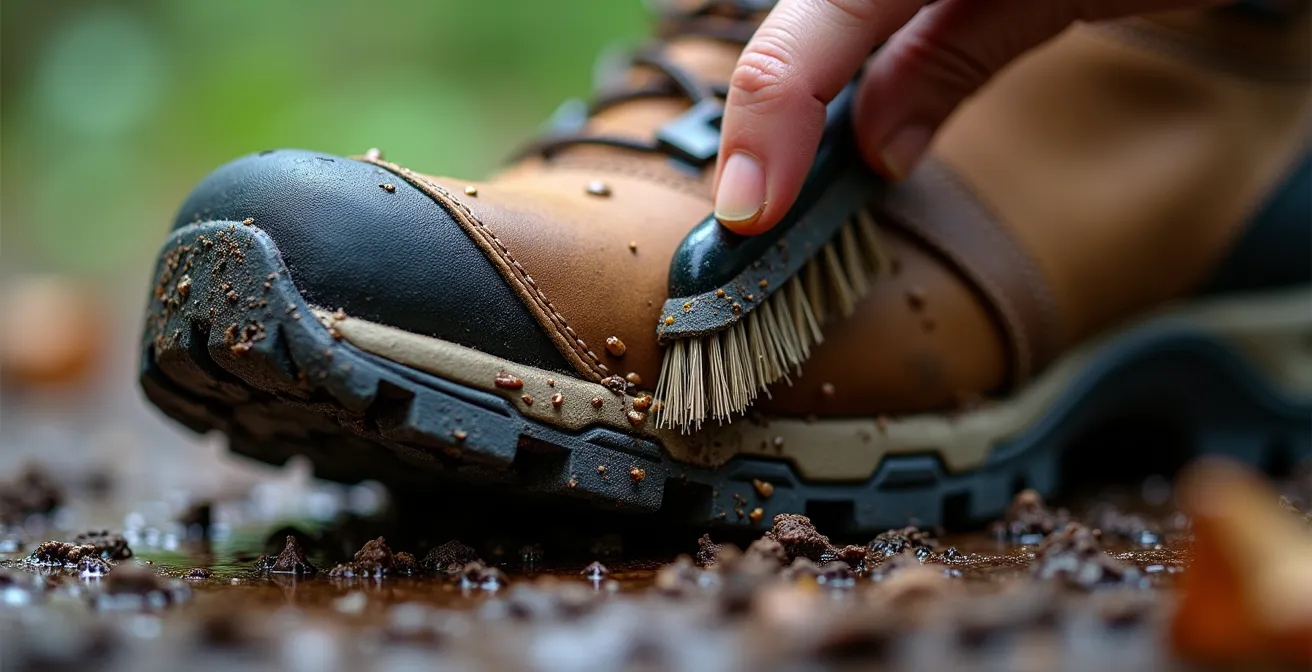
The most terrifying example of such a threat is the chytrid fungus (Batrachochytrium dendrobatidis, or Bd), believed to have spread globally partly on the gear of unsuspecting humans. This waterborne pathogen is responsible for what scientists call a “panzootic”—a global pandemic in the animal world. The results have been catastrophic; National Geographic reports that at least 501 amphibian species have declined and 90 have gone extinct due to this single, microscopic fungus. It is the greatest disease-caused loss of biodiversity ever recorded.
When an amphibian population is wiped out, the consequences cascade through the food web, a phenomenon explored later in this article. The shoe cleaning station is the frontline defense against the next Bd. By removing foreign soil, you are not just preventing the spread of an invasive weed; you are actively participating in a global effort to stop the transfer of invisible killers that can unravel an entire ecosystem. It is the simplest and most profound act of conservation a visitor can perform, transforming a mundane task into a gesture of profound ecological respect.
When to Visit Bird Reserves to Witness Nesting Without Disturbing?
For birdwatchers, witnessing the nesting season is a powerful experience, offering a glimpse into the renewal of life. However, this period is also when birds are at their most vulnerable. A single disturbance can cause parent birds to abandon a nest, leading to the failure of their entire reproductive effort for the year. Consequently, access to bird reserves during this critical time is managed with extreme precision.
The cardinal rule is simple: the birds’ welfare supersedes the visitor’s desire to observe. Many protected areas have blanket closures during the most sensitive months. For example, Swedish environmental protection guidelines specify that many bird protection areas prohibit all access during the spring and summer nesting season. This isn’t a suggestion; it is an enforced legal boundary. Where access is permitted, it is almost always restricted to designated hides or observation platforms, placed at a scientifically determined distance to remain outside the birds’ “circle of fear.”
The impact of disturbance goes beyond a single nest. Chronic stress can have long-term consequences on a species’ viability in a specific location. As conservation biologists studying migratory bird behavior have noted, repeated negative encounters can lead to site abandonment.
A single, highly stressful event like an off-leash dog rushing a flock can cause birds to ‘blacklist’ a traditional, vital stopover site, sometimes permanently.
– Conservation biologists, Research on migratory bird behavior and disturbance impacts
Therefore, the “when” of visiting is determined by the birds themselves. The best practice is to check the reserve’s official website or local notices for seasonal closures before any trip. Ethical observation means prioritizing the subject’s well-being, accepting that the most responsible way to appreciate nesting birds is often from a significant distance, or not at all.
When to Observe Bird Migrations Without Disturbing Their Rest Stops?
Observing the spectacle of bird migration requires a delicate balance of timing and restraint. These journeys are feats of incredible endurance, and the rest stops, or “stopover sites,” are critical refueling stations. Disturbing birds at these sites forces them to expend precious energy reserves, which can compromise their ability to complete their migration or breed successfully. The key to ethical observation is to be predictable and unintrusive.
Effective timing can actually use natural events to your advantage. For instance, planning visits around rising tides can be highly effective for viewing shorebirds, as the water naturally concentrates them closer to observation points without you needing to approach them. Similarly, scheduling a visit for the morning after a major weather front has passed can be rewarding, as many nocturnal migrants will have been grounded and will be more visible as they rest and forage.
Maintaining distance is the most critical factor. In many coastal reserves, a minimum distance of 50-100 meters from shorelines is mandatory to protect not only birds but also seals. Using high-quality optics like spotting scopes is essential; they allow for intimate views from well outside the birds’ “circle of fear,” the radius within which they perceive a threat and take flight. Cumulative impacts from many visitors getting too close are a serious concern; research from English protected areas showed that during peak visitation in 2020, footpaths widened by 40% and litter increased by 100%, illustrating how collective pressure degrades habitats. Always check local notice boards for seasonal access restrictions, as these can change annually based on migration patterns and species presence.
Why Are Permit Lotteries the Fairest Way to Limit Crowds?
When demand for access to a fragile area far exceeds its scientifically determined carrying capacity, managers face a difficult challenge: how to allocate a limited number of entries? While systems like “first-come, first-served” or price-based access exist, the random lottery has emerged as the most equitable solution for balancing high demand with strict conservation limits.
A first-come, first-served system, whether online or in-person, inherently favors those with the time and resources to be first in line. It can create digital “bot wars” or long physical queues, adding stress for both visitors and managers. A price-based system, where permits are sold to the highest bidder or at a premium price, is effective at limiting numbers but introduces a problematic element of elitism, making nature accessible only to the wealthy. This runs counter to the public-trust doctrine that underpins many protected lands.
The random lottery, by contrast, levels the playing field. Every applicant has an equal statistical chance of being selected, regardless of their wealth, schedule, or physical ability to wait in a queue. It is the purest expression of equal opportunity. While it introduces an element of uncertainty for trip planners, this is seen as a fair trade-off for upholding the principle of equity. It ensures that the privilege of visiting these unique places is not determined by an individual’s resources but by a combination of luck and the strict, science-based daily caps needed to protect the environment.
This table clearly contrasts the fairness and effectiveness of the most common permit allocation systems in protected areas.
| System Type | Fairness Score | Conservation Impact | Implementation Challenge |
|---|---|---|---|
| Random Lottery | Highest – equal opportunity | Enforces science-based daily caps | Uncertainty for planners |
| First-Come-First-Served | Low – favors those with time | Can exceed carrying capacity | Creates queues and crowds |
| Price-Based | Lowest – creates elitism | Limits numbers but excludes groups | Revenue generation vs equity |
Key takeaways
- Nature reserves prioritize “purity of purpose” for total ecosystem preservation, unlike multi-use national parks.
- Access is a scientific calculation, not an arbitrary rule, focusing on preventing microscopic threats and cascading ecological collapse.
- Permit systems and lotteries are not just for crowd control; they are tools to ensure equity and stay within a scientifically determined carrying capacity.
Why Does the Disappearance of a Single Insect Species Threaten Your Vacation Spot?
The final, and perhaps most profound, reason for the stringent protection of nature reserves lies in the concept of cascading effects. Ecosystems are not a collection of independent species; they are intricate webs of connection. The removal of a single, seemingly insignificant piece—like one species of insect—can cause the entire structure to unravel. This is not hyperbole; it is a documented ecological principle.
Case Study: Ecosystem Collapse in El Copé, Panama
The disappearance of amphibians in El Copé, Panama, provides a chilling real-world example of this phenomenon. When the invasive Bd fungus caused a mass mortality event among local amphibians, the consequences rippled through the entire ecosystem. As ecological research demonstrates, amphibian die-offs trigger cascading effects across food webs. In Panama, insect populations, now free from their primary predators, exploded. This led to increased grazing on certain plants, which in turn altered the forest’s vegetation patterns. The chemistry of streams changed without the nutrient cycling provided by tadpoles, fundamentally altering the aquatic ecosystem. A single pathogen’s impact on one group of animals transformed an entire landscape.
This case study is a stark warning. The vacation spot you cherish—its clear streams, lush forests, and vibrant wildlife—depends on the health of countless invisible interactions. It depends on a specific pollinator for its wildflowers, a particular beetle for decomposition, and a certain frog to control algae. Nature reserves are managed with this delicate interconnectedness in mind. The strict rules are in place because managers understand that they are not just protecting a single charismatic species, but the entire, fragile web of life that makes a place wild and beautiful.
By preventing the introduction of a foreign plant or pathogen, or by protecting a nesting bird from stress, these restrictions are defending the integrity of the whole system. They ensure that the landscape you hope to visit next year, or that you hope your grandchildren can visit, remains intact and whole, not a hollowed-out version of its former self.
By understanding and respecting these deep-rooted scientific principles, you transform from a mere visitor into a conscious guardian of the world’s last truly wild places. Your compliance is not just about following rules; it is an active contribution to preserving the intricate, and often invisible, web of life.