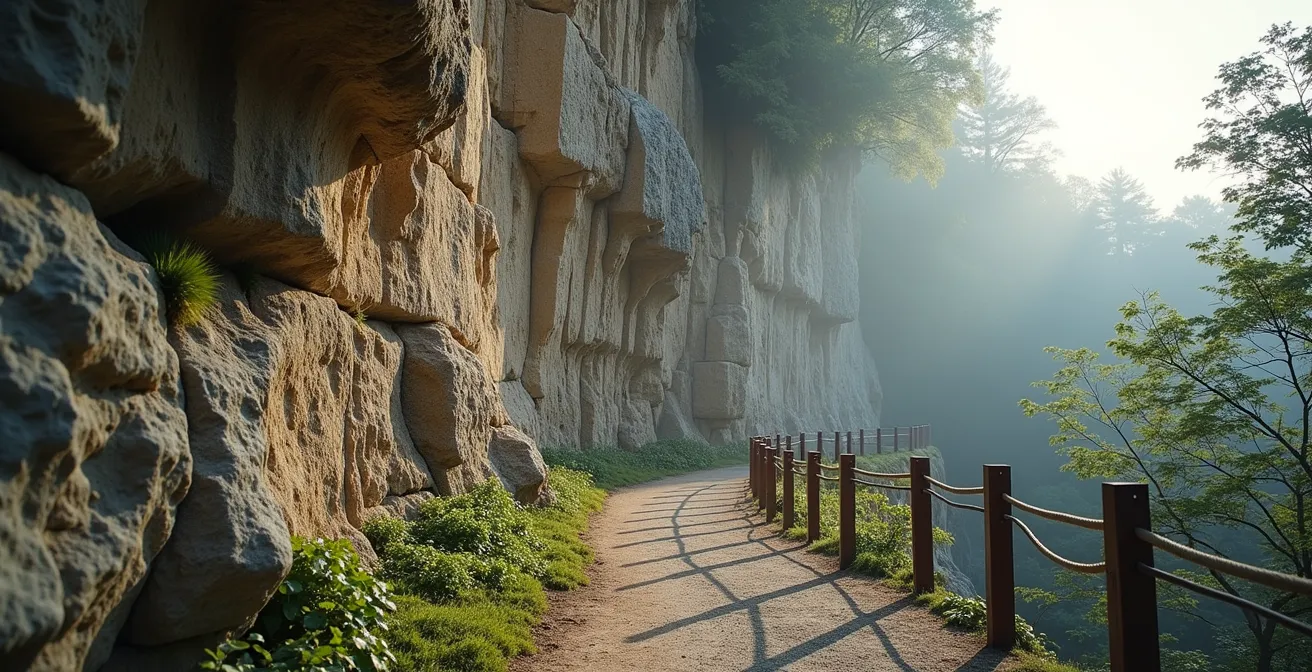
Contrary to the belief that climbing bans are arbitrary restrictions on access, they are precise, science-based measures. The prohibition in fragile limestone zones stems from the rock’s fundamental nature: it is not an inert surface but an active, porous, and chemically reactive biological substrate. Understanding this transforms a climber from a mere user into an informed steward of the environment.
For any dedicated climber or hiker, encountering a “Zone Interdite” or “Access Forbidden” sign at the base of a promising limestone cliff can be a source of profound frustration. The rock face appears solid, the challenge is alluring, and the restriction feels arbitrary, like a rule for rule’s sake. The common assumption is that these bans are overly cautious or based on a general, vague notion of “environmental protection.” Many believe that durable rock can surely withstand the passage of a few enthusiasts, especially when compared to the immense forces of natural erosion.
This perspective, while understandable, overlooks the specific and critical science of limestone geology and the unique ecosystems it supports. The issue is not simply about preventing visible damage or litter. It delves into the rock’s chemical composition, its mechanical response to repeated stress, and its role as a living foundation for rare, specialized flora. Concepts like material fatigue, biological soil crusts, and the rock’s function as a vector for invasive species are central to the reasoning behind these bans, yet are rarely discussed in outdoor communities.
This article will move beyond the simple “do not enter” signs to explain the scientific imperative behind them. We will deconstruct the unique vulnerability of limestone, demonstrating that the ban is not a punishment but a necessary act of preservation. By understanding the intricate relationship between the rock, the life it holds, and the impact of our presence, we can shift our perspective from one of restriction to one of responsible stewardship. The goal is to see the cliff not just as a playground, but as a fragile, slow-recovering ecosystem that deserves our informed respect.
To fully grasp the necessity of these conservation measures, this guide explores the core scientific principles at play. We will examine the geological properties of limestone, the delicate life it harbors, and the legal and practical frameworks designed to protect it.
Summary: Why Climbing on Fragile Limestone Is Banned in Specific Zones?
- Why Does Limestone Crumble Faster Under Human Traffic Than Granite?
- How to Spot the Sabline de Provence Before Stepping on It?
- What Is the Fine for Walking in Restricted Restoration Zones?
- How to Join a Cliff Restoration Workcamp During Your Vacation?
- Limestone or Sandstone: Which Rock Type Offers More Sustainable Climbing?
- The Gardening Error That Threatens Brittany’s Native Coastal Flora
- Why Do Cliff Edges Collapse Even Without Heavy Rain?
- What Are the Strict Prohibitions in French National Parks You Must Know?
Why Does Limestone Crumble Faster Under Human Traffic Than Granite?
The fundamental difference in durability between limestone and granite lies in their mineral composition and geological origin. Granite is an igneous rock, formed from cooled magma, composed of hard, interlocking crystals like quartz and feldspar. This crystalline structure gives it immense compressive strength and resistance to weathering. Limestone, conversely, is a sedimentary rock, primarily composed of calcite (calcium carbonate). This mineral is significantly softer; on the Mohs scale of mineral hardness, calcite rates only a 3, whereas the quartz in granite rates a 7. This inherent softness means it is highly susceptible to mechanical abrasion from ropes, gear, and even the soles of climbing shoes.
Beyond simple hardness, limestone is chemically reactive. As a carbonate rock, it is vulnerable to dissolution by even mildly acidic water, a process that is accelerated by human activity. The repeated stress from a climber’s weight and movement creates micro-fractures in the rock. This phenomenon, known as material fatigue, is not immediately visible but accumulates over time. These fractures increase the surface area exposed to weathering and weaken the rock’s internal structure. Unlike granite, which tends to fail in large, predictable blocks, limestone degrades through a process of crumbling, polishing, and granular disintegration, permanently altering climbing holds and destroying the rock’s natural texture.
This accelerated erosion has a direct impact on the cliff’s ecosystem. Studies conducted on limestone cliffs show that climbed areas have significantly reduced plant cover and species density. The mechanical disturbance and polishing of the rock surface create an inhospitable environment for the specialized flora that has adapted over millennia to thrive there. The rock is not merely a static wall; it is a biological substrate whose physical integrity is essential for the life it supports. While granite can withstand far more traffic with less degradation, limestone’s unique combination of softness, chemical reactivity, and ecological importance makes it exceptionally fragile.
How to Spot the Sabline de Provence Before Stepping on It?
Identifying specific rare plants like the Sabline de Provence (Arenaria provincialis) is challenging for the non-botanist. A more effective conservation strategy is to learn to recognize the signs of a fragile cliff micro-ecosystem as a whole. These ecosystems are not defined by a single plant but by a community of organisms living in a delicate balance. The most crucial of these are often nearly invisible: lichens, mosses, and biological soil crusts. These organisms form a living skin on the rock, stabilizing soil pockets and creating the necessary conditions for vascular plants to grow. Disturbing this “skin” can set the ecosystem back decades or even centuries.
Instead of looking for a specific flower, train your eye to spot the indicators of a living cliff face. Look for patches of dark biological soil crusts on rock surfaces, which can appear as black or brown smudges but are actually complex communities of cyanobacteria, fungi, and mosses. Pay attention to areas with moisture seeps or dark water stains, as these are often hotspots of biodiversity. Small crevices and ledges that have accumulated soil are critical refuges for rare plants and should be avoided. A cliff face that shows a mosaic of green, black, and orange hues from lichens and mosses is a vibrant, active ecosystem, far more fragile than a bare, uniform grey stone.
Using binoculars to scout a route from a distance is an excellent, non-invasive practice. This allows you to identify heavily vegetated sections, soil pockets, or potential nesting sites before you even touch the rock. The goal is to see the rock not as a series of holds and features, but as a vertical landscape with “meadows” and “barrens,” and to choose a path that minimizes your impact on the living parts.
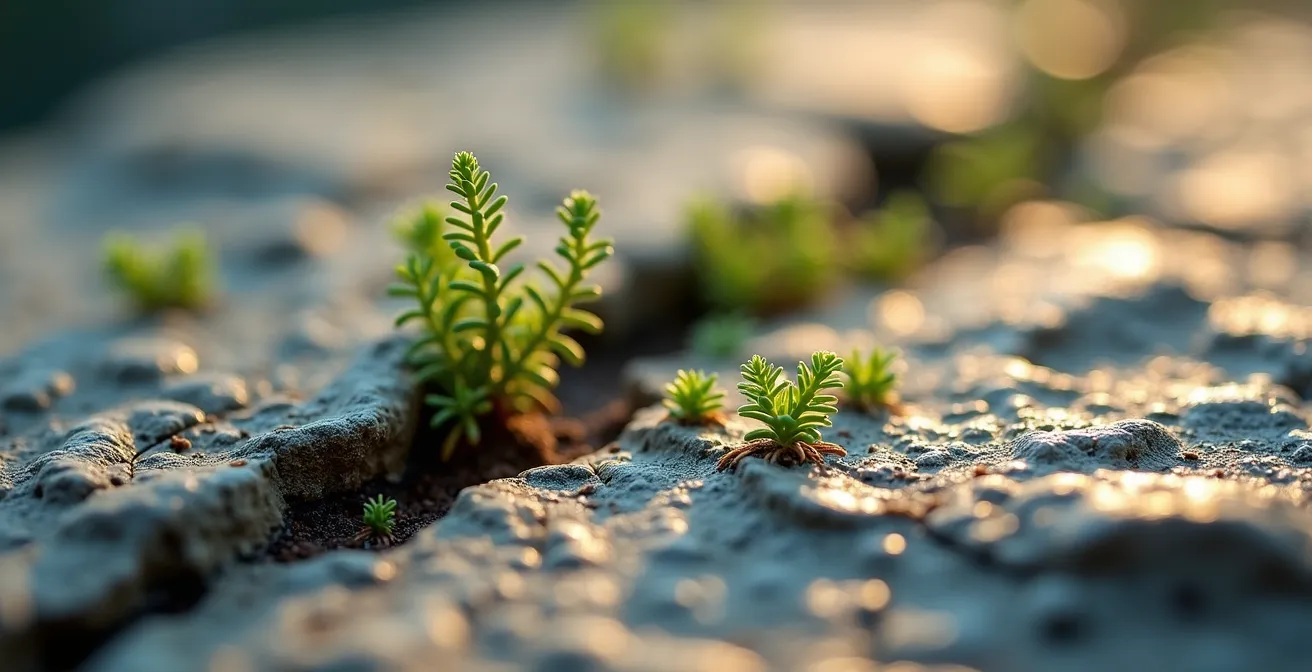
This macro view reveals the intricacy of these ecosystems. The challenge for the responsible climber is to recognize these signs of life and understand that they indicate an area of extreme fragility. The presence of these delicate communities is a clear signal that the area requires careful avoidance, as the rock itself is the foundation of this miniature world.
Your Checklist: Identifying Fragile Cliff Micro-Ecosystems
- Look for dark biological soil crusts on rock surfaces, indicating living communities.
- Identify moisture seeps and water staining patterns on cliff faces, which signal biodiversity hotspots.
- Spot soil pockets in crevices where rare plants, often with tiny roots, may grow.
- Notice the green, black, and orange hues of lichens and mosses, which differentiate a living cliff from bare stone.
- Use binoculars to scout routes from the ground to identify and plan around vegetated sections before climbing.
What Is the Fine for Walking in Restricted Restoration Zones?
The legal consequences for entering a restricted ecological zone vary by country, region, and the specific protective status of the area (e.g., National Park, Nature Reserve, Biotope Protection Area). Fines are not merely symbolic; they are intended to be a significant deterrent. In many European countries, including France where many of these fragile limestone cliffs are found, entering a marked restoration or protected zone is a criminal offense. Fines can range from several hundred to thousands of euros, especially if damage to protected species or habitats can be proven.
The legal framework is built on the scientific evidence of damage. Authorities do not need to prove malicious intent; simply being present in a prohibited area is often enough to incur a penalty. These zones are typically established following extensive ecological study that demonstrates the presence of endangered species or a habitat that is in a critical state of recovery. The signage is the final step in a long conservation process, and ignoring it is viewed as a serious transgression against a collective effort to preserve natural heritage.
The financial penalty is only one aspect. In some cases, legal action can lead to a criminal record, and climbers affiliated with national federations may face disciplinary action from their own organizations. The core of the issue is the demonstrable harm caused by recreational activities in these specific, sensitive areas. As researcher Douglas Larson stated in the journal Conservation Biology, the evidence is unequivocal. His work highlights the severe impact on these unique environments:
Our work clearly shows that rock outcrop ecosystems suffer dramatically when exposed to recreational rock climbing.
– Douglas Larson, Conservation Biology journal
This scientific consensus provides the legal backbone for enforcement. The fine is not just a penalty for trespassing; it is a consequence for contributing to the degradation of a scientifically recognized fragile ecosystem. Therefore, the best practice is absolute adherence to all posted restrictions. The risk of a hefty fine and legal trouble far outweighs the reward of climbing in a prohibited zone.
How to Join a Cliff Restoration Workcamp During Your Vacation?
For climbers and hikers who wish to transition from being passive users of the environment to active stewards, participating in a restoration workcamp is one of the most impactful actions you can take. These initiatives, often organized by national park authorities, conservation charities, or climbing federations, provide a structured way to give back to the crags we love. They offer a unique opportunity to learn from ecologists and access managers firsthand about the challenges these environments face. Rather than simply being told not to do something, you become part of the solution.
Volunteering is not limited to picking up trash. Projects are diverse and cater to different skill levels and physical abilities. Many organizations run “Trail Days” or “Adopt-a-Crag” programs focused on heavy manual labor, such as restoring eroded paths, building sustainable access trails, or removing invasive plant species. This work directly combats the primary impacts of human traffic. Other projects are more delicate, such as re-vegetation initiatives that involve carefully planting native species in degraded areas. This requires patience and a gentle touch but is vital for kick-starting ecological recovery.
For those with certified climbing skills, there are opportunities to participate in technical projects. This can involve high-angle restoration work, such as stabilizing fragile cliff sections or installing signage in hard-to-reach places under the supervision of experts. Finally, a crucial component of this work is educational outreach. Experienced climbers can volunteer to become advocates, teaching others about low-impact practices, the importance of seasonal restrictions for bird nesting, and the science behind the conservation efforts. These programs turn a vacation into a meaningful contribution, fostering a deeper connection to the climbing environment.
Limestone or Sandstone: Which Rock Type Offers More Sustainable Climbing?
When considering the environmental impact of climbing, not all rock types are created equal. Both limestone and sandstone are sedimentary rocks and are generally softer than igneous counterparts like granite, but they degrade in different ways and support different ecosystems. Choosing where to climb, when a choice is available, can be an act of conservation in itself. A direct comparison reveals that sandstone, while still fragile, often presents a more sustainable option than the highly sensitive ecosystems found on many limestone cliffs.
Limestone’s primary component, calcite, is chemically reactive. The oils and magnesium carbonate (chalk) from a climber’s hands can alter the rock’s surface chemistry over time. More significantly, its structure supports a high degree of biodiversity, with many rare, endemic species uniquely adapted to its calcium-rich, alkaline environment. Sandstone, composed of sand grains cemented together, degrades by shedding individual grains. While this erosion is still a concern, the rock itself is less chemically reactive to chalk, and its ecosystems are often less specialized and species-rich compared to limestone biomes.
The recovery time also differs. Lichen communities on limestone can take decades or even a century to recover from damage, whereas a sandstone surface might stabilize more quickly once traffic is removed. This makes the impact on limestone far more long-lasting. The following table, based on general geological and ecological principles, outlines these key differences.
This comparative analysis, supported by findings from organizations like the Sierra Club on climbing impacts, provides a framework for making more informed decisions.
| Factor | Limestone | Sandstone |
|---|---|---|
| Geological Resilience | Dissolves & polishes under traffic | Sheds grains progressively |
| Ecological Dependency | High – supports diverse rare species | Moderate – fewer endemic species |
| Chalk Impact | Chemical reaction with calcite | Minimal chemical interaction |
| Recovery Time | Decades for lichen regrowth | Years for surface stabilization |
While all climbing has an impact, understanding these distinctions is key. When possible, opting for more resilient rock types like granite, or choosing sandstone over a known fragile limestone area, is a practical way to reduce your ecological footprint and contribute to the long-term health of climbing environments.
The Gardening Error That Threatens Brittany’s Native Coastal Flora
One of the most insidious threats to fragile cliff ecosystems is not deliberate destruction, but an unintentional “gardening error”: the introduction of non-native, invasive species by climbers and hikers. Coastal flora, such as that found in Brittany, is often highly specialized and adapted to harsh conditions like salt spray and nutrient-poor soil. These native plants exist in a delicate balance and are easily outcompeted by more aggressive, generalist species. Climbers, by traveling between different regions and crags, can become unwitting vectors of this biological invasion.
Seeds, spores, and small plant fragments can become lodged in the tread of climbing shoes, in the weave of a rope, or on the fabric of a chalk bag. When a climber moves from an inland, weedy area to a pristine coastal cliff, they can transport these hitchhikers. Once introduced into the vulnerable cliff environment—where native plants are already stressed—these invasive species can take root and spread rapidly. This disrupts the natural ecosystem, displaces native flora, and can alter the soil chemistry, making it even harder for endemic plants to survive.
Case Study: The Climber as a Vector of Invasion
Scientific studies have quantified this impact dramatically. Research highlighted by outlets like ScienceDaily has shown that in climbed areas, the proportion of non-native plants was three times higher (81% vs. 27%) than in adjacent, unclimbed areas. The research suggests a two-part mechanism: firstly, climbing activity reduces the density of native plants, which opens up physical space for invasive species to establish themselves. Secondly, climbers directly introduce the seeds and living fragments of these non-native plants via their shoes, clothing, and equipment, effectively “planting” a foreign garden on the cliff face.
To prevent this, climbers must adopt a strict “Clean Crag Protocol.” This involves more than just packing out trash. It means diligently cleaning all gear—especially shoes, ropes, and packs—before leaving each climbing area. Using a stiff brush to remove all visible soil and plant matter is a simple but critical step. When traveling between distinct ecological regions (e.g., from the Alps to the Mediterranean coast), gear should be washed thoroughly. This mindset transforms the climber’s responsibility from simply “leave no trace” to “take no trace” with you to the next location.
Why Do Cliff Edges Collapse Even Without Heavy Rain?
While catastrophic cliff collapses are often associated with heavy rainfall saturating the ground, the stability of cliff edges, particularly in limestone regions, is being constantly undermined by slower, less visible processes. The collapse of a cliff edge is rarely a sudden event but rather the final failure after a long period of progressive weakening. This degradation is driven by a combination of natural weathering and the cumulative impact of human activity, which can create points of weakness that fail even under dry conditions.
A primary factor is chemical weathering. Limestone is susceptible to dissolution by acid rain. Even unpolluted rain is naturally slightly acidic, but pollutants can increase this acidity. As a scientific report from the USGS explains, this acidic deposition accelerates limestone erosion, dissolving the calcite that binds the rock together. This process slowly weakens the rock from the inside out, reducing its structural integrity without any obvious external signs. Over time, the rock mass becomes unable to support its own weight, leading to a collapse that may seem spontaneous.
Human foot traffic along cliff edges significantly exacerbates this problem. Each footstep compacts the soil, destroying the vegetation that helps bind it together and increasing water runoff. More importantly, the repeated loading and unloading of weight contributes to the material fatigue of the underlying rock. This constant, low-level stress creates and expands micro-fractures, providing more pathways for water to penetrate and accelerate internal erosion. As the European Environment Agency notes, this gradual process is a key driver of coastal retreat.
Cliff erosion in coastal areas is almost always the result of structural erosion, resulting in a gradual retreat of the coastline because the amount of sediment that gets eroded exceeds the amount of deposited sediment.
– European Environment Agency, Climate-ADAPT cliff strengthening report
Therefore, a cliff edge collapse without rain is the culmination of these long-term factors. It represents a tipping point where the rock’s weakened structure finally succumbs to gravity. Staying away from cliff edges is not just about avoiding a fall; it is also about preventing your presence from contributing to the very instability that creates the hazard in the first place.
Key Takeaways
- Limestone is not inert rock; it is a soft, chemically reactive biological substrate whose physical integrity is essential for the rare ecosystems it supports.
- The impact of climbing is cumulative. Micro-fractures from gear, chemical changes from chalk, and the introduction of invasive species create long-term, often irreversible, damage.
- Responsible access is about stewardship, not just use. This involves cleaning gear, respecting all closures, and actively participating in conservation efforts.
What Are the Strict Prohibitions in French National Parks You Must Know?
French National Parks (Parcs Nationaux) are areas with the highest level of environmental protection, and their regulations are correspondingly strict and rigorously enforced. While these rules are designed to preserve the natural and cultural heritage of the region, they can sometimes seem opaque to visitors. For climbers and hikers, understanding the absolute prohibitions is non-negotiable for ensuring responsible access and avoiding severe penalties. These rules go beyond simple “leave no trace” ethics and constitute legally binding obligations.
First and foremost, any form of camping or making a fire outside of designated, managed areas is strictly forbidden. This rule is in place to prevent wildfires and minimize disturbance to wildlife. Similarly, all motorized vehicle access is confined to public roads; off-road driving is prohibited. Dogs, even on a leash, are often not permitted in the core zones of national parks to prevent disturbance to wildlife and grazing livestock. You must always check the specific park’s regulations, as this is one of the most common infractions committed by visitors.
Regarding the landscape itself, it is forbidden to damage or remove any natural element. This includes not only plants but also minerals and fossils. For climbers, this means that cleaning or “improving” holds with a wire brush or chipping tool is a criminal offense. Furthermore, there are often seasonal restrictions on certain cliffs to protect nesting birds, such as the peregrine falcon. These restrictions are a legal requirement under wildlife protection laws and are not optional. Flying drones is another activity that is almost universally prohibited in national parks to avoid disturbing wildlife and to preserve the tranquility of the area. Ignorance of these rules is not an acceptable defense, and park rangers have the authority to issue on-the-spot fines.
Frequently Asked Questions About Why Climbing on Fragile Limestone Is Banned in Specific Zones?
Why are there seasonal climbing restrictions?
In most countries, birds are protected by law. All birds, their eggs, and nests are protected, and certain rare and endangered species such as the peregrine falcon are further protected by increased penalties. As confirmed by organizations like the European Outdoor Conservation Association, many crags implement ‘Bird Restrictions’ in the spring (typically from March 1st to June 30th) to prevent climbers from disturbing nesting pairs during their most vulnerable period.
What happens if I climb in a restricted zone?
If protected habitats, such as those harboring rare plants or nesting birds, are damaged or destroyed by climbing or abseiling activities, this can be considered a criminal offense. The consequences can range from significant fines to legal prosecution, depending on the severity of the damage and the protective status of the area.
How can I check current restrictions before climbing?
Always assume restrictions may be in place. The most reliable method is to search for the official website of the park or protected area you plan to visit. Look for sections titled ‘Regulations,’ ‘Plan Your Visit,’ or ‘Access Information.’ Additionally, check regional access databases maintained by national climbing organizations or federations, which often provide up-to-date information on specific crags.